

Xploration • Curation • Recommendation


Empress Effects' new Amp-Like Drive Pedal is a super-versatile Extended Gain-Range Active-EQ Saturator with Pre or Post Boost, and a built-in Noise Gate


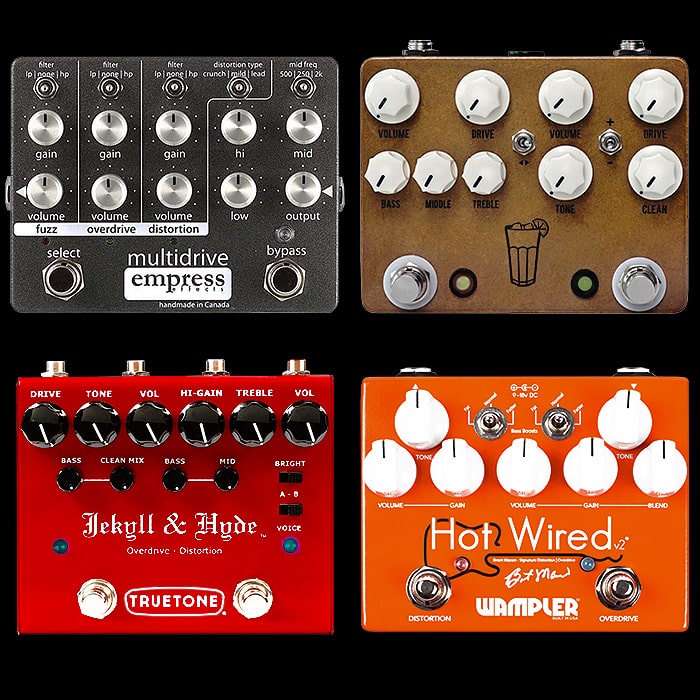
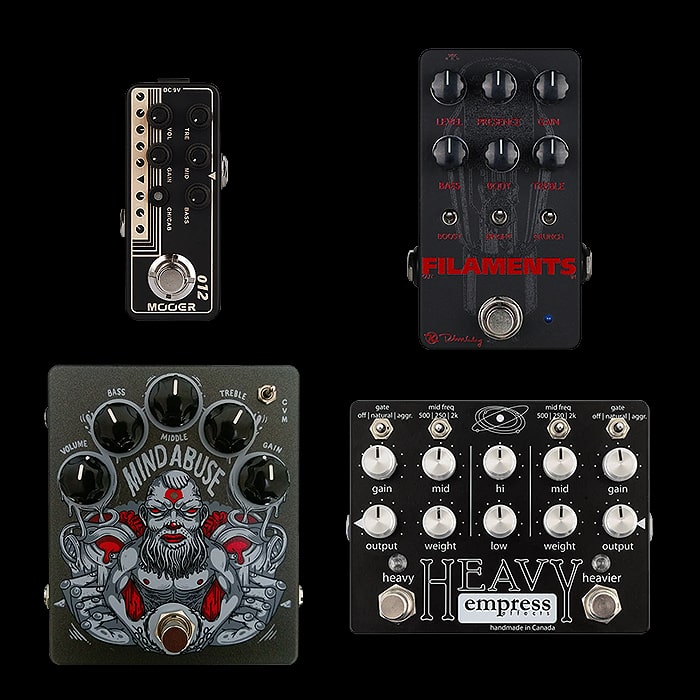
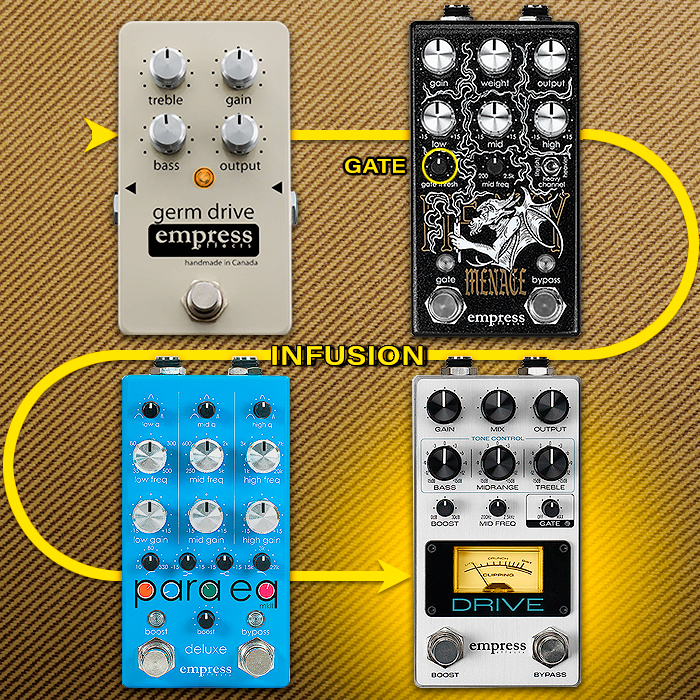
I really rate both the Empress Germ Drive and Multidrive pedals, and have had both Heavy and Heavy Menace pedals from the start. According to the Empress Drive introduction the development path for this new Drive pedal started with patching a Germ Drive into the middle of a Heavy Menace circuit!
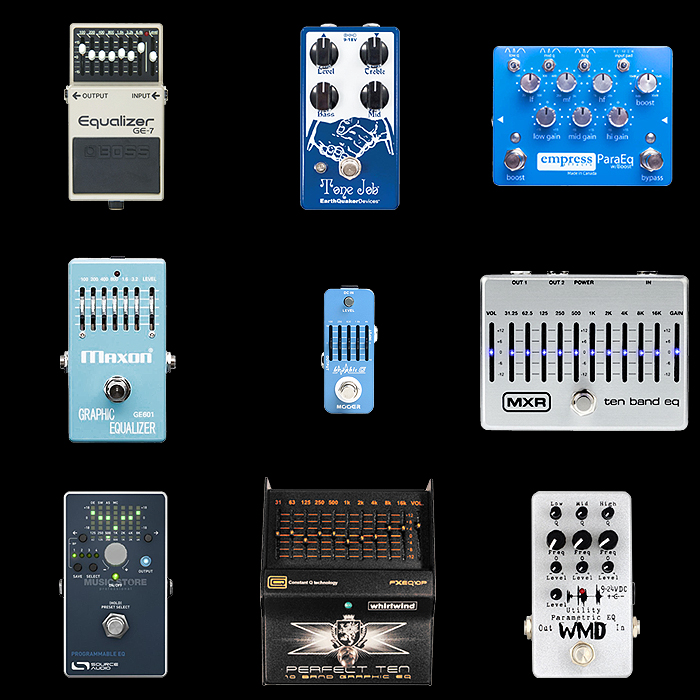
Furthermore, on first glance - there seem to be some parallels to the ParaEQ II too, and indeed Zak tells me that the ParaEQ was an inspiration also - and was in fact used to help set the core frequencies for the 3 EQ’s. You can see that both the ParaEQ and Empress Drive have ±15dB on their Active EQ’s - so there is definitely some degree of overlap there - while the frequency ranges are somewhat different - honed toward the core drive circuit, which when pushed - roughly delivers a sort of Tweed-Amp-like response.
You definitely get that tube-like pushed-amp sensibility, and the the guitar volume cleanup is mostly pretty decent on the drive side, less impactful with the Boost deployed also and fully cranked!
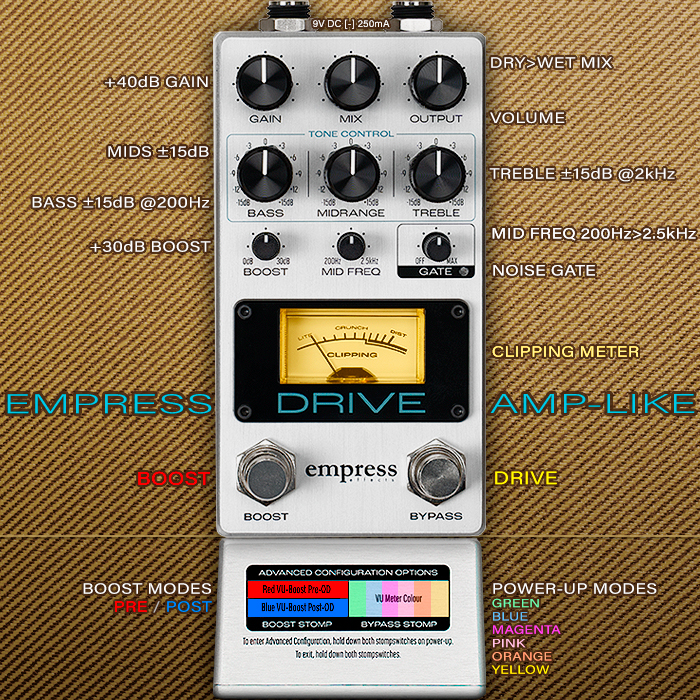
The main visual - as always covers all the key functional elements.
Controls - Gain (+40dB), Dry>Wet Mix, Output Volume, Bass ±15dB @ 200Hz, Mids ±15dB, Treb;e ±15dB @ 2kHz, Boost (+30dB), Mid Frequency Focus : 200Hz > 2.5kHz, Noise Gate, Boost Footswitch, Drive Footswitch.
Power-up Modes - Hold Boost + Bypass on Power-up to set Pre (Red) or Post (Blue) Boost on the Boost Footswitch, or Clipping Meter LED Colour via Bypass Footswitch (Green > Blue > Magenta > Pink > Orange > Yellow).
Rear Ports - 1/4" TS Input, 9V DC [-] 250mA, 1/4" TS Output.
The Clipping Meter is undeniable ’eye-candy’ and bumps up the appeal of the pedal - without adding too much to the proceedings. The further Power-up settings - which allow you to select screen LED colour - are really cool too - you feel inspired when using the pedal - while you’re not really spending your time watching the needle flicker back and forth!
As the core chracter is kind of Tweed-like - I thought the Yellow LED option was the most appropriate, and that is also why I selected a Tweed background for all my visuals!
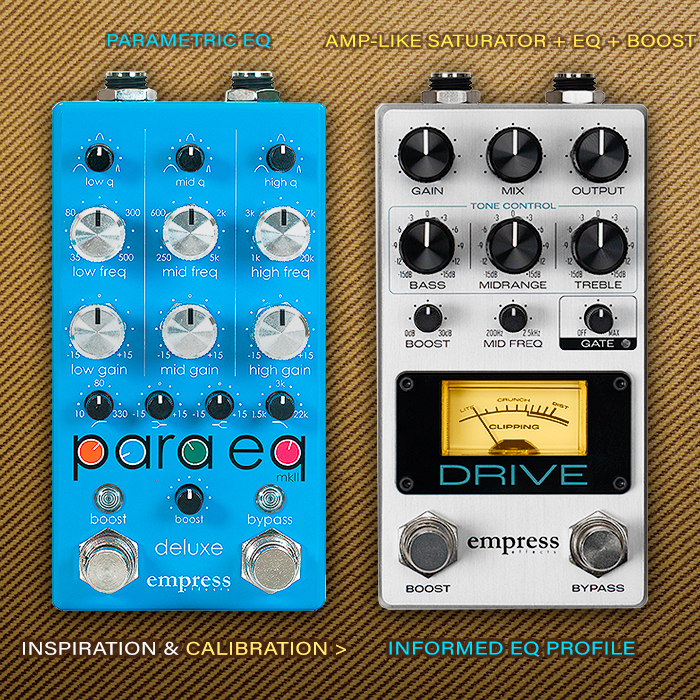
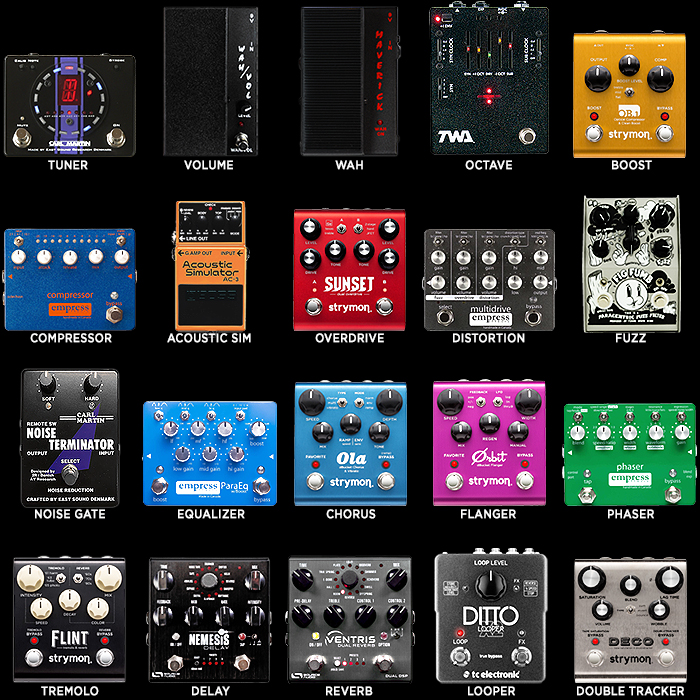
When I first saw the Empress Drive - it immediately brought to mind my MVP ParaEQ II Deluxe - that is to say it's core control topology - looks kind of like a rotated version of the top half of that blue pedal.
The topology follows a similar sort of layout, and while the ParaEQ II informed the Frequencies and in part the look of the Drive - those Active EQ settings were distinctly evolved and honed for the Empress Drive.
For instance, while the ± dials are all the same ±15dB sweep, the Frequency selections are quite different :
ParaEQ II - Lows : 35Hz > 500Hz, Mids : 250Hz > 5kHz, Highs : 1kHz > 20kHz.
Drive - Bass : fc = 200Hz, Mids : 200Hz > 2.5kHz, Highs : fc = 2kHz.
So the Empress Drive was essentially Frequency-calibrated by the ParaEQ II, and where the core gain circuit was originally a mix and evolution of the Germ Drive + the Heavy Menace.
In terms of dialling in specific profiles - I always started off trying to dial in Tweedy tones - but somehow ended up on Plexi style tones nearly every time - I guess those are my go to sounds!
You immediately get the feel for that amp-like saturation - and this pedal is quite superb at delivering a variety of classic British amp tones in particular - at least per my experience - I'm pretty sure it does a really great Tweed too - but I just haven't got there yet! I somehow always end up dialling in a favourite Plexi style voicing - which consistently sounds superb!
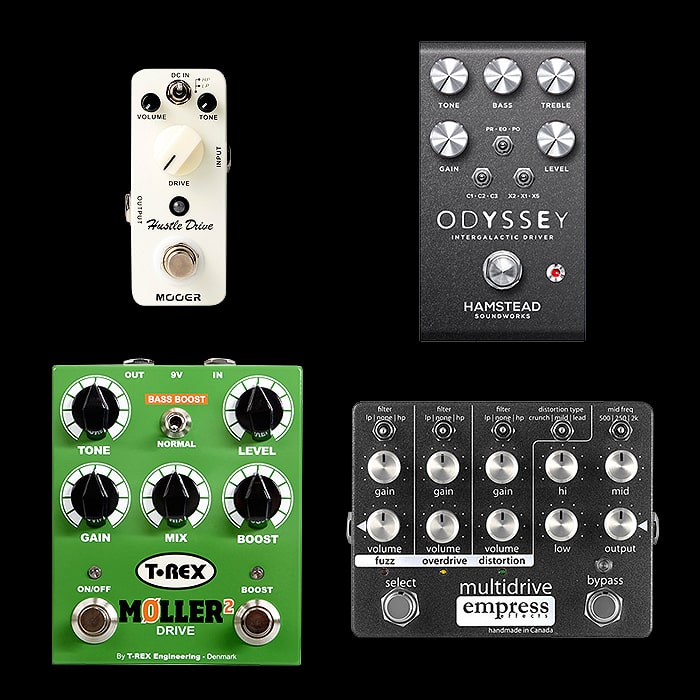
The above visual shows the various constituent parts with influence and infuse the nature of this overdrive!
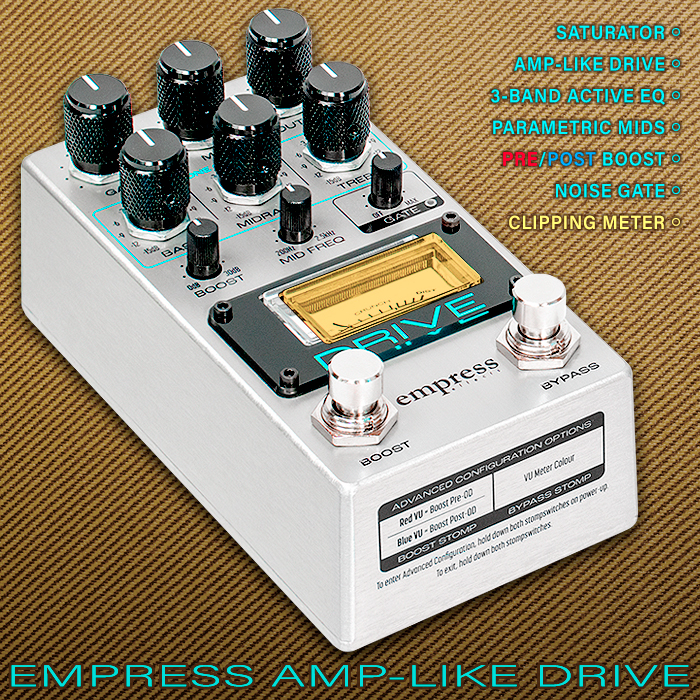
The Empress Drive combines several functions and circuit elements in the one box.
- Saturator
- Amp-Like Drive
- 3-Band Active EQ
- Semi Parametric-Mids
- Pre or Post Boost
- Onboard Noise Gate - which I mostly have set at around 1-2 o'c.
- Highly visually appealing lit-up Clipping Meter
Those elements combined deliver maximum appeal - both in terms of look and function. The Empress Drive delivers on every level pretty much and engenders massive ownership satisfaction - it's such a handsome looking device. The enclosure is a light silvery brushed aluminium - which can look white under some lights - but is a very light silvery grey!
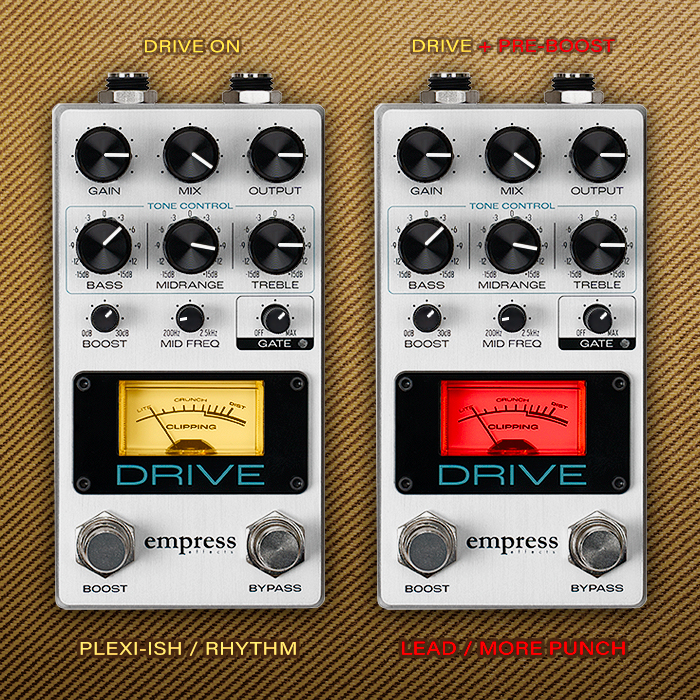
Pictured above is the main Preset I keep landing on.
I often reset the dials to centre and dial things in again from scratch - but almost always land in the same sort of place. Those settings are just so satisfying!
Essentially - Gain is @ 3 o'c, Mix mostly @ Max, Output @ 2-3 o'c (for max harmonics!), Bass @ circa 2 o'c, Midrange @ around +12 > +15dB, Treble @ 3 o'c, Boost @ around 2 o'c, Mid Freq @ around 400Hz or so I think, and Gate mostly between 1 & 2 o'c.
You get a killer core Plexi voicing with the Drive - which then kicks into an even punchier and more vibrant voicing with the Boost deployed, With the Drive on - you can roll back your guitar volume to temper said gain. Once the Boost is added - that cleanup impact is lessened. But there are some signficant dynamics at play there.
The Mids have been beautifully calibrated for Maximum Harmonic impact - just like I like it - even when you subtract and dial those Mids down - you still get spectacular textures.
I recommend everyone check out my above settings - hopefully they manage to delivers some of the joy they do for me!
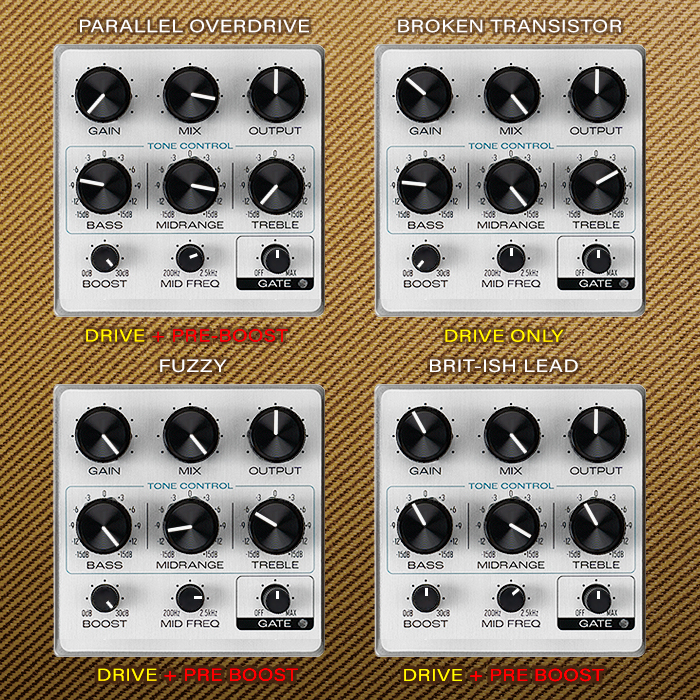
There are 4 quick-start / initial starting position presets in the manual - as I've pictured above! These are interesting foundational presets really which allow you to grasp the nature and range of the pedal to a large degree.
These are mostly introductory presets - and somewhat lean more towards subtle ballpark takes rather than full-fat fully vibrant examples like mine.
Each one of these is interesting in its own way - For the 'Parallel Overdrive' - you're using the push of the Boost as your main gain generator. I prefer a little more Bass and Volume in the mix - otherwise it's a pretty cool starter for 10!
The 'Fuzzy' is interesting too - and really informs you about the building blocks of the circuit - you need a lot of low-end frequencies to deliver a proper Fuzz / Fuzzy texture - hence Bass is Maxed out and the Mid Frequency cuts out a lot of the Upper Mids. I'm still in the process of tweaking that to my preferences - while you can't go too far beyond those core settings - or else you loose the essence of the core fuzzy texture!
'Broken Transistor' does that somewhat beaten-up and badly maintained amp tone, again I tended to tweak these settings a fair amount - to try and accentuate that slightly fractured breakup - needs a few more sessions before I'm 100% satisfied with where I got to.
And finally - we have a 'Brit-ish Lead' setting here - kind of aiming for a similar sort of profile to my own Plexi settings - where I prefer my somewhat beefier and punchier take - this just emphasises the pedal's versatility.
There's for sure a lot of different Drive tones and textures on board - and I'm still just scratching the surface for Post Boost tones. I'm having so much fun with the 'pushed' side of the pedal - and I'm sure I have plenty of further ground to cover there. These kinds of pedals need something of a long-term view - so you can fully gauge the range and versatility of the circuit.
I had hoped I would have had a few more peak settings by now - but I keep seeming to fall back to versions of my Plexi take - those are just so satisfying.
The onboard Noise Gate is genius - obviously borrowed from the Heavy Menace! All my early overdrives are outside my noise gate loop - so with the extended gain range of this Empress Drive - the Noise Gate comes in super handy. As mentioned, I tend to keep this @ around 1-2 o'c!
Favourite Empress Devices!
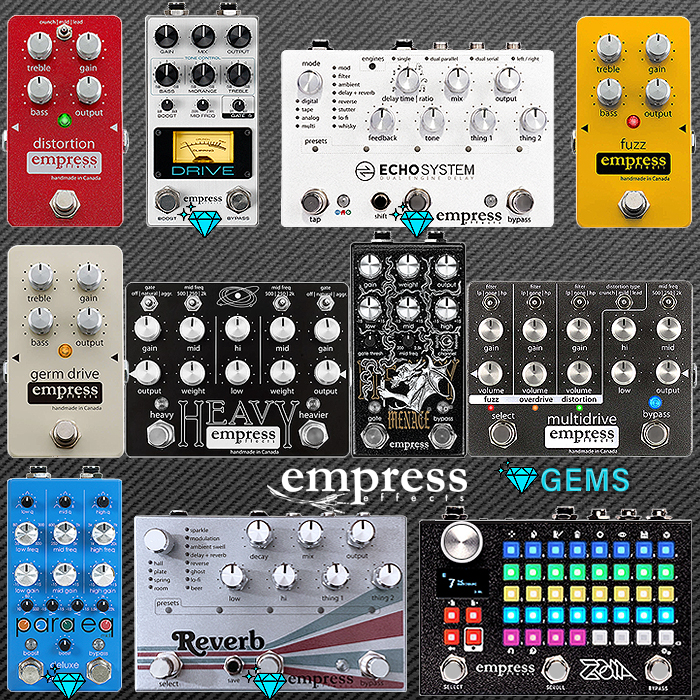
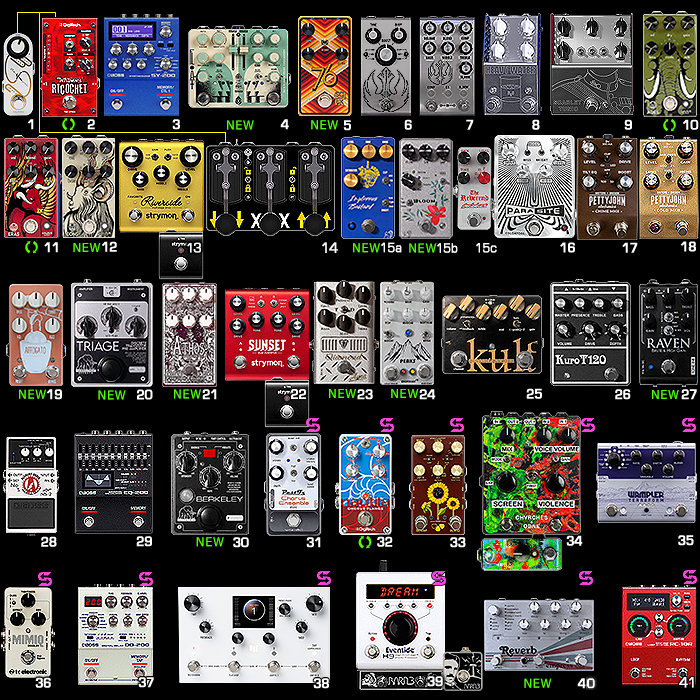
The Empress Drive is my 11th Empress device, and joins the EchoSystem, ParaEQ II Dlx and Reverb in my MVP / 'Gems' selection.
I currently have 3 Empress pedals on the board - the Drive, the ParaEQ II, and the EchoSystem - which remains my favourite ever Delay Workstation. I had always hoped that the 'Reverb' would eventually get the same Parallel routing as the EchoSystem - but that has yet to happen. Those are both brilliant as is in any case.
The Empress Drive is an undeniable triumph - and I expect it to do particularly well. It's really well priced too at $299 and equivalent - these will surely sell by the bucket!
You can read up more about the Empress Drive on the Empress Website, where it should have landed at your local dealer at around the same time as this launch post!
It's beautifully intuitive to operate - everything works as it should, and it has everything it needs - a perfect pedal therefore in my book! And yes the 250mA current draw requirement appears above the power socket on the rear of the pedal. An every-way beautifully executed pedal - exemplary!
Demos





Content Subscriptions