

Xploration • Curation • Recommendation


2025 Reverb Pedals Capsule Collection and Intended Targets


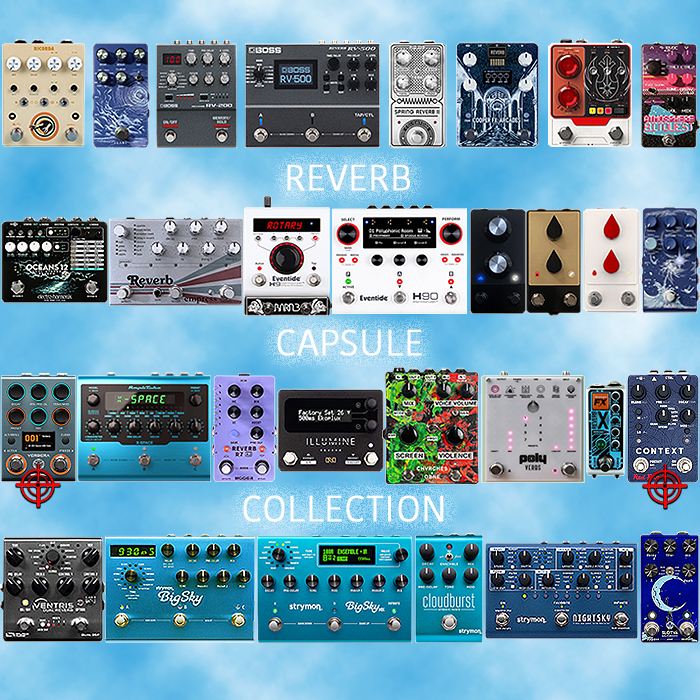
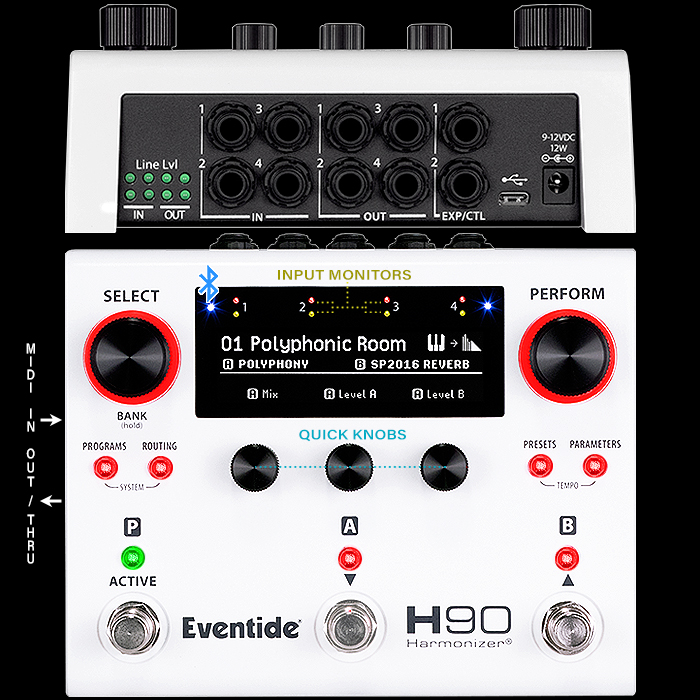
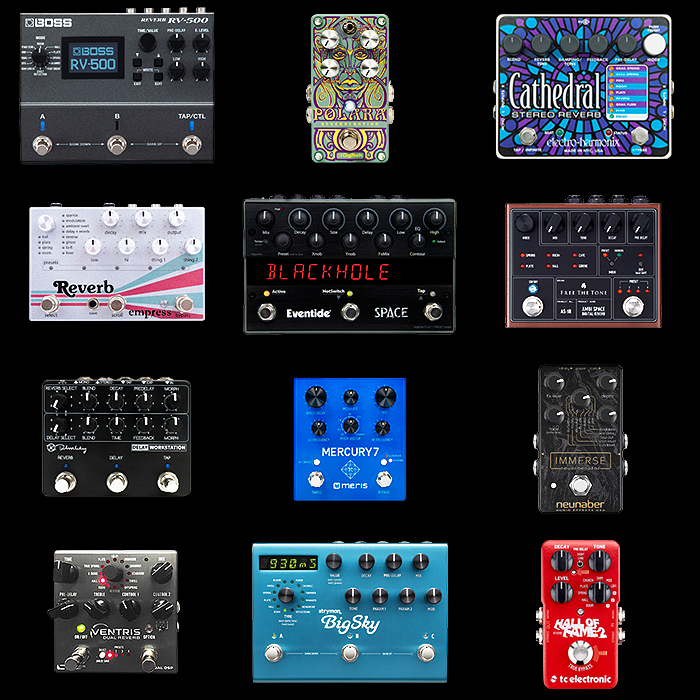
I own a fairly significant number of Reverb Pedals - where I’m mostly focused on Workstation style Pedals with multiple algorithms. I normally have at least 2 Reverbs on the board - a Primary Multi-Verb, and a Secondary more Specialist Verb. Occasionally I have a 3rd Reverb - which can be another Stereo Secondary, or more likely a Mono Tertiary. In fact I can have as many as 4 Reverbs on the board - as the Eventide H90 is always there too!
You can see from my various Pedal-Chain posts that I’ve been through quite a number of Primaries - where the current Primary incumbent is the BigSky MX, and where my current Secondary is the very recently arrived Cornerstone Nucleo - that pairing is about as perfect as it can get - and then I often have the Rainger FX X-Verb Mini as my Tertiary option - for that really cool Mk.gee style distorted gated reverb sound!
Over the years there have been 13 different primaries - where I aim to acquire at least a coupe more - including the Hotone Verbera and Red Panda Context 2. There have been 8 secondaries - while the 2 x Eventides have been used both as Primary and Secondary types.
We then have the Mono Output Tertiaries - which will always be somewhat bit players - as I typically need for my Spatial Effects to be fully Immersive Stereo!
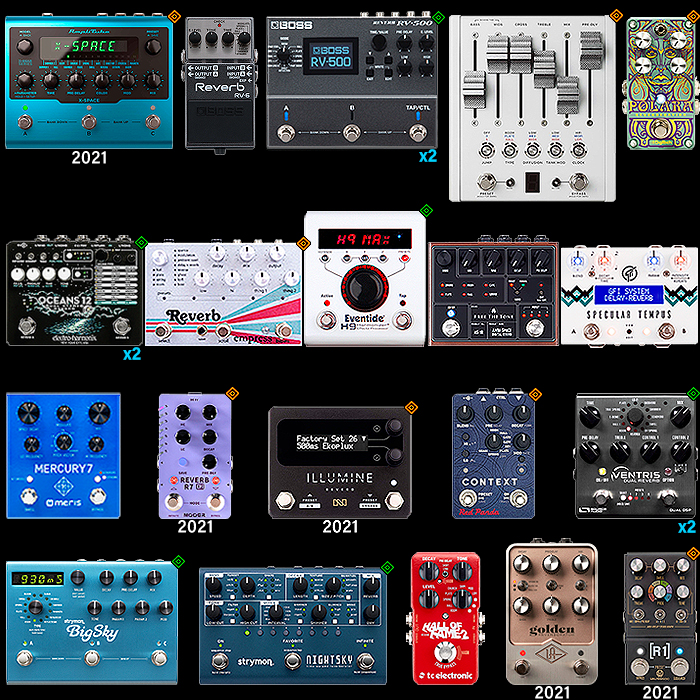
Over the years the ones that have tended to dominate include the Strymon BigSky originally, then Source Audio Ventris, then Boss RV-500, Neunaber Illumine, Amplitube X-Space, Empress Reverb, Poly Verbs, and BigSky MX - those are the ones that have spent the most sigificant time on the board. I’m totally delighted with my currently typical Trifecta of BigSky MX, Cornerstone Nucleo, and Rainger FX Reverb-X. (plus Eventide H90!)
That said I always keep an open mind - and try to give most everyone a fair shake. If you think I’ve overlooked something particularly impressive do let me now!
PRIMARY :
- Boss RV-200 / Secondary
- Boss RV-500
- Electro-Harmonix Oceans 12
- Empress Effects Reverb
- Eventide H9 / Secondary
- Eventide H90 / Secondary
- > Hotone Verbera
- IK Multimedia Amplitube X-Space
- Neunaber Illumine
- Poly Verbs
- > Red Panda Lab Context 2
- Source Audio Ventris
- Strymon BigSky
- Strymon BigSky MX
- Strymon NightSky
SECONDARY :
- AC Noises Ricorda
- Alabs Audio Cetus
- Colortone Spring Reverb II
- Cornerstone Nucleo
- Klowra Limbo
- Mooer R7 X2 Reverb
- OBNE Chvrches Screen Violence
- Strymon Cloudburst
TERTIARY [Mono] :
- Cooper FX Arcades : Reverb
- Dr Scientist BitQuest Atmoshere
- Fjord Fuzz Dovre
- Fjord Fuzz MIME I
- Fjord Fuzz MIME II
- Rainger FX Reverb-X
- Walrus Audio Slötvå
Here follows the general alphabetical listing - where there are 30 overall, but they include a couple of future targets too - the indicated Hotone Verbera, and the Red Panda Context 2! :
- AC Noises Ricorda Stereo Granular Reverb + Freeze / Loop - €352 / $412
- Alabs Audio Cetus Reverb - $109.99
- Boss RV-200 Reverb - $269.99
- Boss RV-500 Reverb - $439.99
- Colortone Spring Reverb II - $199
- Cooper FX Arcades - Reverb Card - $330 for device, cards at $30-$50
- Cornerstone Paul Davids Signature Nucleo Atomic Power Station Reverb - $449
- Dr Scientist BitQuest Atmoshere Reverb Bonus Pack - $249 for device + $50 for bonus pack
- Electro-Harmonix Oceans 12 Dual Stereo Reverb - $269.80
- Empress Effects Reverb - $494
- Eventide H9 Max Multi-FX / Reverb - $699
- Eventide H90 Multi-FX / Reverb - $899
- Fjord Fuzz Dovre Fuzz-Verb - $249
- Fjord Fuzz MIME AI-Infused Reverb - $199
- Fjord Fuzz MIME II AI-Infused Reverb - $249
- Klowra Limbo Reverb - $129
- > Hotone Verbera Stereo Convolution Reverb and IR Loader - $299
- IK Multimedia Amplitube X-Space Reverb - $329.99
- Neunaber Illumine Reverb - $499
- Mooer R7 X2 Reverb - $149
- OBNE Chvrches Screen Violence Stereo Saturated Modulated Reverb - $279
- Poly Verbs Stereo Convolution Reverberator - $399
- Rainger FX Reverb-X Gated Reverb (as used by Mk.gee) - $229
- > Red Panda Lab Context 2 Reverb + Delay - $329
- Source Audio Ventris Dual-Reverb - $429
- Strymon BigSky Multi Reverb - $479
- Strymon BigSky MX Multi Reverb - $679
- Strymon NightSky Time-Warped Reverberator - $429
- Strymon Cloudburst Ambient Reverb - $279
- Walrus Audio Slötvå Multi Texture Reverb - with Presets [discontinued] - $229
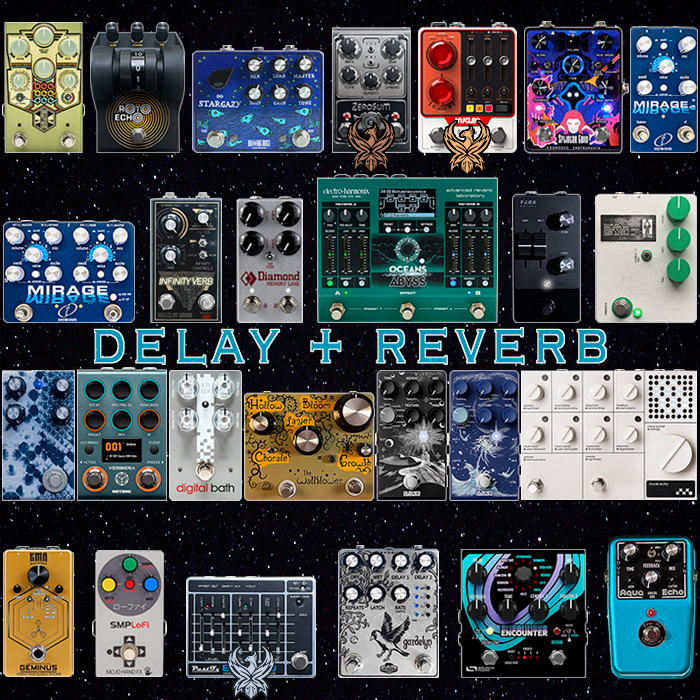
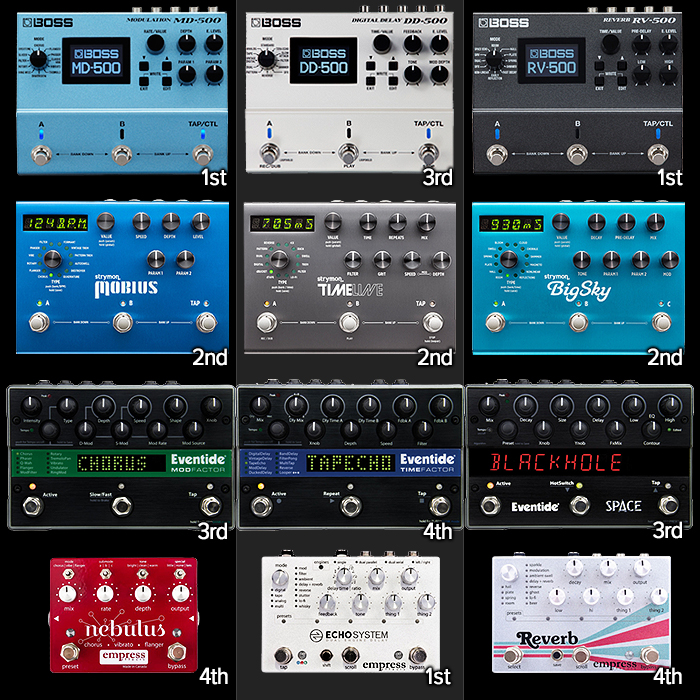
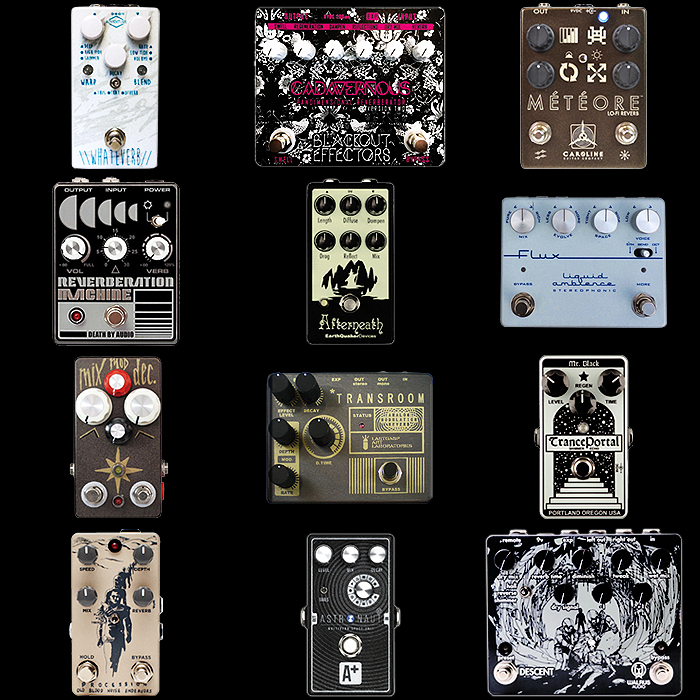
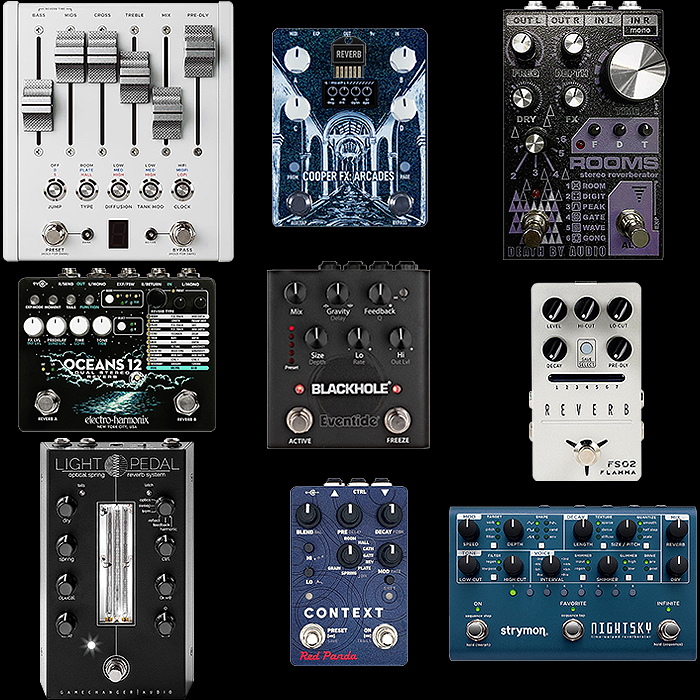
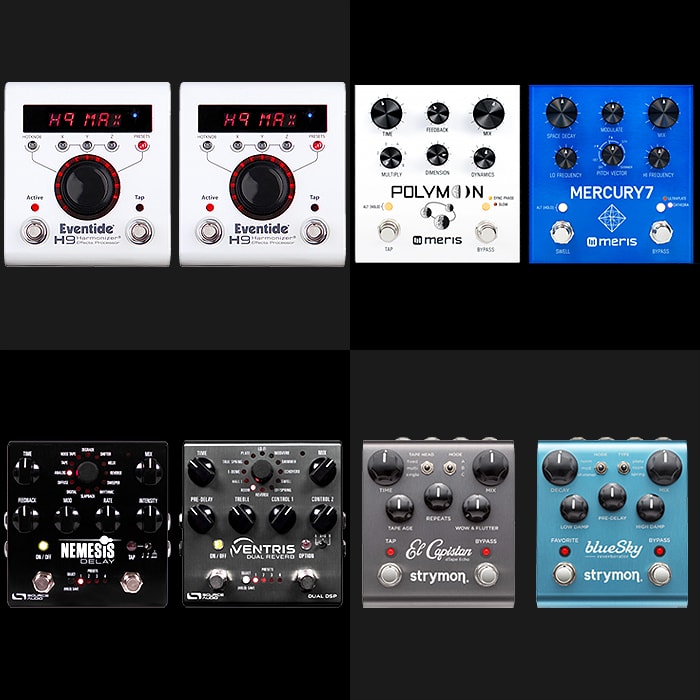
The Value of that visual / page! = $10,744 ($10,146 for my 28).
These are most of my Reverb type pedals - but I’m pretty sure I’ve left out a few inadvertently.
There will be some that say that the 2 x Eventide ones are more Multi-FX - but I bought those primarily based on their Reverb Algorithms in Particular and secondary for their Josh Smith Lesie Rotary Algorithm / Settings. Still to date - my two Eventides get deployed more on the Reverb side of things than on any of the other algorithms - while they do frequently play second or third fiddle even to the core Primary and Secondary choices. The Eventide H90 is always on the board - and occasionally I forget it’s there - or don’t particalry use it - it’s more like a super-sub for me (football analogy!)!
Im any case I think I’ve picked up a pretty impressive collection over the years - and there are some really exceptional ones in that mix! Which are your own favourites - and what do you feel I might be missing out on!!
Oh - and besides the Hotone Verbera and Red Panda Context - I also have he Tomkat Super Heavy on my target list. I kind of decided to prioritise the Reverb Workstatoins - while the Super Heavy is also on the wishlist - as a Secondary Reverb!
Individual Details as below - per usual!
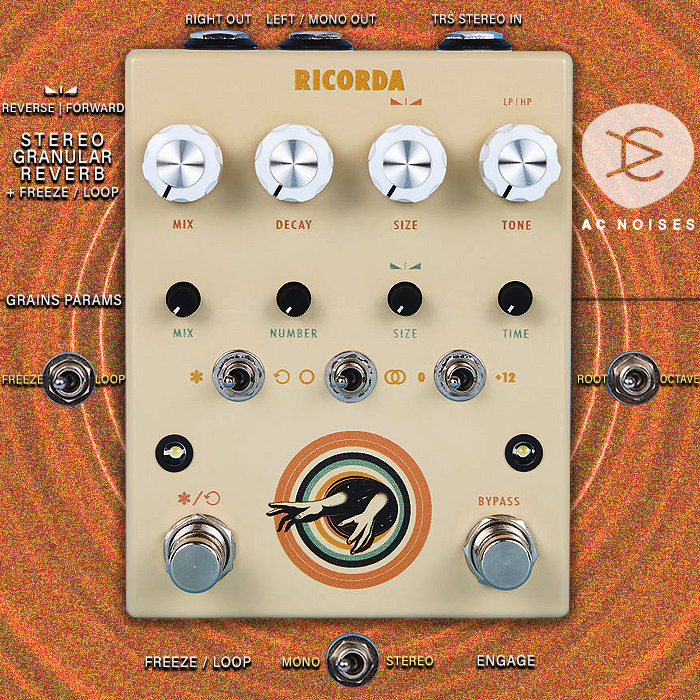
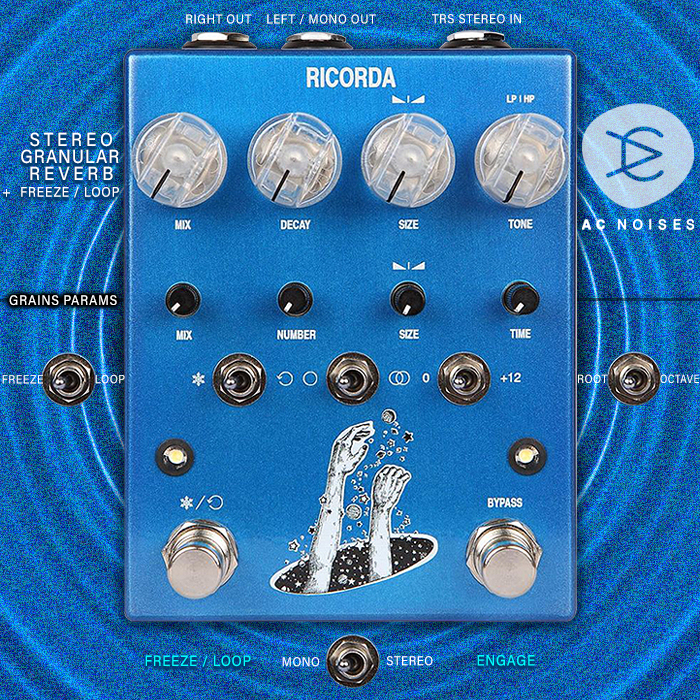
AC Noises Ricorda Stereo Granular Reverb + Freeze / Loop - €352 / $412
Controls [secondary - hold Freeze footswitch, tap to exit] - MAIN REVEBR } Wet Mix [diffuse], Decay Time [lfo speed], Size : > Reverse | Forward < [lfo depth], Tone : Dark > Bright [predelay]; GRAINS } Grains Mix [feedback], Number / Intensity [spray], Size : > Reverse | Forward < [stereo spread], Offset Time [pitch offset], SWITCHES } * / ↺ : Freeze / Looper (2 mins) [post / pre loop], O/OO : Mono / Stereo [dual mono / stereo], 0 / +12 : Root / Octave [pre / post grains], Freeze / Loop Footswitch, Bypass/Engage Footswitch.
A really cool Granular Reverb - which I got as a bonus for my Chase Bliss Mystery Box. This is a somewhat more specialist reverb - where I like it best when it's set to those twittery accordion-like granules. It just sounds superbly 3-dimensional and textural - but is something of a full-on effect too. The Ricorda can do all the subtle stuff to - Forward and Reverse, I'm very happy to have this in the collection - and it's been used a really fair amount!
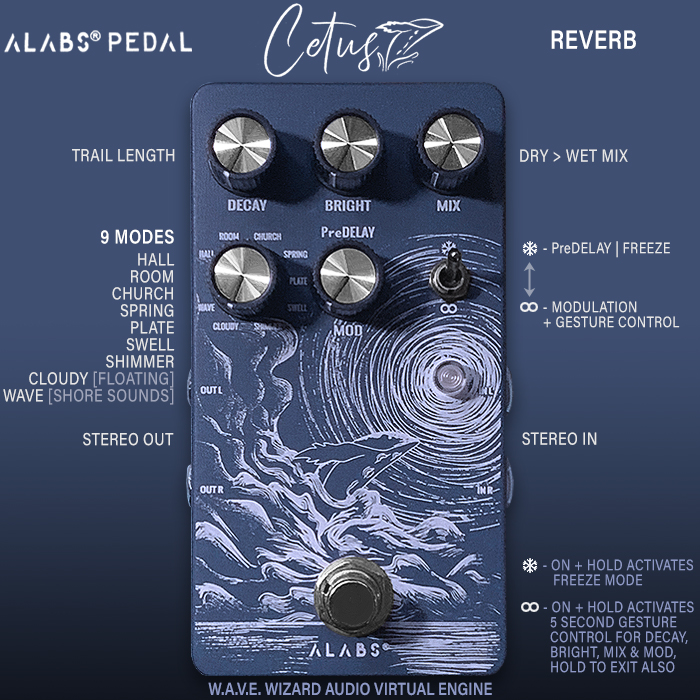
Alabs Audio Cetus Reverb - $109.99
Controls - Decay (Trail Length), Bright, Dry>Wet Mix, Mode : Hall / Room / Church / Spring / Plate / Swell / Shimmer / Cloudy (Floating) / Wave (Lapping Sea Shore), PreDelay / Mod knob, Toggle switch : Freeze : PreDelay | Freeze / ∞ Explore Mode 5s Gesture Control, Footswitch Freeze : Hold for Freeze | Footswitch ∞ + Hold activates Gesture Control for Decay, Bright, Mix, and Mod.
This is a fantastic budget Reverb - where the new Klowra rendition is very slightly improved for mostly the same core algorithms. I'm still very fond of this affordable compact stereo reverb - obviously for the Cloudy and Wave modes in particular - while the Room and Plate are great for always-on Reverbs too. Really a fantastic proportion all round - while the newer Klowra Limbo is very slightly better overall - but there's not that much in it!
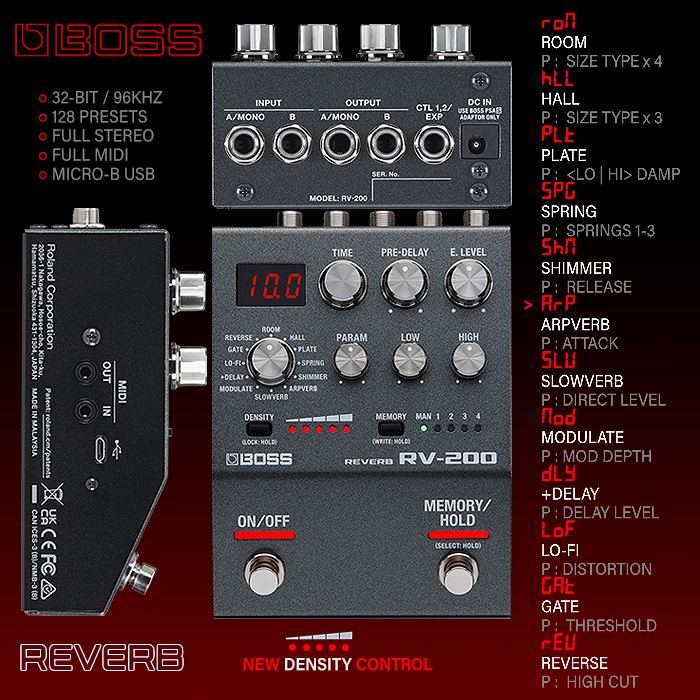
Boss RV-200 Reverb - $269.99
Controls - 3-Digit Display, Time, Pre-Delay, Effect Level, Mode : Room / Hall / Plate / Spring / Shimmer / Arpverb / Slowverb / Modulate / +Delay / Lo-Fi / Gate / Reverse, Param, Low, High, Density [Hold for Panel Lock], Memory [Hold to Save] : Manual / 1-4, On/Off Footswitch, Memory/Hold Footswitch.
The entire Boss 200 Series is exceptional - and this Reverb and the DD-200 delay in particular. Just the perfect mix of algorithms and features. The RV-200 sounds fantastic - and I love the new ArpVerb Mode - this really has everything you need - including Reverse, Lo-Fi and Gated - which are some of my favourite varieties too. I tend to favour the 200 Series over the 500 - as those pedals are so much easier to get a full grasp on. It took me ages to learn the incredibly detailed control structure of the RV-500 - particularly how you can set specific functions on the footswitches. That took a lot of assistance from Boss support over a number of weeks and months. Those big box Boss's make you work a little more for the superior round - versus something like the Strymon BigSky - which deploys more universally from the start - it has a lot to do with Low-Pass and High-Pass filtering in how the core sound is delivered!
Boss RV-200 Reverb - $269.99
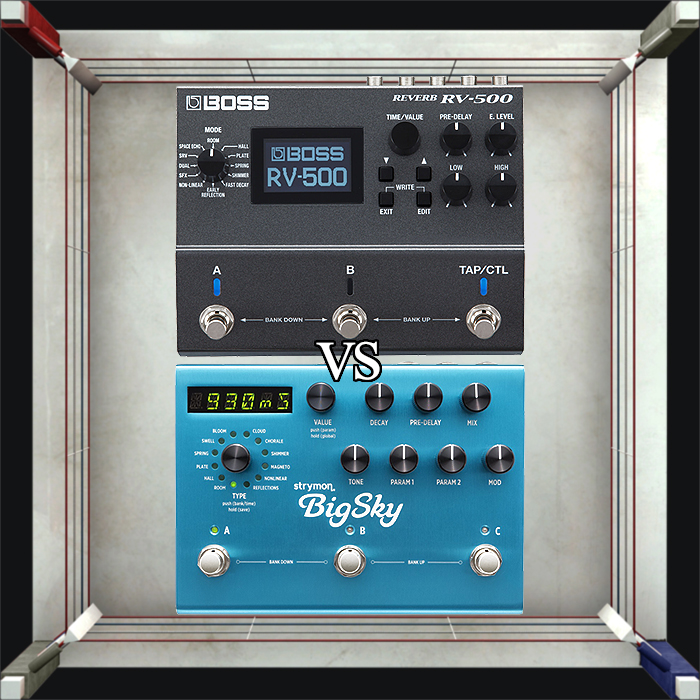
Controls - Mode : Room / Hall / Plate / Spring / Shimmer / Fast Decay / Early Reflections / Non-Linear / SFX Lo-Fi / SFX SlowVerb / SFX Storm / Dual / SRV (Roland SRV-200 / Space Echo (Roland RE-201), Time/Value, Pre-Delay, Effect Level, Down/Up, Exit, Edit + Write, Low, and High.
My fist big box reverb was the Strymon BigSky - which was somewhat more action-ready and more universal by default - be way of its Low-Pass and High-Pass filters - which ensure you get no ice-picky highs or booming wobbly bass. While the Boss equivalents require a little more setup to be as universally adept The Boss pedals are more granular in their level of control - but it can be quite a tricky experience to navigate all the controls. I've always found that I needed to adjust most of the Boss presets - otherwise you will get booming bass and piercing highs. While with the Strymons you can instantly flip from Clean to High Gain - without experiencing any flub or low-end boom. So you just need to adjust the Boss ones somewhat - which means you can often get better results in the end - but those pedals make you work for it!
A key advantage of the generation of Boss vs the BigSky - was that the Boss could play 2 Stereo Reverbs plus 2 Stereo Delays simultaneously - so in effect sort of 4 stereo effects at a time - which was way beyond the BigSky's capabilities then. The Source Audio Ventris was actually the first to deliver on Dual Simultaneous Stereo Reverbs - and the Boss RV-500 followed very soon after - then the EHX Oceans 12 - but then a massive gap until people started doubling up - which the Eventide H90 can of course do, alongside the latest BigSky MX generation of Strymon. The RV-500 delivered some superb sounds for me - but I spent a long time fiddling with settings to get there!
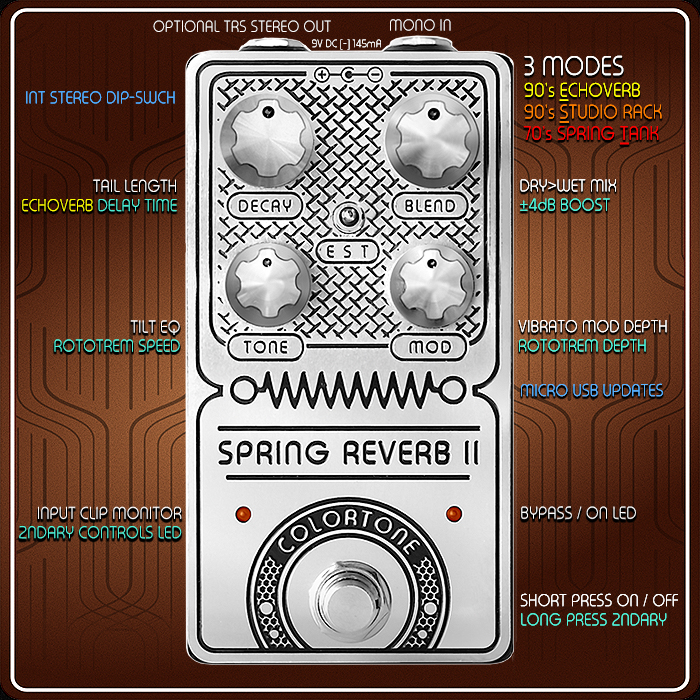
Colortone Spring Reverb II - $199
Controls - Decay (Tail) / EchoVerb Delay Time, Blend (Dry>Wet) / ±4dB Boost, Tilt EQ Tone / RotoTrem Speed, Vibrato Mod Depth / RotoTrem Depth, Footswitch Short Press = On/Off, Footswitch Long Press = Secondary Params On/Off, Internal Stereo-Out Dip-switch, Micro USB Port on right-edge for Updates and Requests.
Algorithms - EchoVerb / Studio / Tank / RotoTrem.
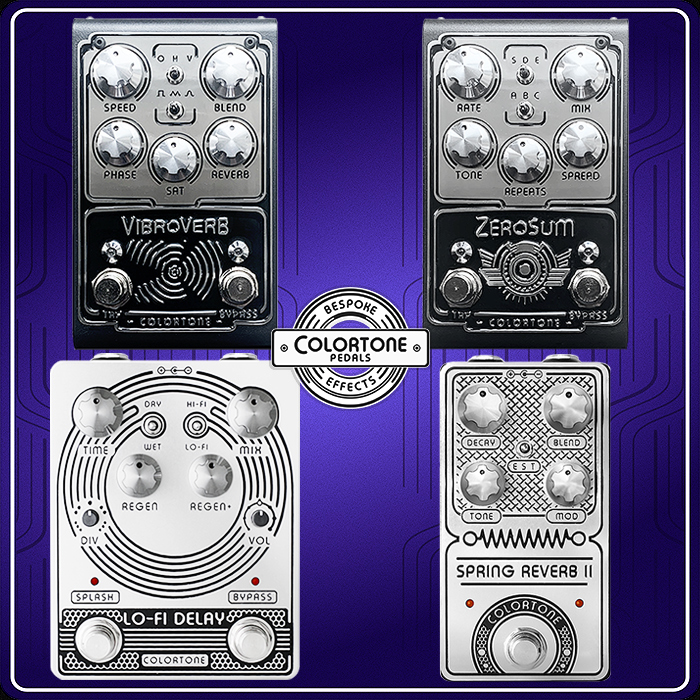
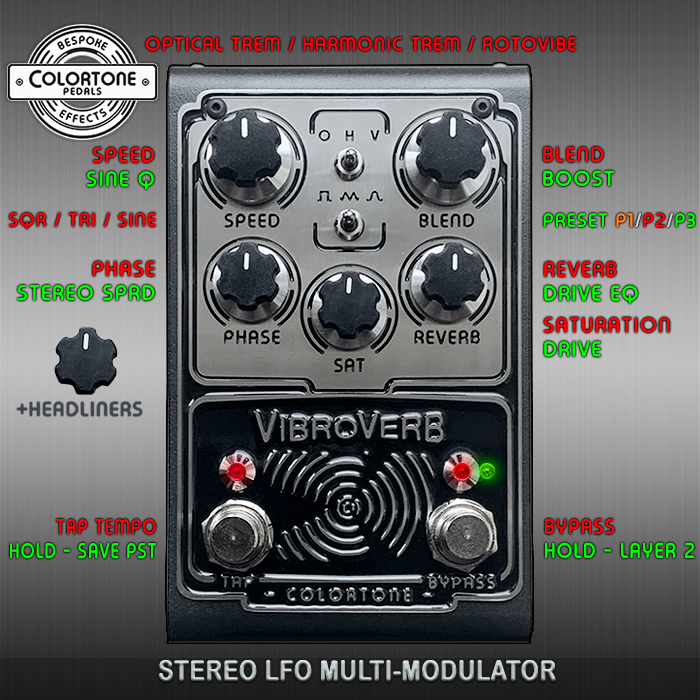
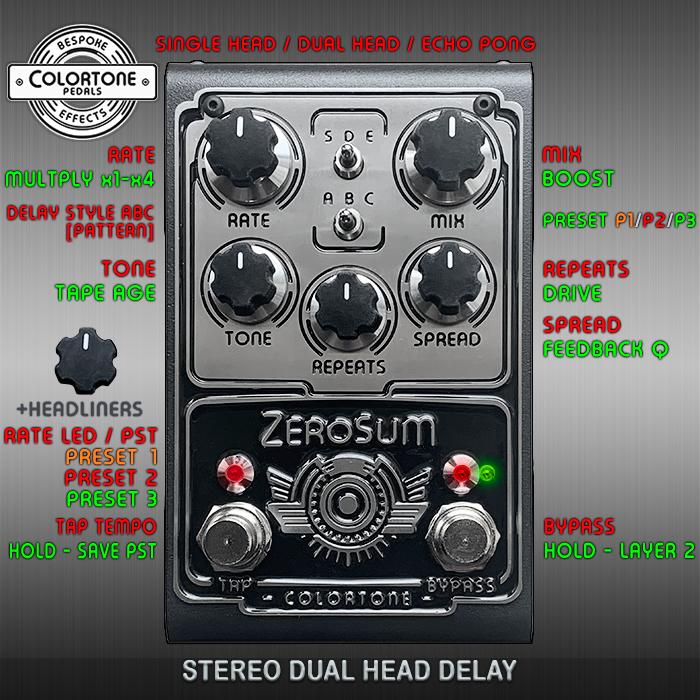
The latest iteration of the Colortone Spring Reverb delivers 4 amazing algorithms - the RotoTrem is particularly cool. And it delivers in stereo, while it's only a Mono-in. MISO device - which means it won't currently fit on the board - as I already have an essential MISO pedal in that slot - and you can only have one! Which is why I envisaged Colortone's AD Hauser to go full stereo - which he's done on his latest VibroVerb and ZeroSum pedals. For sure we will get a full-stereo Reverb from him before long - and as long as you don't have a MISO pedal on the board already - then this one delivers fantastic tones too!
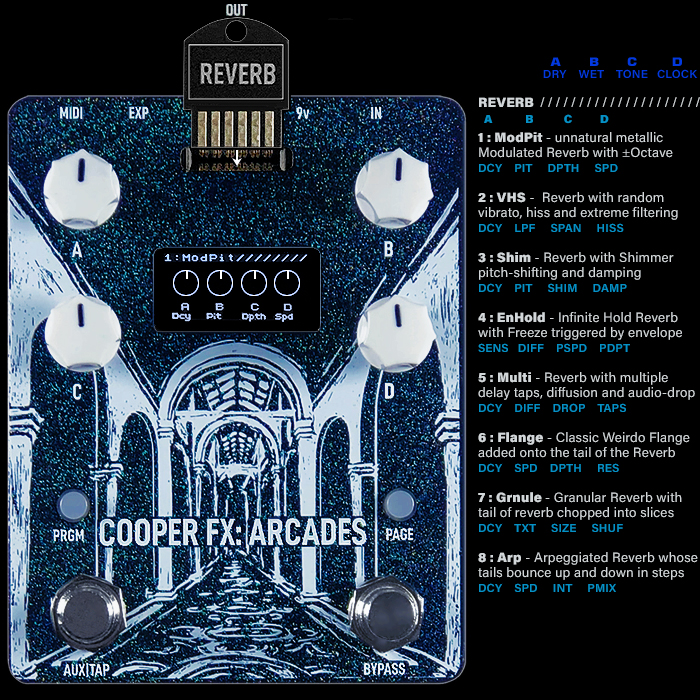
Cooper FX Arcades - Reverb Card - $330 for device, cards at $30-$50
Controls - Mode : Modulated Pitch Reverb / VHS / Shimmer / Envelop Hold, Multi-Taps Reverb / FlangeVerb, Granular Reverb / Arpeggiated Reverb, Dry, Wet, Time, Clock, Decay / Sensitivity, Pitch / Diffuse / Filter, Depth / Size, Variable D.
Tom Majeski's Arcades Cartridge-style device was a fantastic innovation at the time - and influenced a number of later pedals - including the latest generation of Alexander Effects Compacts - with those same sort of 4 parameter controls combing analog knobs with digital screen and parameters - I owned pretty much all the 8-Mode cartridges bar the custom Ambient Endeavors one - which Tom failed to send through to me. The Arcades was a fantastic device - and the Reverb Card one of the strongest in the series - really lush and unusual Reverbs - but alas Mono only - and so these were Tertiary options. It's been a while since that pedal was on the board - I really used to like I - but at the same time wanted the spatial effects to be in stereo ideally, Still very decent for the time - and not at all bad if you dig it out again!
Cornerstone Paul Davids Signature Nucleo Atomic Power Station Reverb - $449
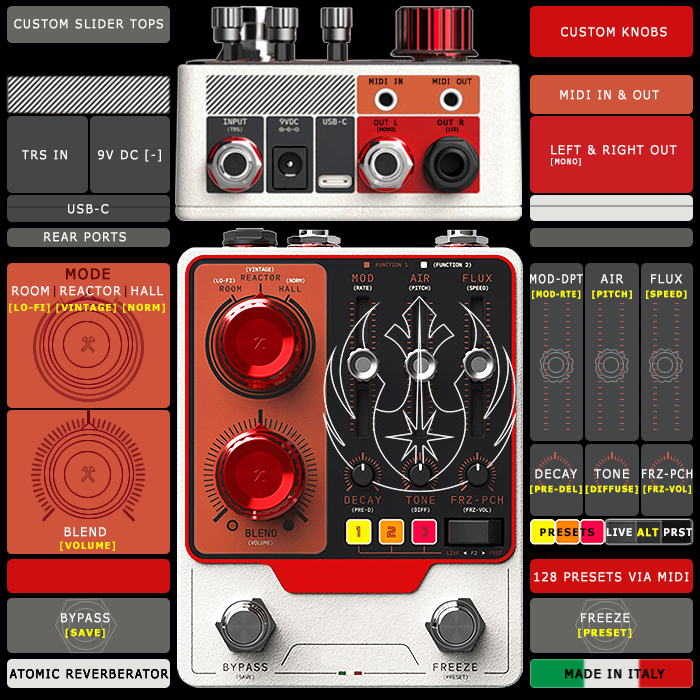
Controls - Mode : Room [lo-fi], Reactor [vintage], Hall [normal], Blend [volume], Modulation [rate], Air [pitch], Flux [speed], Decay [pre-delay], Tone [diffuse], Freeze-Pitch [freeze-volume], Rocker Switch : Live Panel / F2 Secondary / Presets [1|2|3], Bypass Footswitch [save], Freeze Footswitch [preset 1-3].
This one is interesting - thanks to my good friend Dylan and Definitive Guitars for helping me source one of these quickly. My formerly highly communication friend Emilio has ghosted me since the middle of June - and would not respond to any of my usual queries. I can only assume he doesn't care any more - and certainly does not care about our former relationship - I seem to have been exiled and set adrift from that brand - so I won't put in any major effort to promote said pedal - and in fact - have already stripped off all the branding and replaced with my Star Wars Rebel Alliance Jedi Insignia!
As mentioned - Dylan helped me get hands on one, and I actually really love it - it's one of the best designed pedals ever - and delivers what I always felt that the Chase Bliss CXM 1978 needed to deliver for me - in a more versatile and smaller package, Those 3 Modulation, Shimmer, and Granules slides are just genius - and you can easily step up or down for your reverb output - going from aways-on subtle to fully textured in the quickest possible was, As far as I'm concerned it's perfect Secondary Reverb - but as the main guy won't even respond to me these days - I'm not going to go out of my way to do a proper review and promote said pedal - I do really love it though as expected - and paid a little over the odds to get one in quicker - still the right decision.
Cornerstone will now inherit the same mantle as Jackson Audio and Empress - and have their branding stripped and replaced by the Rebel Alliance Jedi insignia - most every time I reference those pedals - which will only be in group overview articles ... If you cross me and don't apologise - then I will enact Newton's 3rd Law!
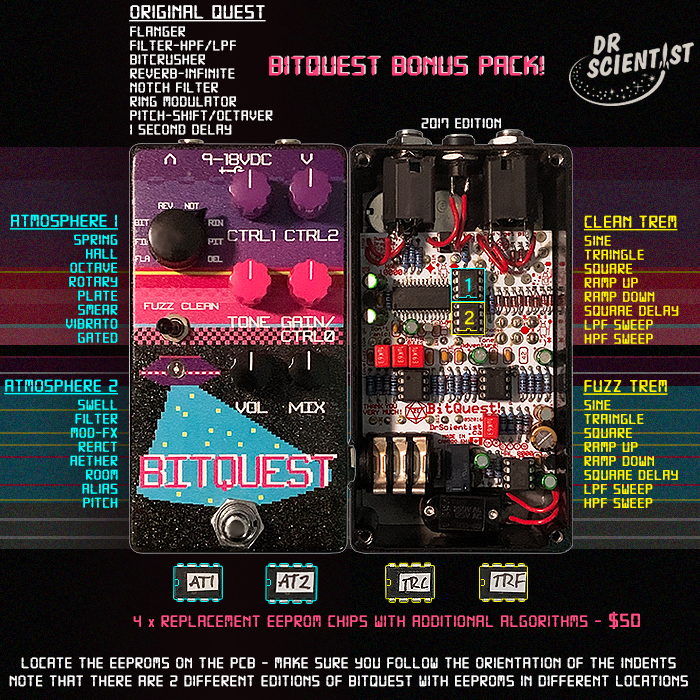
Dr Scientist BitQuest Atmoshere Reverb Bonus Pack - $249 for device + $50 for bonus pack
Controls - [Atmosphere Chip 1] : Mode : Spring / Hall / Octave / Rotary / Plate / Smear / Vibrato / Gated, Ctrl O Decay, Ctrl 1 Mod Rate / Vrs, Ctrl 2 Vrs.
[Atmosphere Chip 2] : Swell / Filter / Mod-FX / React / Aether / Room / Alias / Pitch, Ctrl 0 Decay, Ctrl 1 Vrs, Ctrl 2 Vrs.
The actual Dr Scientist Atmosphere has been discontinued as you just can't get that particular chip any more. The only way to get the Atmosphere currently is to own a BitQuest, and then buy the $50 Bonus Pack - consisting of 4 EPROM Chips - 2 of which have the 16 Algorithms from the Atmosphere- and the other two EPROMS have 8 Tremolo algorithms - with or without Fuzz. A couple of the filter tremolos are superb and possibly worth the $50 alone - it's quite incredible though that BtQuest owners can get all the Atmosphere algorithms for just an extra $50 outlay! It's so worth it - while it is a Mono only effect.
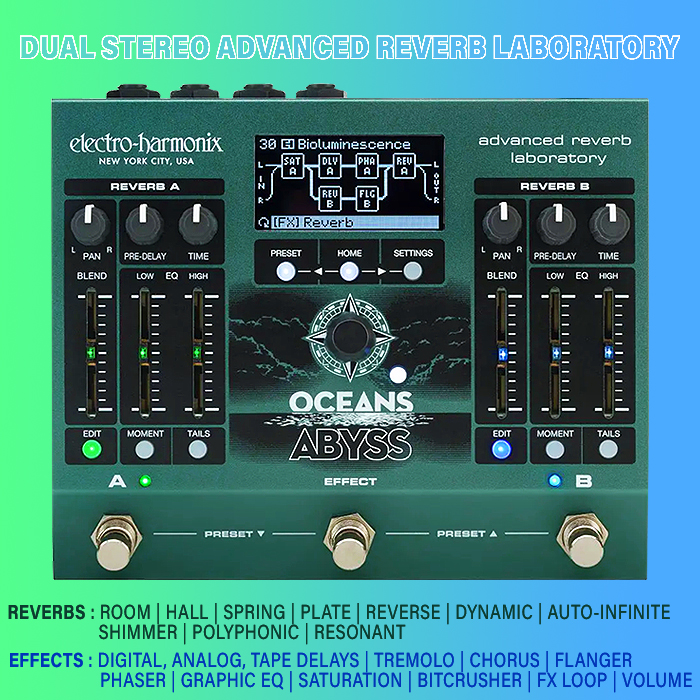
Electro-Harmonix Oceans 12 Dual Stereo Reverb - $269.80
Controls - Expression Mode, Momentary, Tails, Function, Mode : 1 / 2 / 3 / Lo-Fi / Tide, Reverb Type : Room / Spring / Plate / Reverse / Echo / Trem / Mod / Dyna / Auto-Infinite / Shimmer / Poly / Resonant (Dual Mode), Parameter 1, Parameter 2, FX Level / Infinity Level, PreDelay / Send Level, Time / Lo-Fi, Tone / Tide, Select A/B, Left Footswtich Reverb A, Right Footswitch Reverb B.
I quite enjoyed the sound of this one - which looks amazing on paper - but in real life those legends are just way too small - and it's tricky to decipher that times what's going on - as the labels are just minuscule at any distance. It's OK to use as a preset pedal - but once you get to tweaking and dialling things in - you just struggle to decipher what is what - which kind of explains the size of the most recent Oceans Abyss flagship - which alas is a little on the large side for me - but where it solves the legibility / usability issues of the Oceans 12. It sounds pretty cool - but I struggled at time to get to grips with it! Showing that not everything that makes sense zoomed in on paper or a screen - where in reality the overall dimension are too small to accommodate all those labels at sufficiently legible sizes!
Empress Effects Reverb - $494
Controls - Mode : Hall / Plate / Spring / Room / Sparkle / Modulation / Ambient Swell / Delay + Reverb / Reverse / Ghost / Lo-Fi / Beer, Decay, Mix, Output, Low, Hi, Thing 1, Thing 2, Presets, Select Footswitch, Save Button, Scroll Footswitch, Bypass Footswitch.
Definitely one of my all-time favourite Reverbs - with a superb extended set of algorithms. Much like my other Empress favourite - the EchoSystem - this one has that same great utility. While you occasionally need the manual to figure out precisely what Mode / Sub-mode you're playing - and what the Thing 1 and Thing 2 Parameters are! Unlike the EchoSystem - it doesn't do the dual-channel parallel double effect thing. And where new Reverbs are increasingly including Convolution Reverbs / IR's - the Empress Reverb is starting to show its age a little. It's still a fantastic Reverb overall but probably needs an update - to catch back up with say the BigSky MX!
Eventide H9 Max Multi-FX / Reverb - $699
Controls - Hot Knob, X, Y, Z, (X+Y+Z for Bluetooth On/Off), Presets, Central Rotary Controller, Active Footswitch, Tap Footswitch
Algorithms - Blackhole / DualVerb / DynaVerb / Hall / MangledVerb / ModEchoVerb / Plate / Reverse Reverb / Room / Shimmer / Spring / TremoloVerb. [+ the news ones - which you can download].
The Eventide Space Reverb Workstation proceeded the Strymon BigSky by a couple of years - yet the BigSky would go on to dominate that space in part because of a slightly optimised size / form factor - and possibly because of an overall more dynamic set of Reverbs. The Space though was still a bonafide classic - so for me the H9 was just an optimal way for me to access those algorithms - I bought the H9 mostly to access those various Reverb algorithms. And then when the H90 materialised that was just a further more powerful evolution of the H9 - which in turn for me was a format evolution on the Space! The Blackhole in particular has really stood the test of time - and features on a later stand-alone device - as well as on all those essential Reverb Workstations. For me those Space derived algorithms are still special - and worth having access to!
Eventide H90 Multi-FX / Reverb - $899
Controls - Select Program / Playlist / Bank [hold], Perform / HotKnob, Programs + Routing (System when pressed together), Quick Parameter Knobs 1-3, Presets + Parameters (Tempo when pressed together), [P] Active / On Footswitch, [A] Bank Down Footswitch, [B] Bank Up Footswitch.
Algorithms - Blackhole / DualVerb / DynaVerb / Hall / MangledVerb / ModEchoVerb / Plate / ReverseReverb / Room / SP2016 Reverb / Spring / Shimmer / TremoloVerb / Wormhole.
For me this is a great evolution of the H9 - which for me was in turn a great evolution of the Evntide Space - containing those killer Reverb Algorithms in a far more compact format - with easy controllability via the Bluetooth connected app. I've not really kept my H9 up-to-date - that one has kind of been retired from service - to be replaced in the field - by the far more potent H90 - which has far more granularity about it - alongside the ability to deliver 2 simultaneous effects - much like those relatively early Ventris and RV-500 devices! The H90 is a really power-house of a pedal. While I still use the algorithms on my Primary Reverb machine - a little more - which currently is the BigSky MX - but H90 is a fantastic support / super-sub for that!
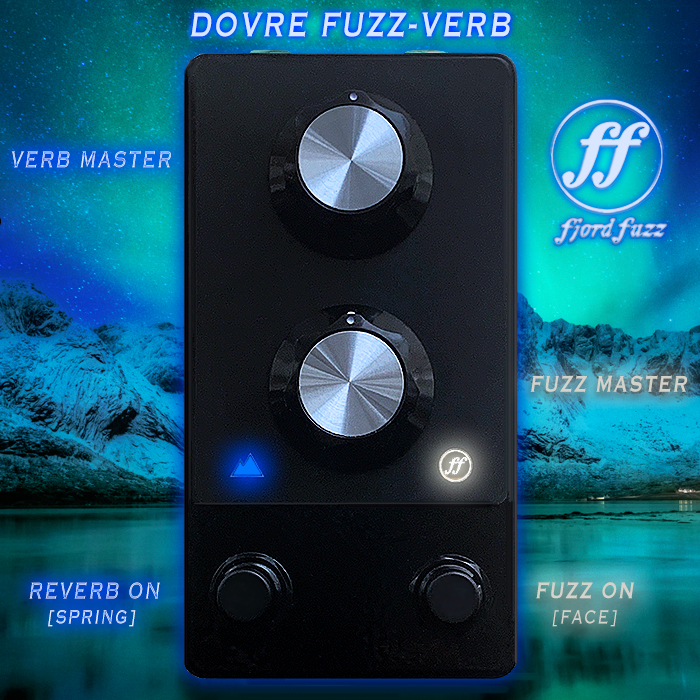
Fjord Fuzz Dovre Fuzz-Verb - $249
Controls - SPRING REVERB } Reverb Master / Decay Length, Reverb Footswitch; SILICON FUZZ FACE } Fuzz Master / Output, Fuzz Footswitch.
This is a fairly unique Fuzz-Verb - where the Reverb potion is mostly used as a carrier element here - to prop up and add further sustain and verve to the Fuzz, The Reverb is based on a Spring Reverb sound - but designed to come across fairly neurally - to more empasize the fuzz side, I could also have included the Rainger FX Pull Focus here - which adds Chorus and Reverb to a core distortion tone - but there are definitely similarities - albeit the Pull Focus has that interesting delayed onset feature. I really like this one - but can't really answer why I included this and not the Pull Focus - that's often just the idiosyncrasy of curation!
Fjord Fuzz MIME AI-Infused Reverb - $199
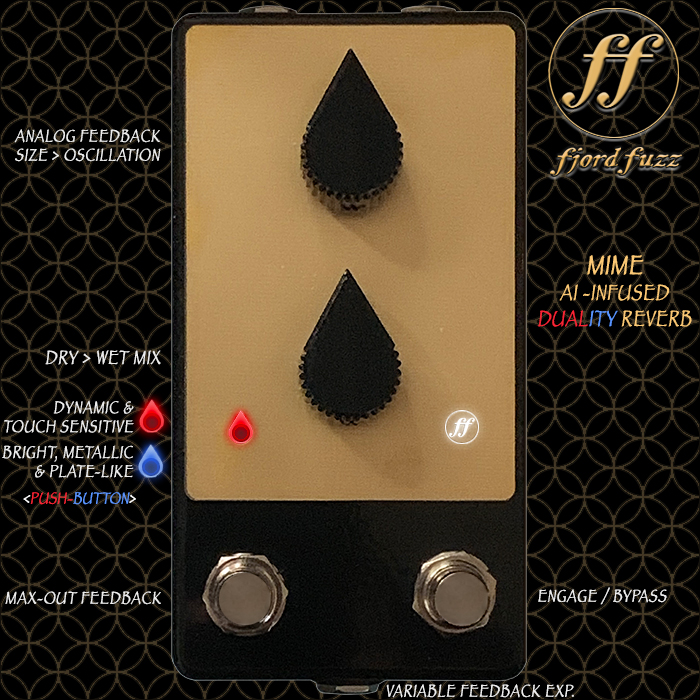
Controls - Upper knob : Analog Feedback / Reverb Size > Oscillation, Lower knob : Dry > Wet Mix, Tear-drop Push-Button : Red Reverb / Blue Reverb, Left Footswitch : Max Feedback, Right Footswitch : Engage/Bypass.
A cool AI-infused / inspired 2-mode reverb - where Daniel and Eirik Nordstrand designed the Red Dynamic and Touch-Sensitive voicing - and the AI suggested the brighter, more metallic and plate-like Blue side. A really cool duality Reverb!
Fjord Fuzz MIME II AI-Infused Reverb - $249
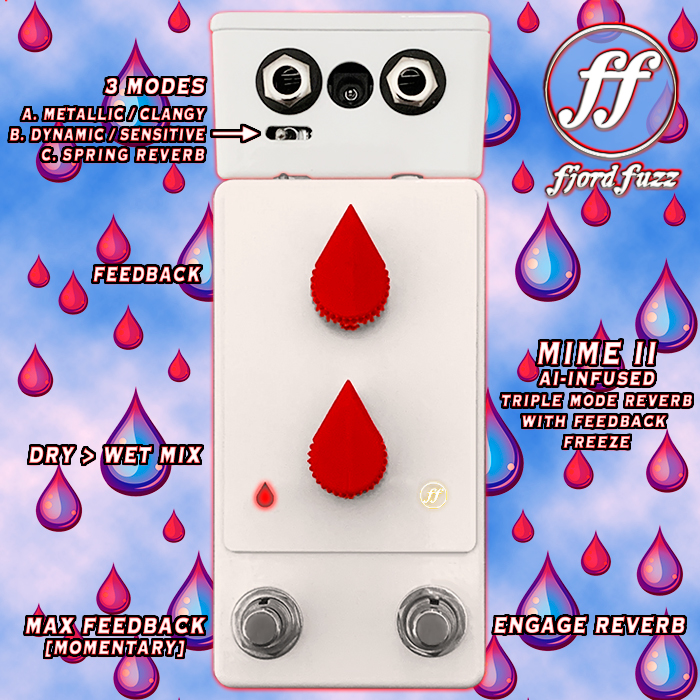
Controls - Mode (3-way toggle on top edge) : 1 Metallic and Clangy Plate-like Reverb / 2 Dynamic, Touch-Senstive Reverb / 3 Spring Reverb, Feedback (>Oscillation), Dry > Wet Mix, Max Feedback Footswitch (Momentary), On / Bypass Footswitch.
The AI-Infused MIME II gains a Spring Reverb algorithm - evolved from the one on the Dovre - I believe all 3 voicings have been somewhat refined here compared to the original MIME I - while the original Red and Blue modes are sill mostly the same. The addition of Spring Reverb certainly make this pedal a little more versatile!
Refresher!
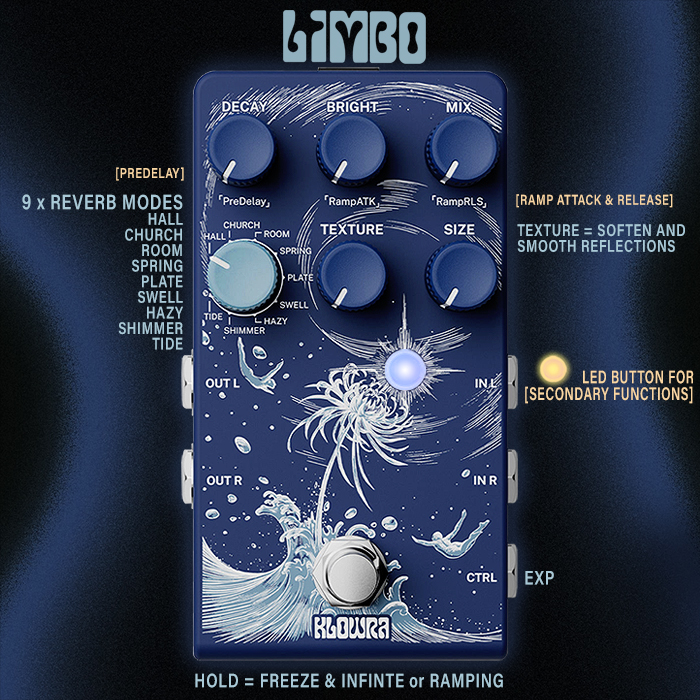
Klowra Limbo Reverb - $129
Controls - DECAY [predelay], BRIGHT [ramp atk time], MIX [ramp rls time], MODE : Hall / Church / Room / Spring / Plate / Swell / Hazy / Shimmer / Tide, TEXTURE, SIZE, LED Button for ALT / [secondary modes], Press-Hold Footswitch for Tap Tempo and Ramping.
As I've detailed previously - the Klowra team use to be at ALABS Audio - but then struck off on their own - with the kind of core team intact from that earlier release. The Limbo is a refinement and enhancement of the Cetus - those are larger the same algorithms - just further refined. You get a better control interface - with a new handy push-button secondary function, and new 'Texture' control - which in truth doesn't really add that much over and above the original. The best way to define it is as a slightly refined version of the Cetus - with a better control interface. Otherwise there are all kinds of similarities - including the colourways and the overall sci-fi / fantasy look of those artworks!
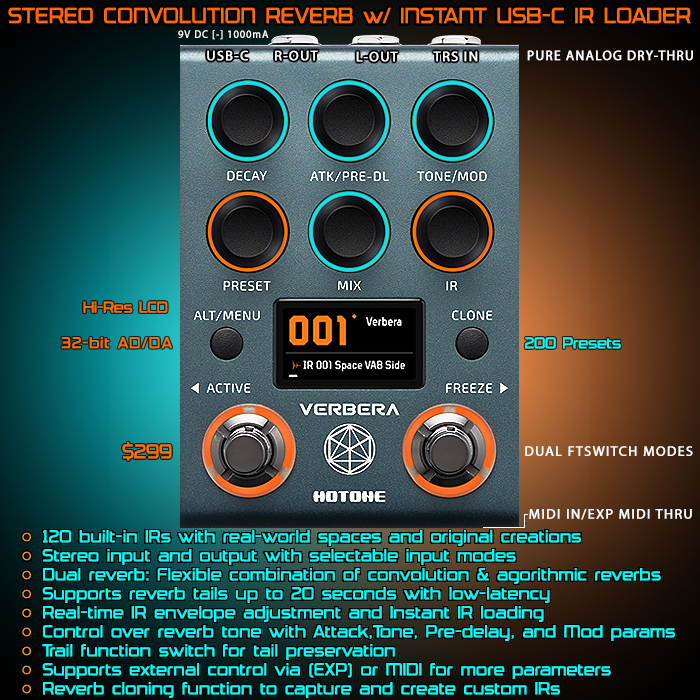
Hotone Verbera Stereo Convolution Reverb and IR Loader - $299
Controls - Decay, Attack / Pre-Delay, Tone / Modulation, Preset, Mix, IR, ALT/MENU Button, Hi-Res LCD, CLONE Button, Active Footswitch, Freeze Footswitch [Dual Footswitch Modes].
120 included IRs / Modes!
This is one of my active targets - just £249 in the UK - which is a great price for a Convolution Reverb of this fidelity and quality - and with so much onboard. The only downside really is a high current draw of 1000mA - while my recent power-supply upgrade makes it easy for me to handle that - I have spare outlets that I can combine - to double up on the amperage. As a comparison the other 2 Convolution Reverbs on this list are $399 and $679. I'm always after more sci-fi effects - and reading though the 120 IR's descriptions - here seem to be plenty there that would appeal to me. This is s super smart device - I don't yet know how accessibly or usable it is - but it generally promised to be great - particularly at that price-point!
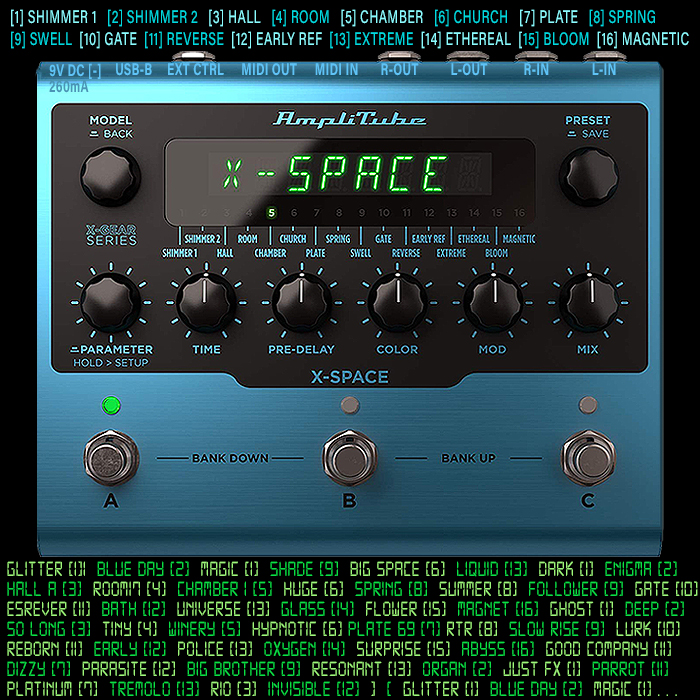
IK Multimedia Amplitube X-Space Reverb - $329.99
Controls - Model/Back, Preset/Save, Parameter/Setup, Time/Decay, Pre-Delay, Color (Frequency Focus), Mod, Mix, Footswitches A|B|C / Bank Down/Up.
Algorithms - Shimmer 1 / Shimmer 2 / Hall / Room / Chamber / Church / Plate / Spring / Swell / Gate / Reverse / Early-Reflections / Extreme / Ethereal / Bloom / Magnetic.
Another one of my favourites - somewhat under the radar these days - but a really great sort of sci-fi reverb - with some incredible ambient soundtrack-like effects. This was a Primary for a while - and I really enjoyed using it - I did a glowing review at the time - but it's seemingly passed most people by. Overall a really great Reverb Workstation - with a great highly legible screen and really logical and intuitive interface. This one deserves to do so much better than it has - really good build quality and solid attention to detail. IK Multimedia / Amplitube normally do a really decent job with their hardware - where I believe it's still mostly made in Italy!
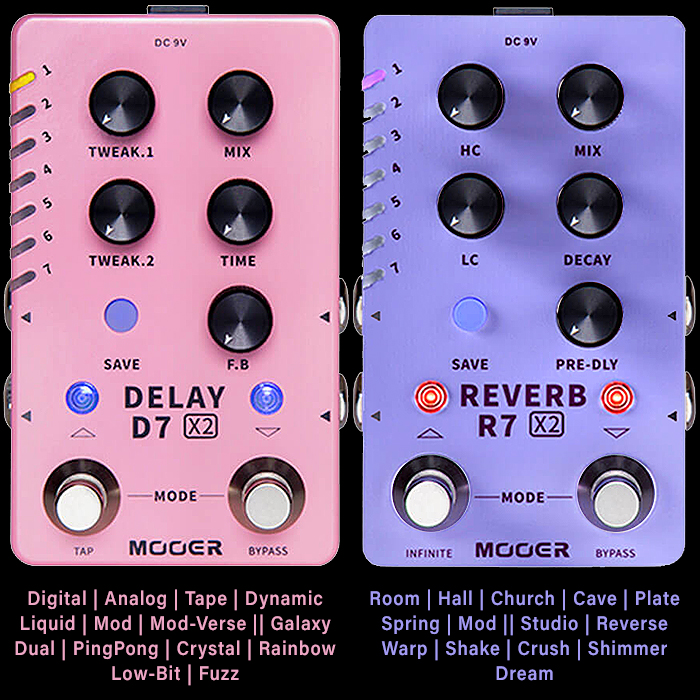
Mooer R7 X2 Reverb - $149
Controls - High-Cut, Wet Mix, Low-Cut, Decay, Save Button / Modes, Pre-Delay, Infinite/Freeze Footswitch, Bypass Footswitch, Press Both Footswitches to Scroll through the Modes.
Algorithms - Room / Hall / Church / Cave / Plate / Spring / Mod / Studio / Reverse / Warp / Shake / Crush / Shimmer / Dream.
With its 14 algorithms - this is the Compact Reverb with the most options in its tank - and a good mix of vanilla and more unusual effects. I would really just want a reverb with purely sci-fi and soundtrack-like ambient effects - really like you're designing a soundtrack for a classic sci-fi film - say Alien/s or Bladerunner - a lot of those swooshy, and metallic and industrial artefacts effects. This Mooer isn't perfect - but there is nothing else at this size which delivers more flavour! Would be cool to get say 20 sci-fi reverbs within a compact unit - the technology is certainly up for the task - just no one has really pushed that envelope yet!
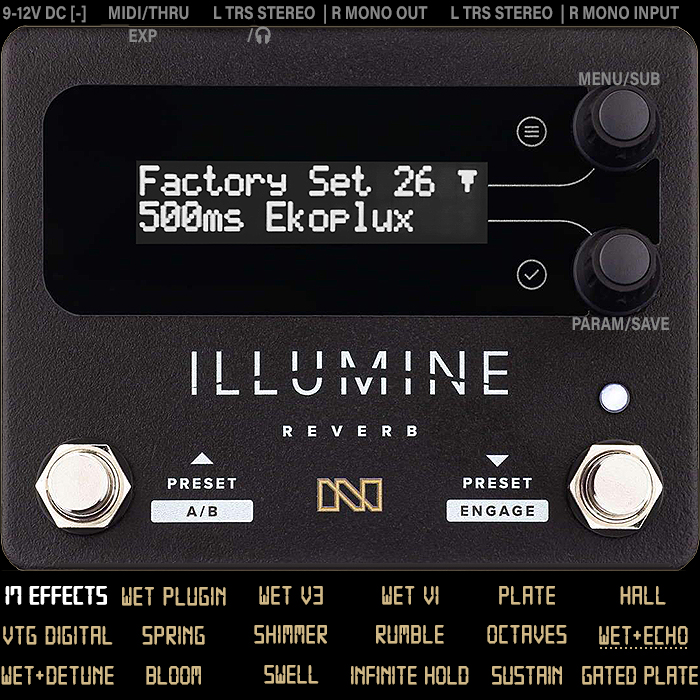
Neunaber Illumine Reverb - $499
Controls - Menu / Sub-Menu, Parameter / Save, Preset Up / A/B Footswitch, Preset Down / Engage Footswitch.
Algorithms - Wet Plugin / Wet V3 / Wet V1 / Plate / Hall / Vintage Digital / Spring / Shimmer / Rumble / Octaves / Wet V3 + Echo / Wet V3 + Detune / Bloom / Swell / Infinite Hold / Sustain / Gated Plate.
This one seems somewhat under the radar too these days. I had this one as my Primary for a long while - and I really loved it - still do. It's just the nature of this Blog that I need to keep featuring new and diverse pedals. This is still one of the great reverbs - with some really smart features and functions above - with a really compact enclosure for such potent Reverb Workstation - with its 17 modes, and upgrade path. I could have stuck a pin in my timeline at several times - and be happy continuing to use whatever pedal was Primary then - all the Primaries have been pretty decent - there are some I would not necessarily want to return to - while I'd be quite happy to revisit all my favourites - which include this one. As mentioned - the control interface here is really slick - just a couple of core controls really - but they do so much - once you figure out the sequence. And you can to all kinds of clever things - like set your own cluster of favourite effects - switching them on or off from the Preset selection - lots of smart touches like that make the Illumine so great. A lot of those that I recommended the pedal to when it materialised - are still using it now - obviously Neunaber's 'Wet' Modes are legendary!
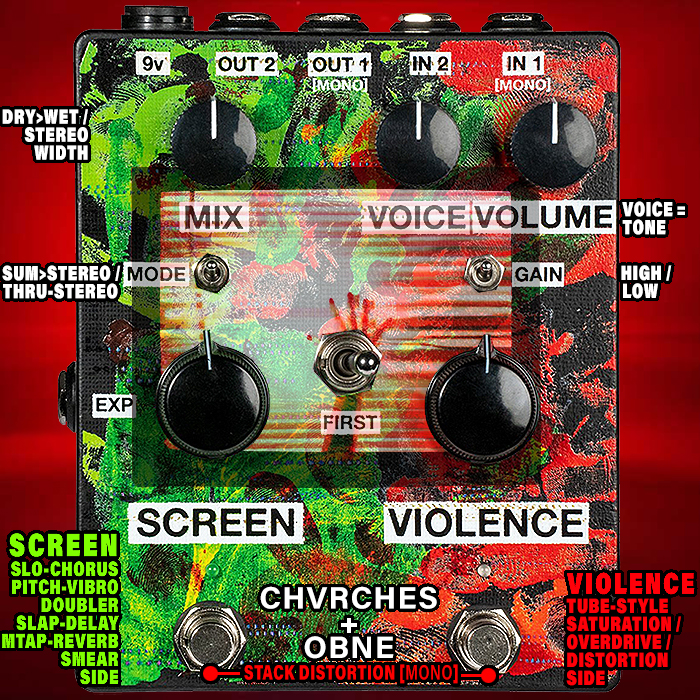
OBNE Chvrches Screen Violence Stereo Saturated Modulated Reverb - $279
SCREEN Modulation Side - Mix : Dry>Wet [mono] / Stereo Width [stereo], Screen : Variable knob taking you from Slow Chorus / Pitch Vibrato [max Mix] > Doubler > Slapback Delay > Multi-Tap Reverb > Almost ∞ Tails / Smear, Screen Engage Footswitch.
VIOLENCE Saturation Side - Voice [Tone], Volume, Gain : High / Low, Violence : Saturation > Overdrive > Distortion control, Violence Engage Footswitch, Press Screen + Violence Footswitches together to Engage Stacked Distortion Mode (mono only).
UNIVERSAL - Mode : 1] Sum > Stereo / 2] True Through Stereo, First : Violence > Screen / Screen > Violence.
One of the more unusual ones here - and slightly over-sized. I was fooled into thinking it was a 1590-BB format - but it's basically one of those core large pedals - but up on its side. I'm so happy that OBNE has settled on a more compact square format now. In any case this is a Reverb-Saturator - almost shoegazer stye in most ways - with a really smart progressively changing Delay / Reverb section - which picks up more texture and modulation as you crank it up. The pedal sounds wonderful at all times - but It's larger than it needs to be. OBNE should consider reissuing it a a more compact size!
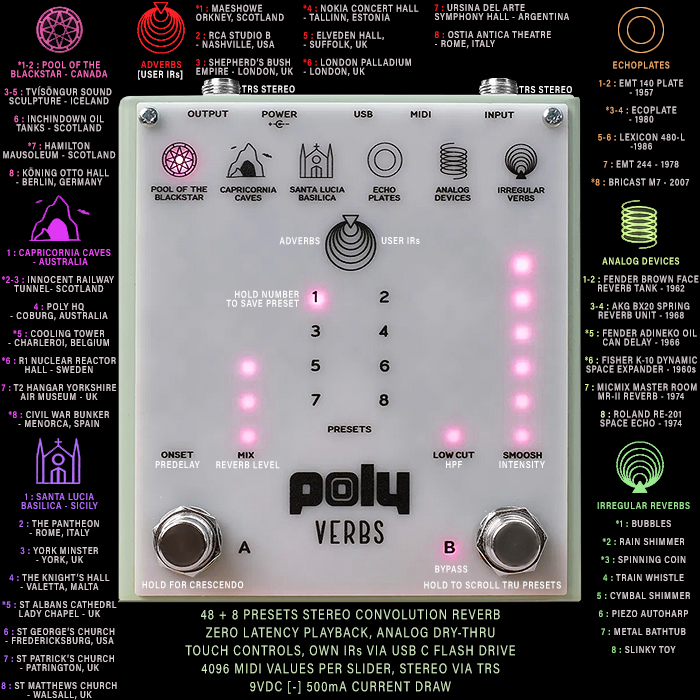
Poly Verbs Stereo Convolution Reverberator - $399
Controls - Spaces / Devices / Elements (groups of 8) : Pool of the Blackstar (≈Hall), Capricornia Caves (≈Cavern), Santa Lucia Basilica (≈Cathedral), Echo Plates (≈Plate), Analog Devices (≈Spring), Irregular Reverbs (≈Oddball Reverbs / Shimmer), Adverbs (≈Rooms / User IRs), Onset (Predelay), Mix (Reverb Level), Presets 1-8 (per Category), Press-hold number to save Preset), Low Cut (HPF), Smoosh (Intensity / Spreads and Expands Sound Particles to fill Void), A Footswitch = Hold for Reverb Crescendo, B Footswitch = Bypass / Hold to scroll through Presets.
My very first Convolution Reverb - and a fantastic take on that format - a little lacking in overall granularity of effect - while capable of some fantastic output. I have a few niggles with these Poly devices - particularly in how long they take to boot up - and every now and again fail to boot up properly. Also I don't always get on with the touch-controls - I think that's mostly my own physiology - at times I struggle to make contact. And I don't like how those devices aren't properly stateful - you get taken to a common starting point every time you start up the device - there is no continuity from one session to the next. But overall those niggles don't really mar the experience - the pedal is incredibly broad in its range, while at times I wish I had more control over he individual voicings!
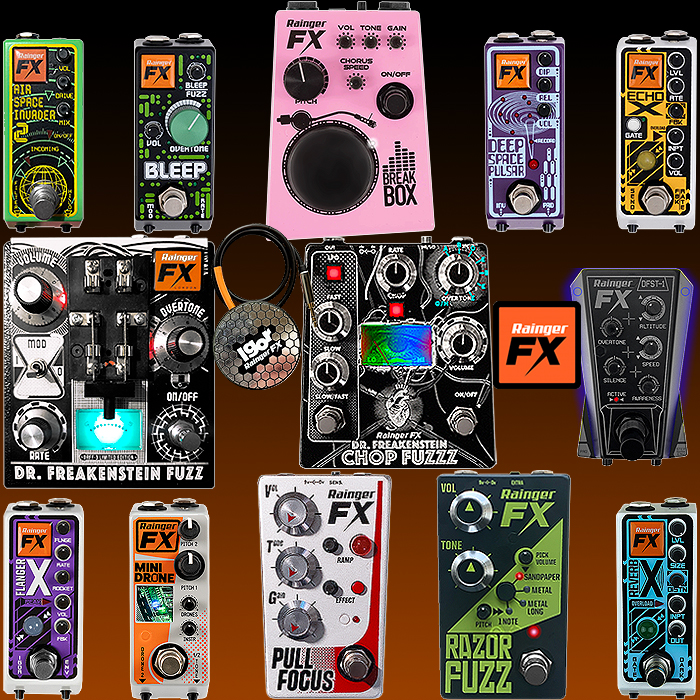
Rainger FX Reverb-X Gated Reverb (as used by Mk.gee) - $229
Controls - Level, Size, Distortion, Input, Output, Gate, Dark, + Igor Expression Pad.
This pedal has gained a cult following after being championed by Mk.gee who uses it really smartly in combination with his 424 Portastudio. This delivers a distorted gated reverb which just sounds so unique - It does that one thing exceptionally well! It's frequently on my board as the Tertiary / Quaternary Reverb! I have a particular mini slot that this Reverb-X mostly lives on - the Pico Attack Decay is currently on that slot - but most of the time it's the Reverb-X.
Red Panda Lab Context 2 Reverb + Delay - $329
Controls - Blend / Balance, PreDelay / Delay, Decay / Feedback, Hi Freq Damping / Dynamics Ducking, Modes : Room / Hall / Cath / Gate / Rev / Plate / Spring / Grain / Tap Divisions, Low Freq Damping / Dynamics Threshold, Modulation / Modulation Rate, Shift / Secondary Functions Button, Preset / Infinity / Save Footswitch, On / Infinity / Trails Footswitch.
This is the second of my active targets - I overall really like the format of those Red Panda pedals - and already have the Particle 2 and Raster 2 Delays - meaning this Context 2 remains a target, alongside the Bitmap 2 Bitcrusher. And while the enclosure and control format is mostly really decent - I don't like the way you need to hook the pedal up to your laptop to update the routing settings so you can run it in full TRS Stereo, That caught me out on both my previous models. I would ideally either want a Strymon-style 3-way routing switch, or else have auto-sensing of TRS cables - like some devices already do. Overall the Context has a great mix of features and algorithms in a really handy format - I really wish they would sort out the pedal's routing abilities - so that it's easier to go full stereo by default!
Source Audio Ventris Dual-Reverb - $429
Controls - Time, Mode : Room / Hall / E-Dome / True Spring / Plate / Lo-Fi / Modverb / Shimmer / EchoVerb / Swell / Offspring / Reverse, Mix, Pre-Delay, Treble, Control 1, Control 2., Channel Selector : A / A+B / B, On/Off Footswitch, Option Footswitch.
This was my second Primary after my original Strymon BigSky - and I really loved this one - it was the first of the Dual-Reverb effects pedals - and came out just before the Boss RV-500 - which was my Primary Reverb after the Ventris - also a Dual-Reverb Effect pedal - I expected everyone to follow suit - but we had to wait a while until the EHX Oceans 12 did similar - and it was a very long time before the BigSky was rebooted as a Dual-Reverb + Convolution Reverb edition. The Ventris is still one of the greats - and several are still using it by default. I still very much love its format and output quality. I feel it's quite a bit stronger than its Nemesis Delay sibling - where my preference is for the DD-200. While for that form factor that the Ventris comes in - there's nothing else really that comes close in terms of its technical prowess.
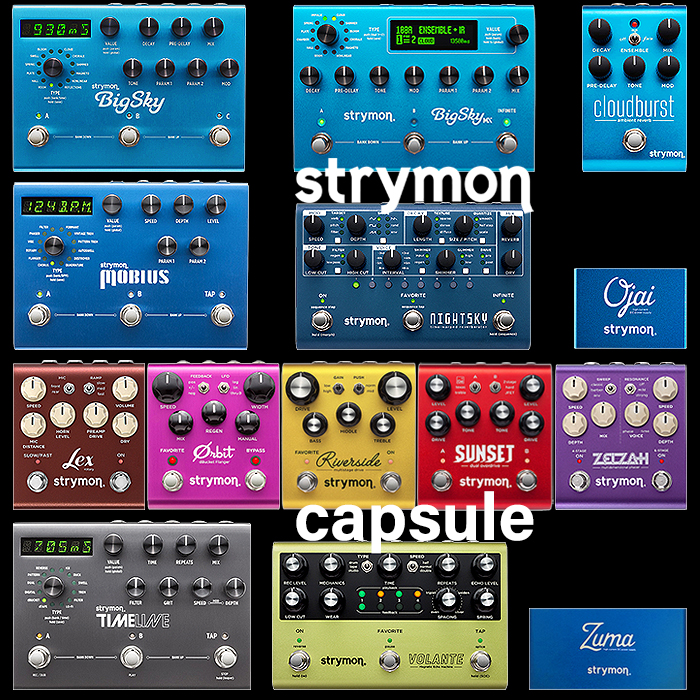
Strymon BigSky Multi Reverb - $479
Controls - Type : Room / Hall / Plate / Spring / Swell / Bloom / Cloud / Chorale / Shimmer / Magneto / NonLinear / Reflections, Value / Param / Global, Decay, Pre-Delay, Mix, Tone, Param 1, Param 2, Modulation, Footswitches A | B | C - Bank Down / Up.
The BigSky was my very first Big Box Reverb Workstation - and led a pretty hallowed existence for a while - until first Source Audio, and then Boss created their Dual-Reverb takes - allowing you to combine two Stereo Reverbs at the same time! As an innovator I obviously needed to follow the path of innovation and try out those new breeds of pedals, While I still really love everything that the BigSky delivered originally - those algorithms are pure class - and work instantly across both clean and supersaturated high gain inputs - you can flip between modes and inputs with zero penalties! There's a reason the BigSky is so beloved, and how it totally managed to overshadow the equally potent Eventide Space at that time. Like most I had some issues with the menu / display on the Big Sky - while most everything else was pretty satisfactory. And Strymon then went on to fix all the niggly bits of the BigSky - for its much improved BigSky - with better screen and control topology - and the addition of Dual-Reverb capabilities and Convolution Reverb IR-loading. Some people weirdly profess that the older algorithms are better than the newer more refined ones - while for me they're pretty much equally good - and overall the BIgSky MX is a massive upgrade over its predecessor.
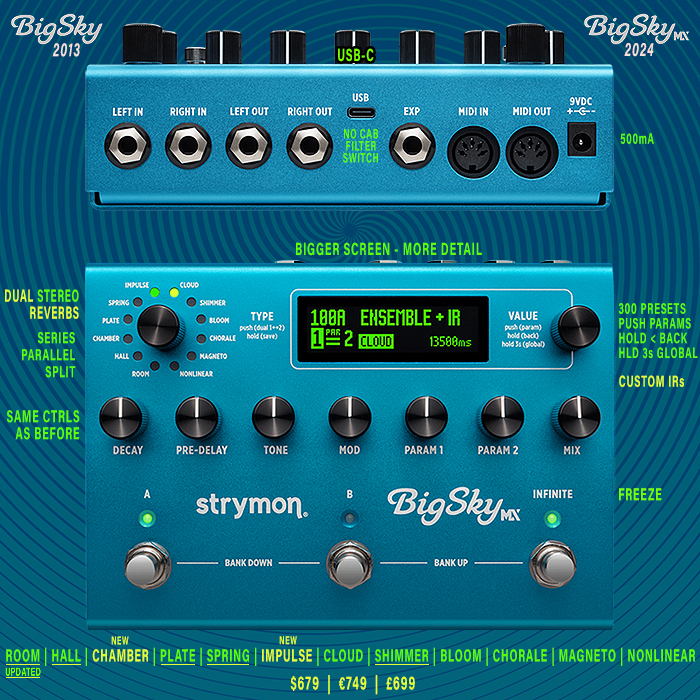
Strymon BigSky MX Multi Reverb - $679
Controls - Type (Dual) : Room / Hall / Chamber / Plate / Spring / Impulse / Cloud / Shimmer / Bloom / Chorale (Formant) / Magneto / Nonlinear (Swoosh / Reverse / Ramp / Gate / Gauss / Bounce), Value (Param / Back / Global), Decay, Pre-Delay, Tone, Mod, Param 1, Param 2, Mix, A - Bank Down - B - Bank Up - C (Infinite).
As just mentioned - this is an every-way upgrade from the original BigSky - which massively improves the Screen and Interface and adds the 'Impulse' Convolution Reverb option - where you can upload your own Reverb IRs. You also get the Dual-Reverb abilities that Source Audio and Boss pioneered nearly 10 years ago now. There are still some naysayers who say the original has better sounding algorithms - but that's not been my experience of the pedal - for me it's every way improved - and a much better and more potent reverb than its predecessor. There's a reason why this is my current Primary - its all-round prowess pretty much makes it the leading Reverb Workstation contender for me at this time. I do still want to check out the Hotone Verbera and Red Panda Context - while I feel I would return once more to this one at this time. I'm not along in saying it - but I think this one is the current frontrunner for best Reverb Workstation pedal currently out there - it mixes up all the different reverb essential the you might need in the one device - it properly delivers the maximum all-round Reverb fire power as fas as I'm concerned - while there is case to be made for several of the algorithms on my other favourites. The BigSky MX is the current best-fit-line - but it's not quite the effect still that I would like to see - I feel there's more innovation coming down the line - and within a year to two we will likely see another new champion!
Strymon Cloudburst Ambient Reverb - $279
Controls - Decay, (Strings) Ensemble : Off / Moderate (mezzo piano) / Strong (forte), Mix, Pre-Delay, Tone, Modulation.
This was the first of Strymon's Compact Editions -building on the strength of Strymon's 'Cloud' algorithm and editing a couple of more variations for more versatility. And what a fantastic debut it was - still by far and away the strongest of those editions - which for me have been a little bit a case of diminishing returns for each subsequent release - I don't really desire any of the Cloudburst's other later released siblings - while I had to have the Cloudburst - I guess I'm a Srymon Reverb fan! In any case I think they really knocked It out of the park for this release - which was so strong that the follow-ups heavenly really stood a chance! It's no replacement for one of the larger workstations - but as a fairly versatile Secondary Reverb - it's a great choice. Not quite as great as the Nucleo - but then again that is a slightly larger form factor!
Strymon NightSky Time-Warped Reverberator - $429
Controls - MOD } Speed, Target : Verb / Pitch / Filter, Depth, Shape : Triangle / Square / Ramp / Saw / Random / Envelope, DECAY} Length, Texture : Sparse (Granular), Dense (Plate), Diffuse (Wash), Size/Pitch, Quantize : Smooth / Half Step / Scale, MIX} Reverb, Dry, TONE} Low Cut, Filter : Regen / Low Pass, High Cut, VOICE} Interval : -8va > +8va, Shimmer : Input / Regen, Shimmer, Glimmer : High / Low, Drive : Pre / Post, Sequence Steps: 1-8, On / Sequence Step / Hold (morph) Footswitch, Favourite / Sequence Tap Footswitch, Infinite / Hold (Sequence).
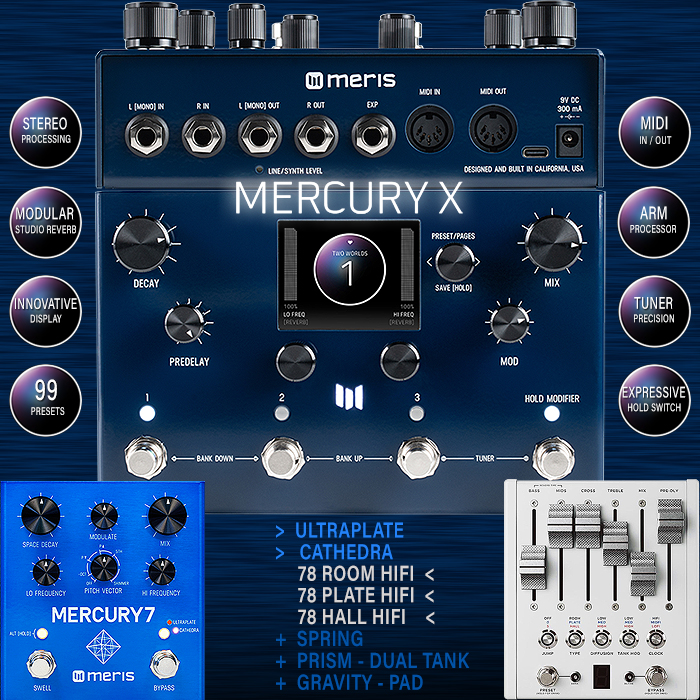
The NightSky is an interesting departure for Strymon - away from its typical Reverb Workstation roots. This one is more of a Sound Design Device or a Build-a-Verb type pedal - where you build up your core Reverb sound from a number of effects Building-Blocks / Modules. You can see the different segments individuated in the above Controls reference - where the Reverb Effect is kind of split into its component pars. This is one for he more experimental types and tweakers - it takes up too much time as far as I'm concerned - I feel there are more efficient ways to build up a reverb from basic components - it's something that none of those devices has fully cracked yet - be it this NightSky, Meris's Mercury X, or even Poly's Beebo, or Empress's Zoia. I find all those pedals a little clunky and long-winded. Pedal interface design / innovation is sill lagging far begin the bleeding edge of consumer electronics. We will get there eventually - while currently these sound-design pedals are really mostly just for one category of knob-tweakers - who enjoy doing these things through limited interfaces. You need a significant amount of patience to get the most out of the NightSky - including arpeggiating / sequencing the tales of the reverb. For the right sort of mentality - these devices are a godsend - but they do take up a lot of your time - and I guess I just don't fully have the patience for those menial tasks. I still really like the NightSky - it was my Primary for a while - and I kind of took it as far as I could - for sure I ended up with some very unique Reverb sounds - but it took way too much trial and error to get there! For some people this will be the perfect set of reverb building blocks - but for most everyone else you're better off with a Reverb Worksation!
Walrus Audio Slötvå Multi Texture Reverb - with Presets [discontinued] - $229
Controls - Decay, Filter, Mix, X Variables, Modes : Dark / Sine, Rise / Warp, Dream / Sink, Depth, Bypass Footswitch, Sustain Footswitch, Quick Press Both to scroll through 3 Presets, Long Press = Save!
This one is actually very recently landed - in fact just ahead of the Cornerstone Nucleo. I had long intended to to get one of these Slötvå's - but I waited until it was discontinued. I lucked out in any case and picked up a Mint (Near Mint!) example from Ebay - and got it for a reasonable price. It was part of the last sweep ahead of the Walrus Audio Capsule Collection post - where I always try to seek out long-term-target bargains - and there were a few to be had at that time. It's a cool effect for sure - but firmly in the Tertiary Reverb category on account of its Mono nature. There is now a stereo version of the Slö - but that's a much larger enclosure - which doesn't really suit my sensibilities. This one is a little bit of a short-lived oddity - which made I the version that I wanted the most. It won't get a lot of use necessarily but it's a cool exhibit nevertheless - and I'm glad I have one for my Walrus Capsule Collection. As I keep mentioning - I generally have a massive preference for Stereo Spatial Effects - to anything which doesn't output in stereo - ends up being somewhat Secondary - or in fact Tertiary on that scale. As per my list there are a few Tertiary Mono effects there - so this one is in good company. I tend to treat theses as sustaining or texture events - and when deployed it's mostly in conjunction with other effects! Still a really cool variant - particular in the Slötvå edition!