

Xploration • Curation • Recommendation


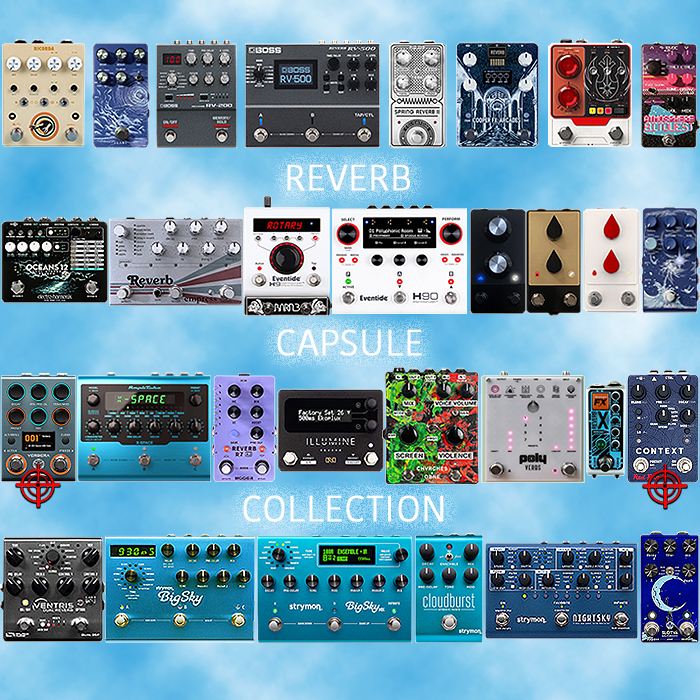
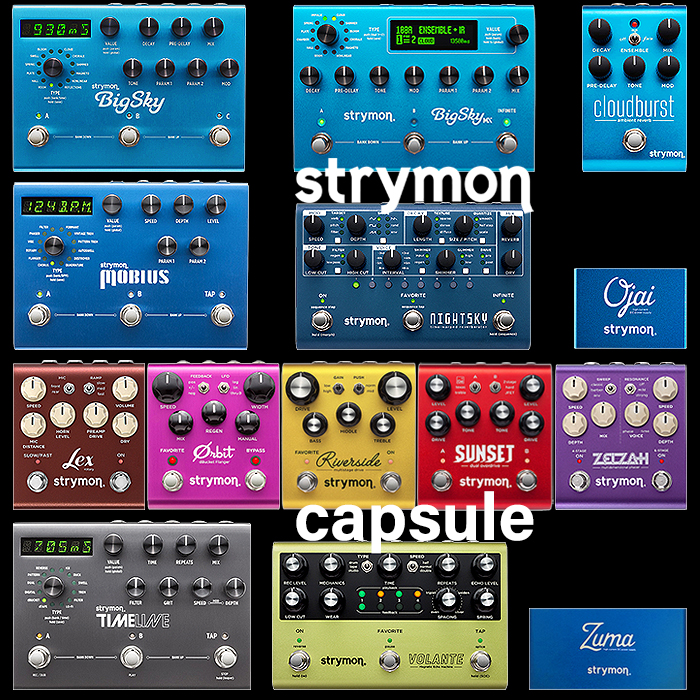
2025 Strymon Capsule Collection


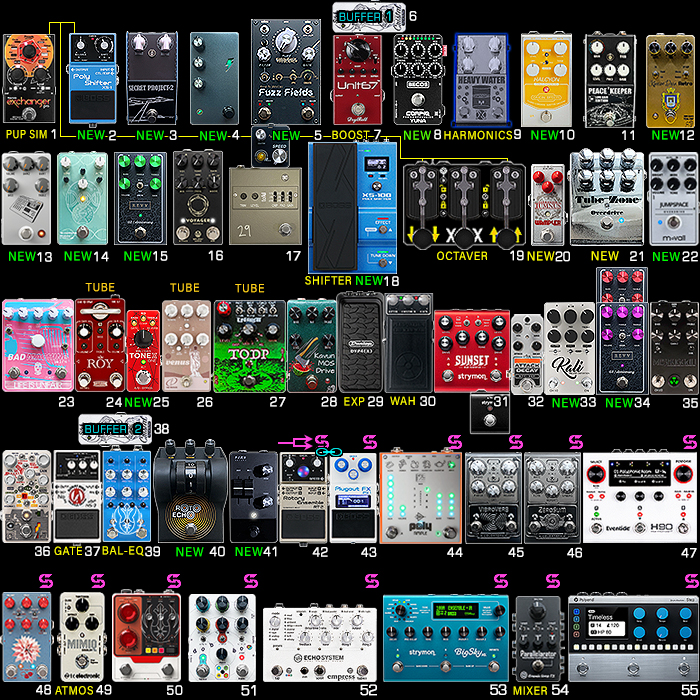
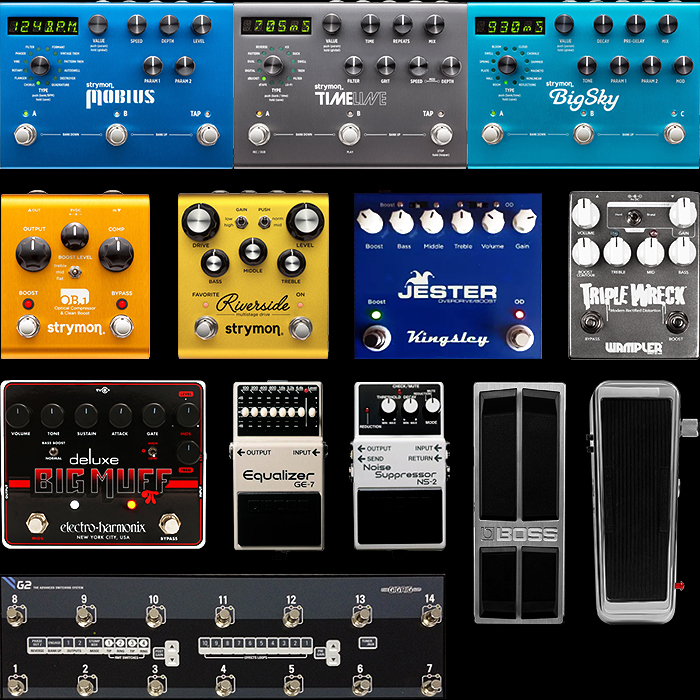
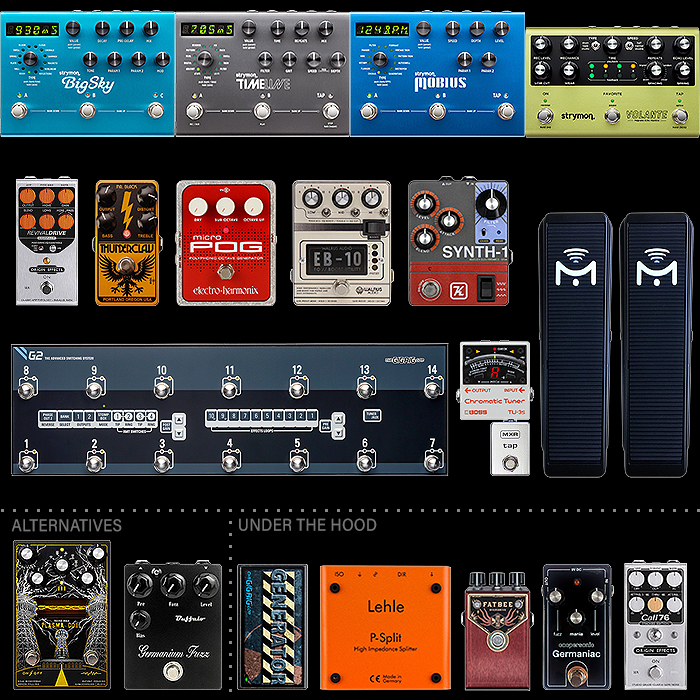
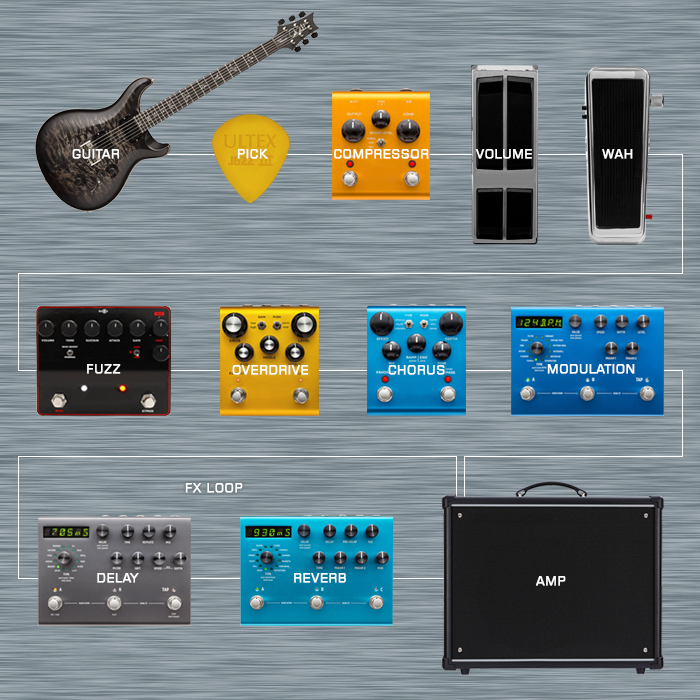
My Strymon journey started in December of 2016 - of course with the ’Stryfecta’ of BigSky, Mobius, and TimeLine. That was my first foray into Strymon, as well as the first of my Workstation pedal types - where I’ve favoured Stereo BIG-BOX solutions for Modulation, Delay and Reverb ever since. You can see the Stryfecta was a very significant part of my first official pedal-chain arrangement - first shared in April of 2017 - as below!
Those who have followed me for some years will immediately pick out the Riverside and Sunset pedals in the above arrangement too. Those are two of my most used pedals of all time, and therefore my most used of my Strymon pedals.
Both of those are indeed mostly deployed as auxilliary Boosts - as tone components and tone-enhancers - for pedals both upstream as well as downstream from their positions. Right at this moment the Riverside is on hiatus - as I use that slot also for 29 brand Pedals - which are a similar square format - and the TOKI Fuzz is currently on that slot. No doubt the Riverside will be back on duty again very soon - in fact probably at the end of this month!
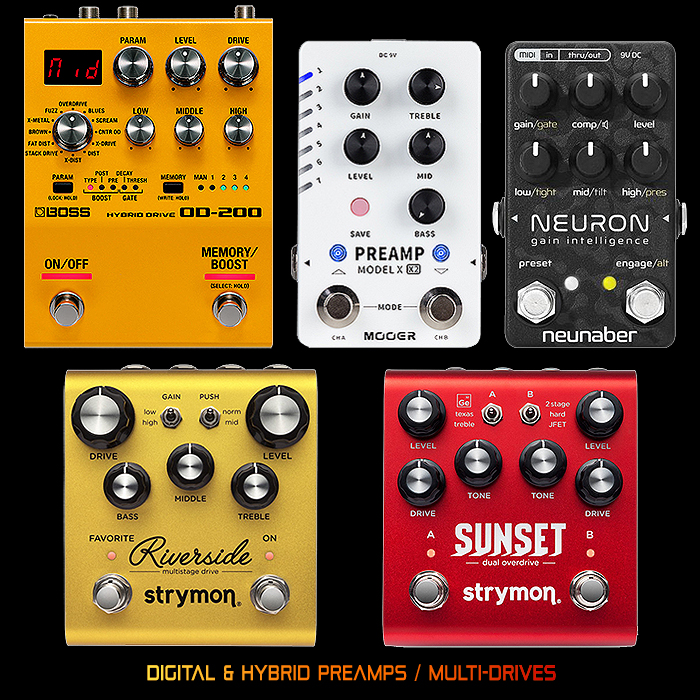
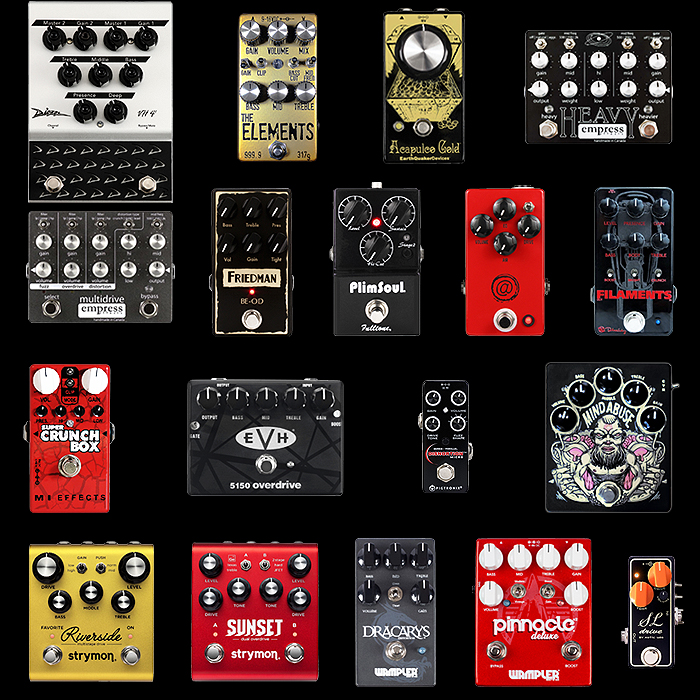
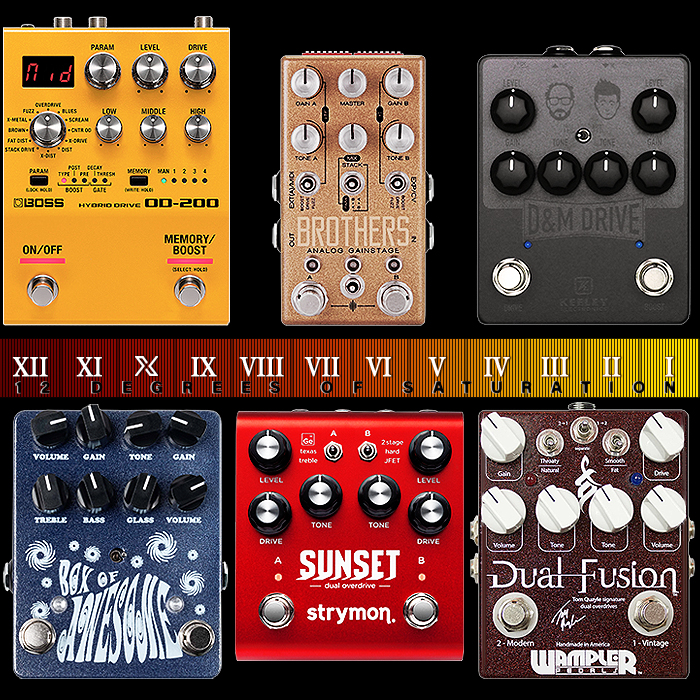
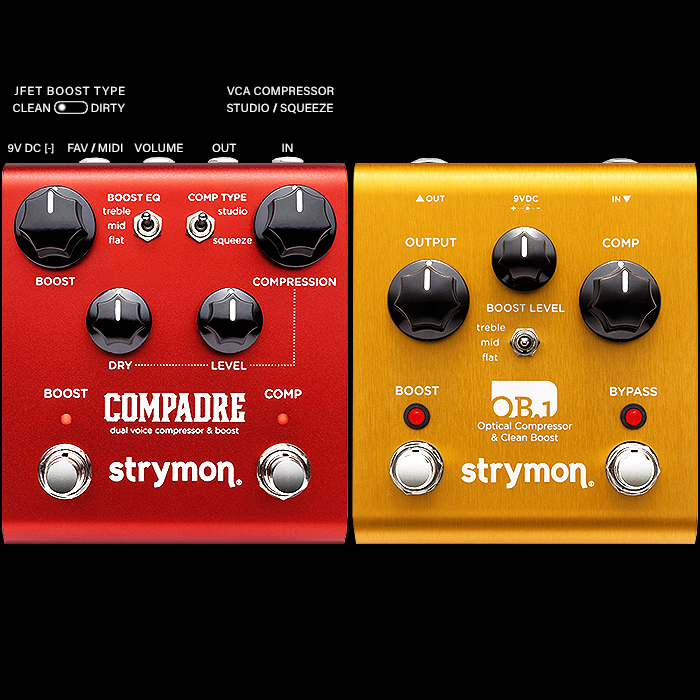
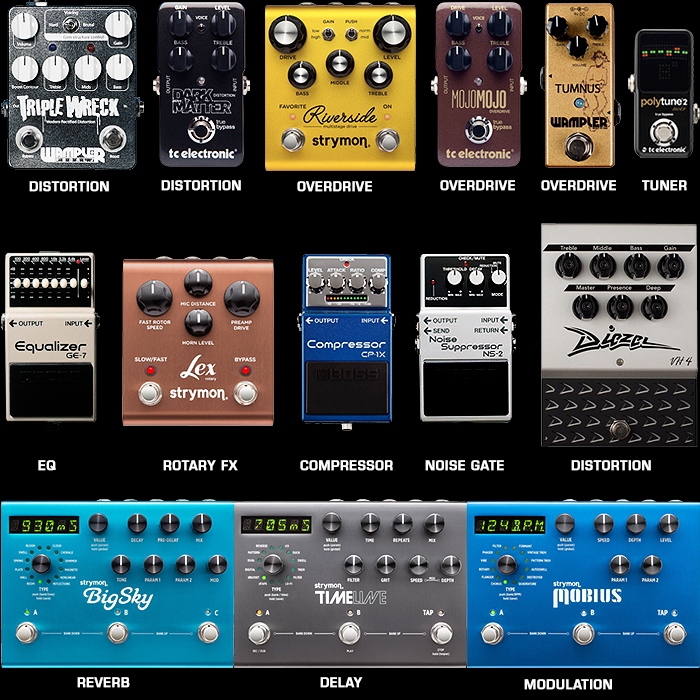
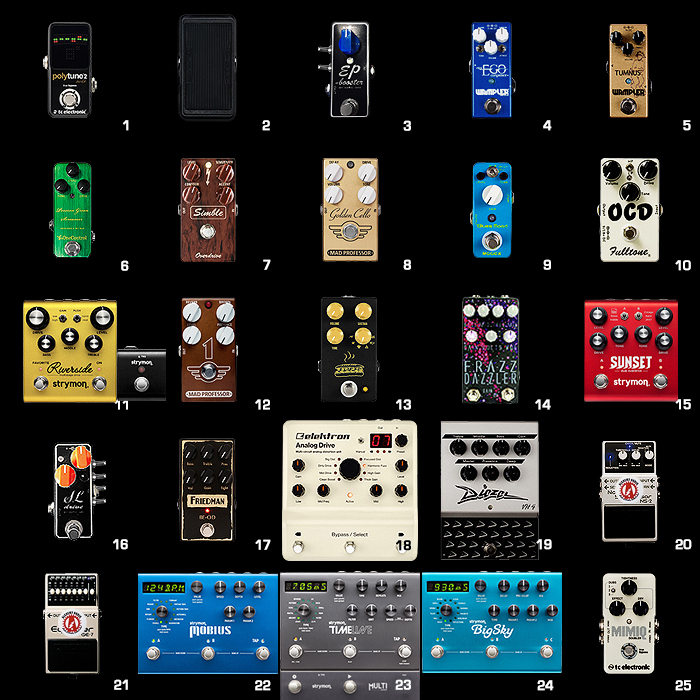
I did a piece in 2022 on how I use Digital / Hybrid drive pedals in my rig - which of course featured my 2 favourites - as above along with a few more examples - while those others have barely gotten a look in - in comparison to shoe Strymons. I adapted to both of them really quickly - and they are mostly used as stacking and boosting pedals - where for the Sunset is 99% se to the two boosts - and in particular the Treble Booster Mode - which seems to improve almost anything. And when that doesn't wok - then the clean boost mode is the solution. The Sunset is one of 2 dual-boosts that I regularly deploy - while my Heavy Water is the always-on precursors to that!
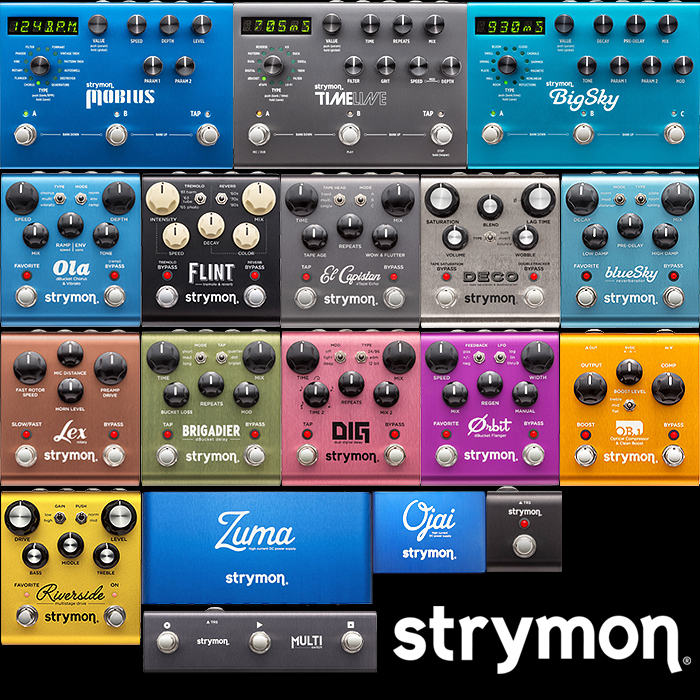
I did the above visualized article back in 2016 - just shortly after I had acquired my Stryfecta - I was super impressed with that brand at that time - and it's legacy has carried my right through to the present time - where my latest new Strymon acquisition was the BigSky MX - which has been on the board since September of last year, while my latest overall addition is a second-hand pristine Orbit dBucket Flanger - which I always wanted - and included in this latest sweep! The above visual just precedes the Sunset - which came out in the following year - 2017!
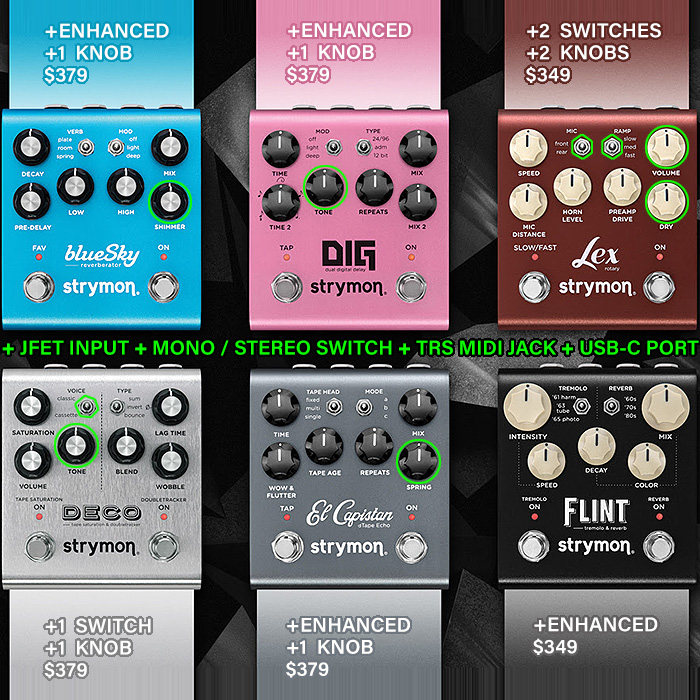
I daresay there are a few more in my path here - probably the Deco and El Capistan - and possibly even a BlueSky, Dig and Flint - while I really have plenty already.
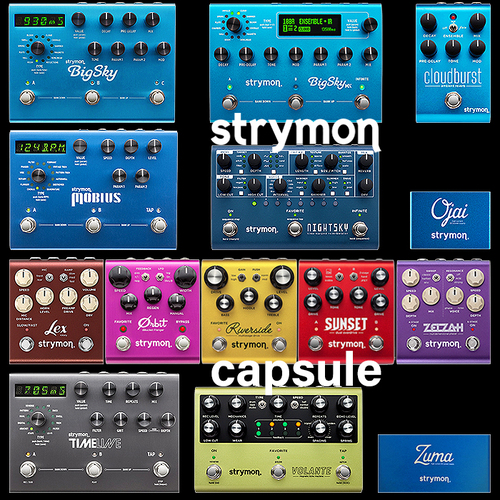
My current Strymon selection consists of these following 14 devices - which also include the Ojai and Zuma power supplies that I have made such good use of over the years! :
- BigSky Multi Reverb - $479
- BigSky MX Multi Reverb - $679
- Cloudburst Ambient Reverb - $279
- Lex V2 Rotary Modulation - $349
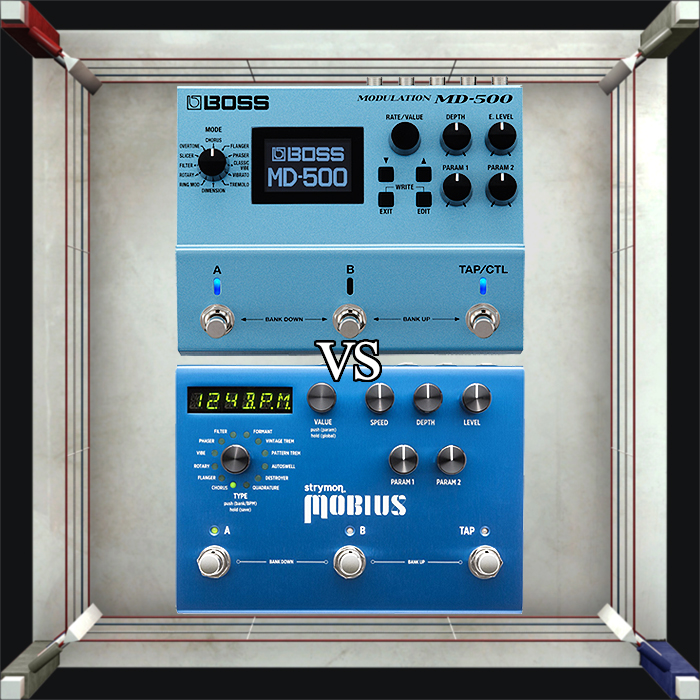
- Mobius Multi Modulation - $449
- NightSky Experimental Reverb - $429
- Ojai 5 Isolated Outlet Power Supply - $169
- Orbit dBucket Flanger [discontinued] - $299 when new!
- Riverside Drive & Distortion - $299
- Sunset Dual Overdrive - $299
- TimeLine Multi Delay - $449
- Volante Magnetic Tape Delay - $429
- Zelzah Phaser & Modulation - $349
- Zuma 9 Isolated Outlet Power Supply - $279
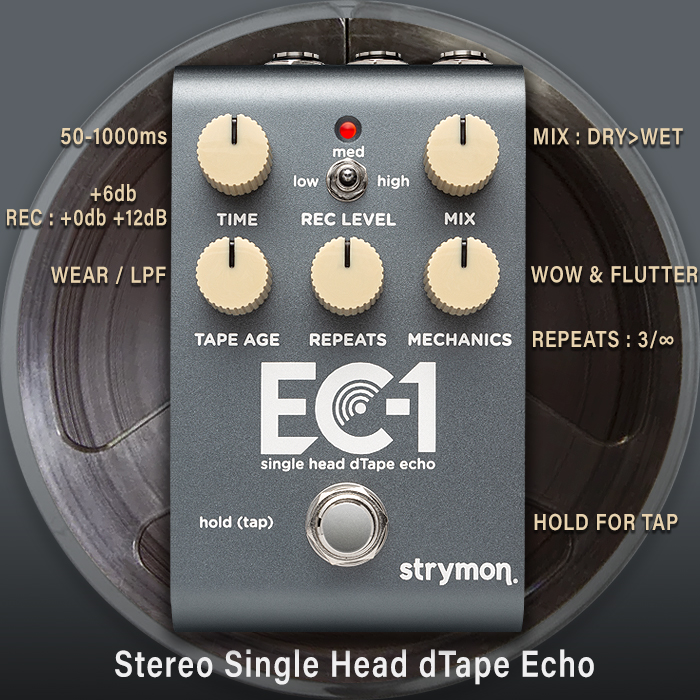
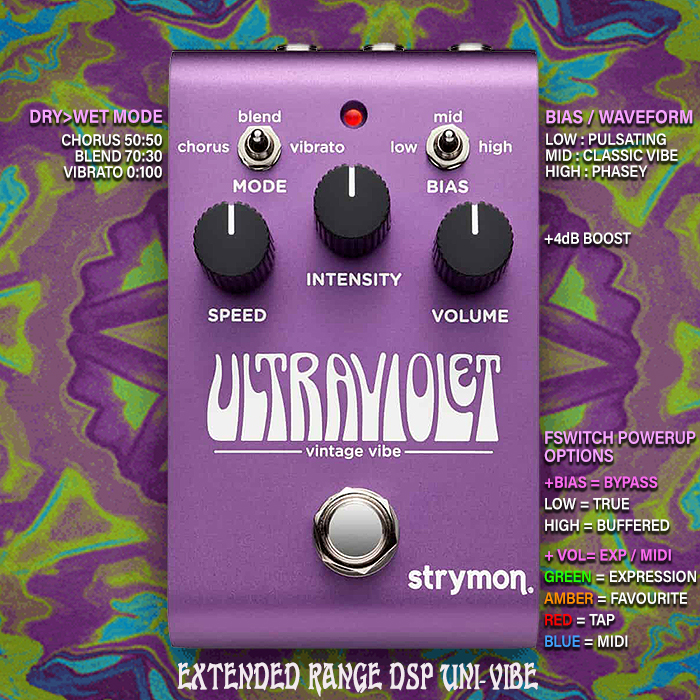
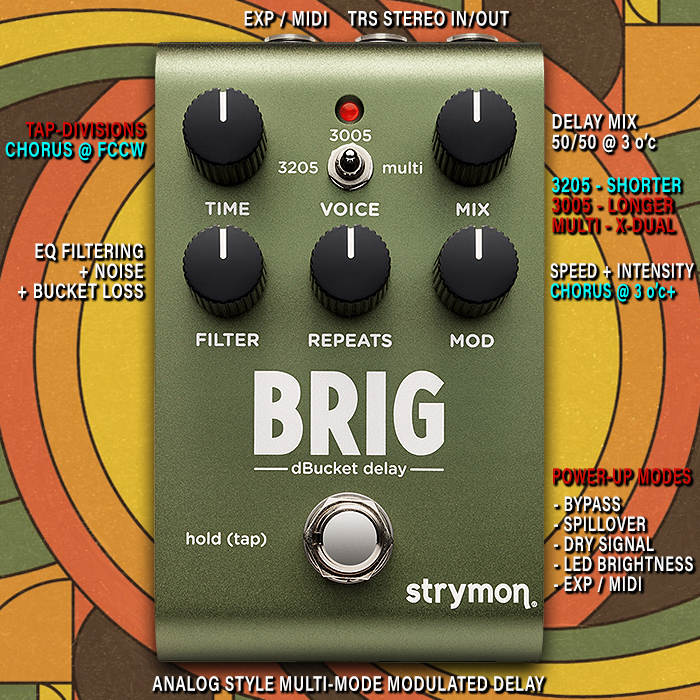
For the compact editions it's been a case of diminishing returns for me - the Cloudburst is amazing - while I've not really fancied the follow-up Brig and EC-1 delays or the Ultraviolet Vibe. I have an inkling that we might get a Chorus iin that range next - which I will likely sweep up - in every other way I think I'm pretty rounded here already for all the main food groups!
Note that the pedal order in the main visual has been adjusted for visual symmetry!
Here follow the individual details - as always! :
BigSky Multi Reverb - $479
Controls - Type : Room / Hall / Plate / Spring / Swell / Bloom / Cloud / Chorale / Shimmer / Magneto / NonLinear / Reflections, Value / Param / Global, Decay, Pre-Delay, Mix, Tone, Param 1, Param 2, Modulation, Footswitches A | B | C - Bank Down / Up.
My very first Reverb Workstation and of course a key part of my original Stryfecta - this pedal pretty much charted the future of this class of effect and many still prefer it to the more recent BigSky MX upgrade - citing that some of those older algorithms have more nuances to them!
While I appreciate all the additional features in the new device. I recently covered off all my Reverb pedals and the Strymon ones have for sure left an indelible impact - so many legendary algorithms - it managed to entirely overshadow Eventide's Space Reverb - which is an incredibly device in its own right. While the overall package and quality of algorithms meant that the BigSky is the most impactful of the Reverb Workstations to date - still a fantastic device in its original incarnation - even though some of the menu diving is a little clunky and the screen needing to be a little bigger and clearer which definitely happened for the MX Upgrade.
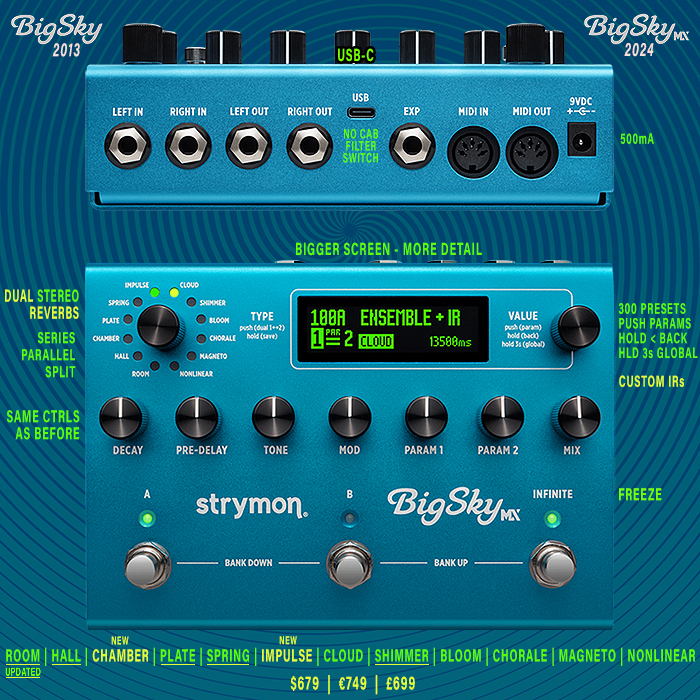
BigSky MX Multi Reverb - $679
Controls - Type (Dual) : Room / Hall / Chamber / Plate / Spring / Impulse / Cloud / Shimmer / Bloom / Chorale (Formant) / Magneto / Nonlinear (Swoosh / Reverse / Ramp / Gate / Gauss / Bounce), Value (Param / Back / Global), Decay, Pre-Delay, Tone, Mod, Param 1, Param 2, Mix, A - Bank Down - B - Bank Up - C (Infinite).
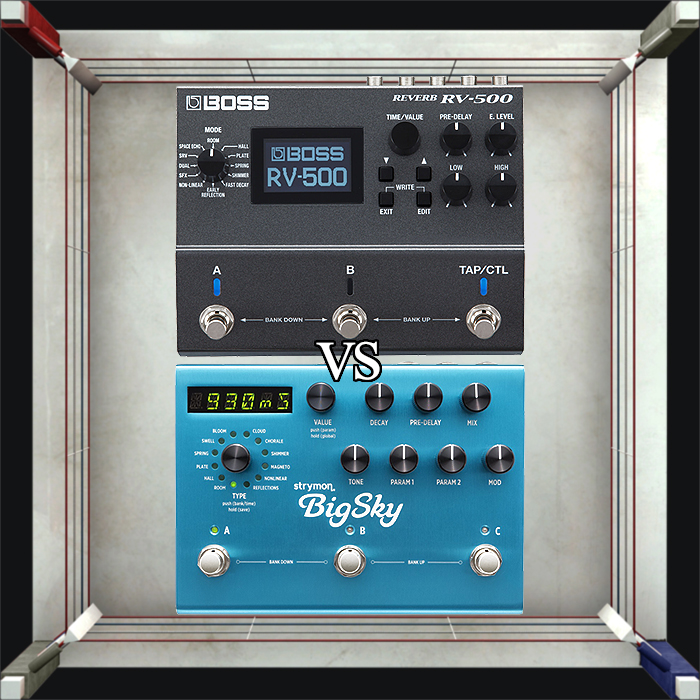
The upgraded and updated BigSky tackled near enough all the flaws and challenges of the original - giving it a better control interface and bigger more legible screen, refining the algorithms and adding an IR-Loader Convolution Reverb - as well as giving you 2 Algorithms at a time - which is the reasons I moved on from the original device to first the Source Audio Ventris, then Boss RV-500, and EHX Oceans 12 - all those benefited from dual simultaneous effects, In fact the Boss RV-500 gave you 4 simultaneous effects - 2 Reverbs, each with their own settings for Delay - so 2 x Reverb + Delay!
Some of my friends have said that the newer refined algorithms aren't as good as the older ones in some ways - while for me - everything on the BigSky MX is a very decent improvement over the original BigSky - and a very worthy successor - as mentioned, the BigSky MX has been on the board for nearly a year now (since September of last year - 2024).
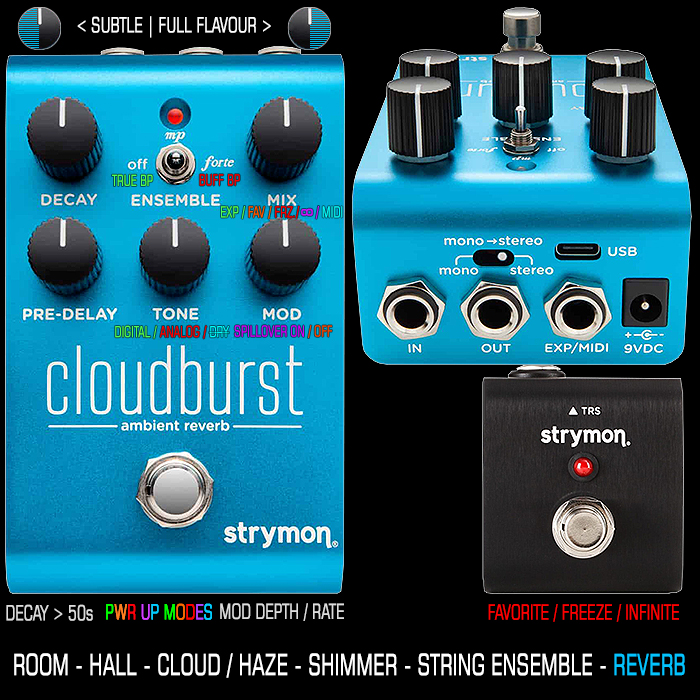
Cloudburst Ambient Reverb - $279Controls - Decay, (Strings) Ensemble : Off / Moderate (mezzo piano) / Strong (forte), Mix, Pre-Delay, Tone, Modulation.
Controls - Decay, (Strings) Ensemble : Off / Moderate (mezzo piano) / Strong (forte), Mix, Pre-Delay, Tone, Modulation.
This is essentially a 2-voice Reverb - Cloud and +Ensemble (Shimmer) - but with so many variations besides - particularly when working the Mix, Tone and Modulation controls. You can get such a broad palette of different styles of reverb through the careful manipulation of those dials - it's a really clever design of reverb - whose small form belies its expansive nature. Obviously it can't hold a candle to the BigSky types - but for a compact pedal it's something of a wonder. The follow-ups from that series did not seem anywhere near as magical!
Mobius Multi Modulation - $449
Controls - Type [Push for Bank / BPM, Hold to Save] : Chorus / Flanger / Rotary, Vibe / Phaser / Filter / Formant / Vintage Trem / Pattern Trem / Autoswell / Destroyer / Quadrature, Value [Push Param / Hold Global], Speed, Depth, Level, Param 1, Param 2, Footswitch A, Footswitch B, A+B = Bank Down, Tap Footswitch, B + Tap = Bank Up.
My original BIG-BOX multi-modulator is on an even keel with the Boss MD-500 - each of them has some distinct / stronger modulation flavours - but they're largely equally potent - and depending on which Modulations I really wanted to use I might use one over the others - while has all-in one solutions both are very decent. The Wampler Terraform still has my overall favourite mix of Modulation algorithms - but it doesn't have it all its way as the Mobious and MD-500 are better on some of those modes - I really like all 3 - and those are fairly interchangeable for me in most ways - just depending which elements I want to lean into the most - say Format on this Mobius - or the Dimension Chorus on either the MD-500 or Terraform.
More recently the Eventide H90, and Walrus Audio MAKO [M1] have taken up some of those duties - but the Mobius still gets a spin every now and again and I still really like it. Some times those devices are switched out just because a new one has materialised - and that then stays on the board until the next one arrives etc. - so just because one gets swapped out - it doesn't mean it's inferior. The Mobius is still pretty good value all-round!
NightSky Experimental Reverb - $429
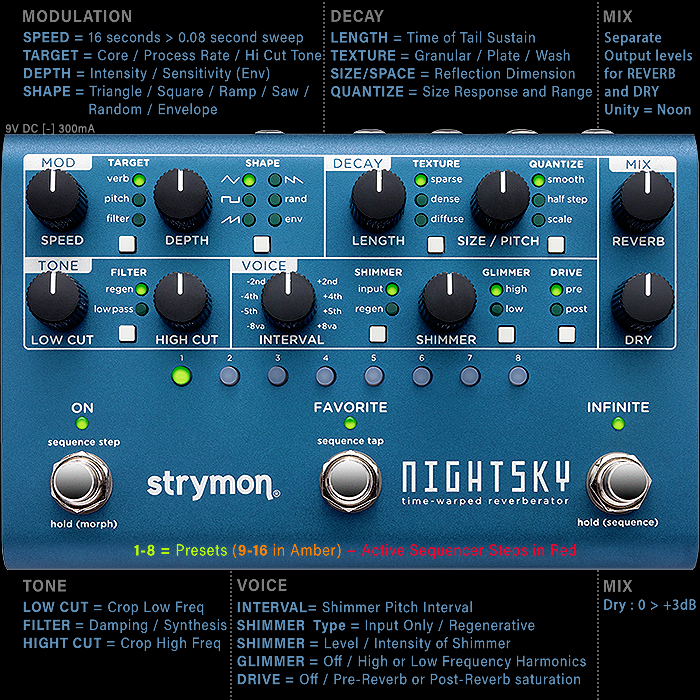
Controls - MOD } Speed, Target : Verb / Pitch / Filter, Depth, Shape : Triangle / Square / Ramp / Saw / Random / Envelope, DECAY} Length, Texture : Sparse (Granular), Dense (Plate), Diffuse (Wash), Size/Pitch, Quantize : Smooth / Half Step / Scale, MIX} Reverb, Dry, TONE} Low Cut, Filter : Regen / Low Pass, High Cut, VOICE} Interval : -8va > +8va, Shimmer : Input / Regen, Shimmer, Glimmer : High / Low, Drive : Pre / Post, Sequence Steps: 1-8, On / Sequence Step / Hold (morph) Footswitch, Favourite / Sequence Tap Footswitch, Infinite / Hold (Sequence).
This is an amazing Reverb Sound Design Tool - a sort of 'Build A Reverb in Sections' device - where you combine different functional blocks / sections to deliver your own style of Reverb - with a little Modulation, Pitch-Shifing and Shimmer on top say. Where you can also sequence your Reverb tail in 8 steps - if that's your thing!
Where this device is definitely not for everyone - and requires a particular mindset to deliver the very best results - in a similar way to the Meris LVX and Mercury X - which are very much Sound Design devices too. There are lots of complexities with the NightSky - where you have several secondary settings to get to grips with also. I quite like it in parts - but feel there must be a more intuitive way (with less secondary options) to deliver the same kind of device. How compatible a device is - depends not on its ultimate potential and potency - but on how well you gel with it, and figure out how best to deploy it. The NightSky is definitely a bit specialist - perfect in the hands of someone like Cohen Hartman - but not necessarily the average reverb enthusiast - where they would probably be better served by something like the Cornerstone Nucleo - which does a lot, but has a somewhat more linear and intuitive overall experience!
Ojai 5 Isolated Outlet Power Supply - $169
Potency - 5 x 9V Outlets @ 500mA.
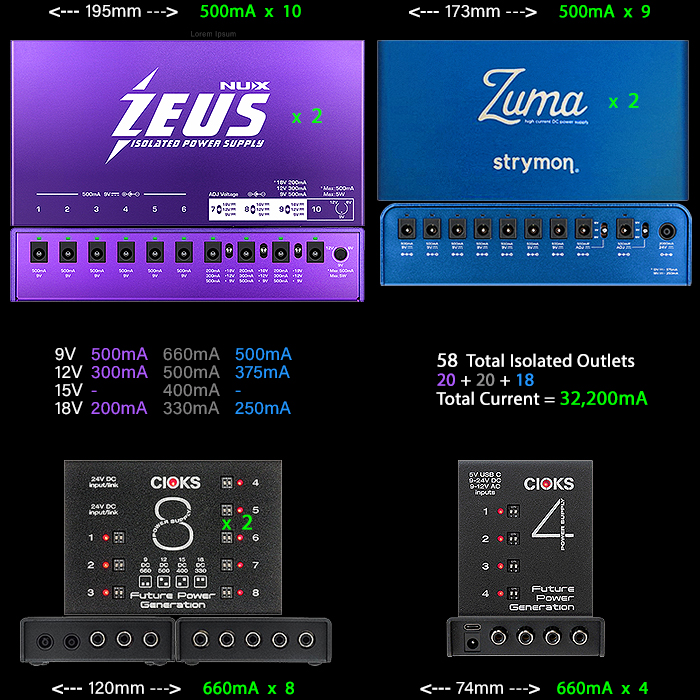
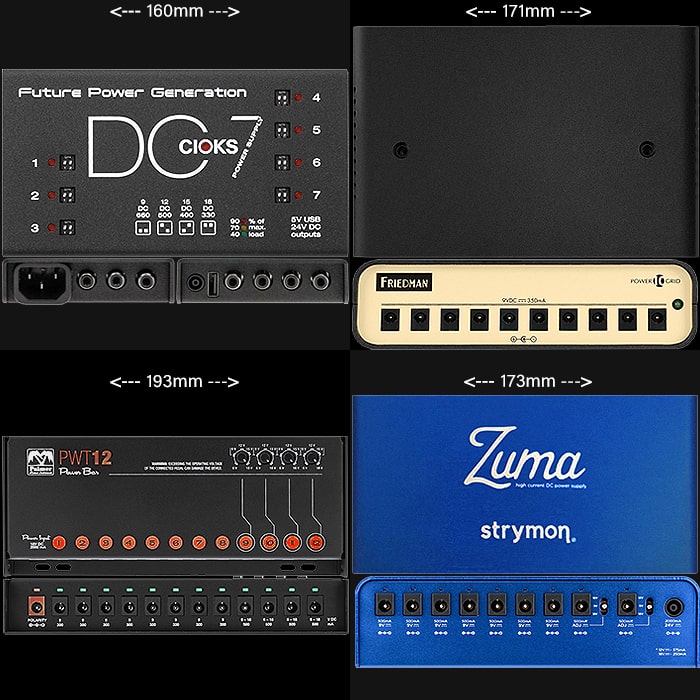
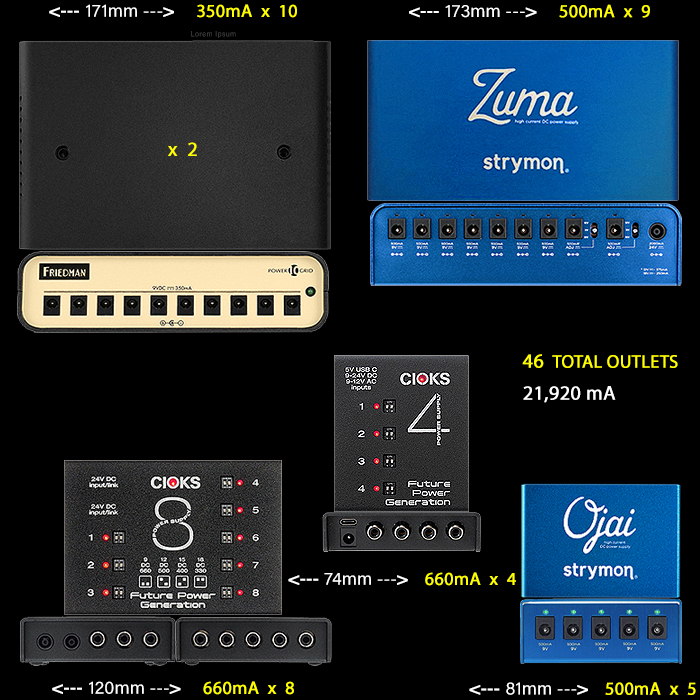
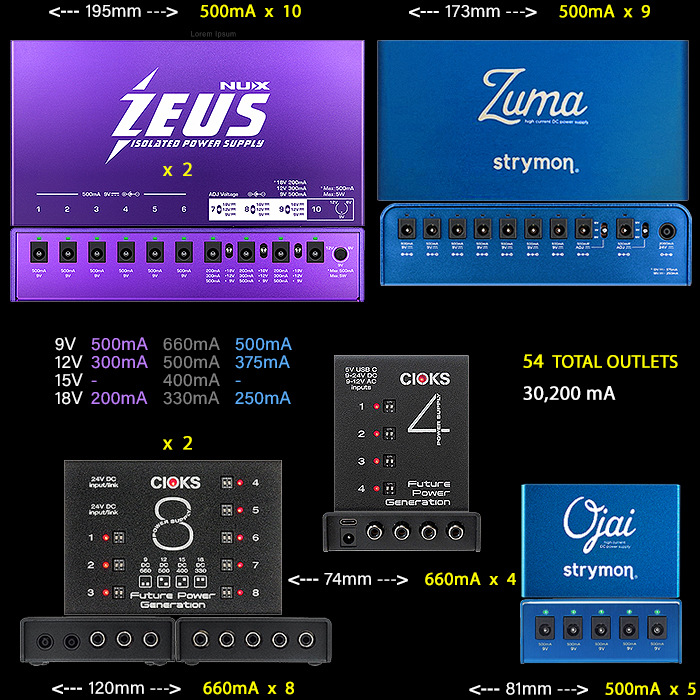
The Ojai has been a pretty good servant to me over the years - neat and reliable - but only 5 fixed outlets - where I recently replaced it with a second Zuma - as I really needed the extra outputs for my ever more complicated rig, The signal clarity was starting to get impacted - and so I kind of doubled-down on the strength of that device - to bring it back up to 'pristine ' which the change to Zuma helpsd with - also the 2 Friedman Power Grid sap-outs for the NUX Zeus. So really it was just the organic growth of some parts of the rig - which necessitated more outlets - with more variability (9V / 12V / 18V) for which the Zuma is actually brilliant. Not that the Ojai has an inline transform on the power chord - versus having one in the device - like on the Zuma! For simple rigs the Ojai is perfect - not really for the size of task for my pedal-chain - which is indeed back to sounding pristine after the latest changes. I can still connect the Ojai to one of the Zumas I - think - so nice to have that in reserve - for just in case!
Lex V2 Rotary Modulation - $349
Controls - Speed, Mic : Front / Rear, Ramp : Slow / Med / Fast, Volume, Mic Distance. Horn Level, Preamp Drive, Dry, Slow/Fast Footswitch, On/Bypass Footswitch.
The Lex is my first referenced square-box Strymon - while actually the fourth added to the collection. First of that series for me was the Riverside, then the Sunset, then the Zelzah, Lex, and finally the Orbit was just acquired recently - in fact so recently that it hasn't quit landed yet. The Lex used to be my favourite Rotary Speaker effect, but latterly has been edged out by the new Boss RT-2 Rotary Ensemble which I prefer. I also really like the Tech 21 NYX Roto Choir - while the RT-2 is just the perfect variant for me. For the Lex to match up to that - it needs to be more syrupy and flavourful - with just a touch more volume above unity! I still really like the Lex - it sounds pretty great - but I rather prefer the Boss RT-2 one - there's no question that the Lex V2 is a super smart device - the RT-2 just sound more like a Hammon / Barrel Organ style effect to me - it's richer in texture and capable of going quite a bit louder than the Lex!
Orbit dBucket Flanger [discontinued] - $299 when new!
Controls - Speed, Feedback : Positive +/- Negative, LFO : Logarithmic / Linear / Thru-0, Width, Mix, Regen, Manual, Favourite Footswitch, Bypass Footswitch.
I tend to favour Flangers - it's one of my favourite modulation favours for sure - and I've had one eye on this Strymon Orbit for the longest time - but only pulled the trigger on this recent rundown sweep of these Strymon effects of mine - where I was determined to add at least one more worthy one into the mix. This analog BBD style emulation flanger is one of the great digital emulations - I've liked it for a while, but just never got to the final stage until now - where I secured a fairly pristine second-hand unit. Those usually mean I need to remove velcro from those kinds of pedals - but they're mostly very well looked after. I saw one going for very reasonable money - and therefore pounced - even though the Mobius has a great flanger onboard - actually so does the Zelzah Phaser - its' one of is hidden tangents. That said several people have recommended this to me over the years - and this is me putting some faith into that advocacy!
Riverside Drive & Distortion - $299
Controls - Drive, Gain : Low / High, Push : Normal / Mid, Level, Bass, Middle, Treble, Favourite Footswitch, On Footswitch.
The Riverside was the first of my Journeymen / Workhorse pedals - where it mostly sits on Booster duties - while also delivering a subtle warm classic overdrive, or a fairly blistering 80's style singing metal lead style distortion on occasion. So it's incredibly versatile! It also yields its place on occasion to other square format devices - particularly from 29 Pedals - where h the TOKI Fuzz is currently residing on that slot - but where the Riverside will be returning to its prime slot real soon! It's never off the board for very long!
Sunset Dual Overdrive - $299
Controls - Level A, Drive A, Tone A, A Voicings : Ge (Klon) / Texas (SRV TS808) / Treble (JFET Treble Booster), B Voicings : 2Stage (Direct Drive / Dumble) / Hard (DS-1 / Rat / Dist+), JFET (Clean Boost / Soft OD), Level B, Drive B, Tone B, A Footswitch, B Footswitch.
An absolutely essential pedal for me - where I mostly use it for its 2 Boost Modes - for tone enhancing and increased headroom and volume purposes - Treble Booster on the left footswitch, and Clean Booster on the right footswitch. If one of those won't make your up-stream pedals sound better - the other one does! I use this right across all my gain and modulation pedals - to hep accentuate different parts of the signal. The Sunset is a perfect dual boost for me - much like the ThorpyFX Heavy Water is at the start of the chain Those two dual-boosts are always in the chain!
Of course I occasionally use it for its other more straight-up drive and distortion modes - but most of the times this is my second essential dual-boost!
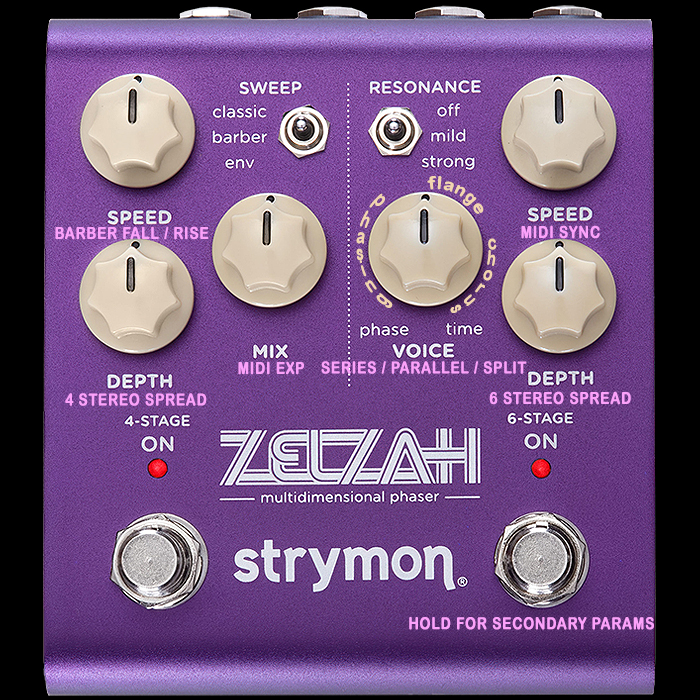
Zelzah Phaser & Modulation - $349
Controls - Speed [Barber Fall / Rise], Sweep : Classic / Barber / Envelope, Resonance : Off / Mild / Strong, Speed [MIDI Sync], Depth [4-Stage Stereo Spread], MIX [MIDI Expression], Voice : Phasing > Flanging > Chorusing [Routing : Series / Parallel / Split, Depth [6-Stage Stereo Spread], 4-Stage On Footswitch, 6 Stage On Footswitch.
This is an incredible Multi-Modulator way beyond its Phaser roots - where those two 6 and 8 stage channels together deliver compelling flavours of Flanging, Chorusing, Rotary, Tremolo and Vibe even with all kinds of cool nuanced in-between sounds. This pedal also has the really cool Barber Pole / Shaperd Effect onboard. In having this I don't really need the Orbit - as the Zelzah already delivers an amazing Flanger style voicing - while it's nice to have a specific and dedicated pedal too. This Zelzah is such a versatile Modulator - it' kind of a 6 or 7-in-1!
TimeLine Multi Delay - $449
Controls - Type [Push for Bank / BPM, Hold to Save] : dTape / dBucket / Digital / Dual / Pattern / Reverse / Ice / Duck / Swell / Trem / Filter / Lo-Fi, Value [Push Param / Hold Global], Time, Repeats, Mix, Filter, Grit, Mod Speed, Mod Depth, Footswitch A / Rec / Dub, Footswitch B / Play, A+B = Bank Down, Tap Footswitch / Stop [Hold for Looper], B+Tap = Bank Up.
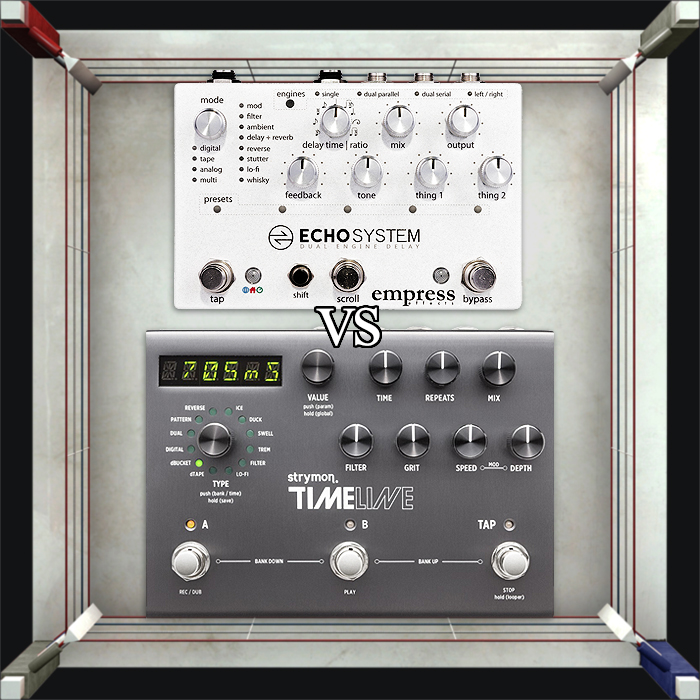
The TimeLine is the third and totally vital part of the Stryfecta. I always have a Delay and Reverb active at all times - while Modulations are more selective and incidental. So the critical path of the Stryfecta was always going to the Delay alongside the Reverb. Like the BigSky - the Algorithm here are killer - with a great Tape-style Delay, and quite superb crystalline 'Ice' Mode - which is my favourite of the textured modes here - while day-to-day I'm mostly on the dTape, dBucket, Pattern and Lo-Fi Modes. There are some great individual modes here - while overall the BigSky is probably just a fraction stronger, and latterly the TimeLine came to be mostly replaced by the superb Empress EchoSystem - which allows you to double up effects for even more impact. I know a lot of people still favour the TimeLine - while for me - the best of those Multi-Delay units is probably still the EchoSystem - it's he one that is currently active as my principal delay!
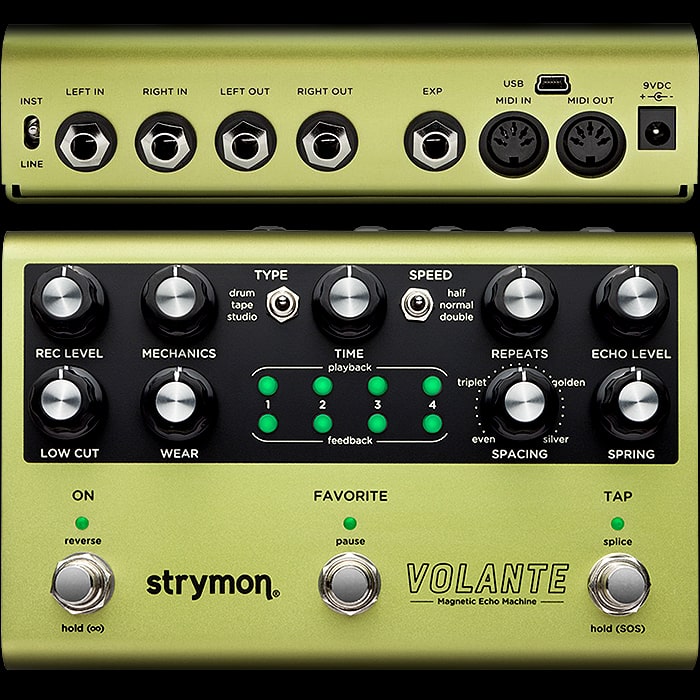
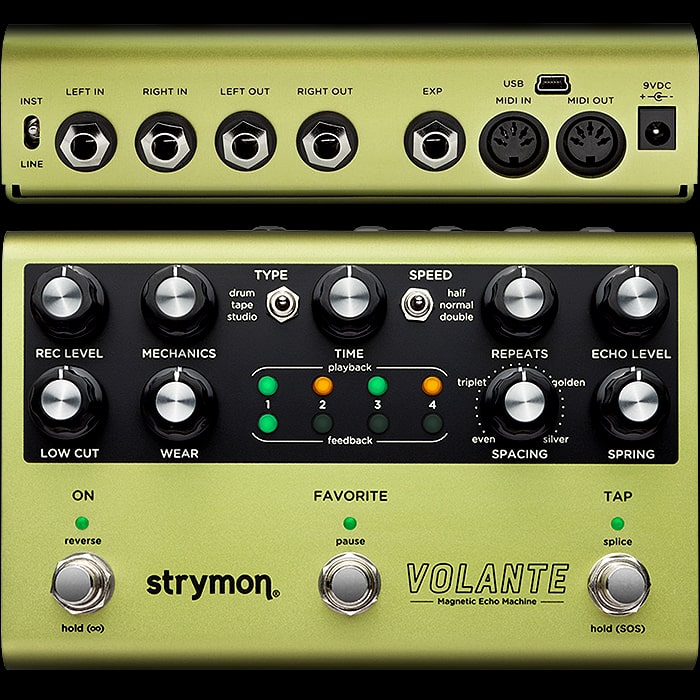
Volante Magnetic Tape Delay - $429
Controls - Record Level, Mechanics, Low Cut, Wear (Age), Type : Drum / Tape / Studio, Time, Playback & Feedback Select : 1-4, Repeats, Echo Level, Spacing : Even > Triplet > Golden > Silver, Spring, On Footswitch / Reverse / Hold for '∞', Favourite Footswitch / Pause, Tap Footswitch / Spice / Hold for Sound-on-Sound.
A superb combination Magnetic / Multi-Head Tape Delay device - which covers Echorec, Echoplex and Space Echo varieties and more - with a particularly smart push-button Playback / Feedback selection - across the 4 Record/Playback head mechanic as well a a unique Spacing control, This is beautiful sounding but at times a relatively subtle affair - where the Preamp-assisted Boss RE-201 Space Echo sounds somewhat moe expressive for me - with a somewhat fatter and juicier output. I also really rate Boss's DM-101 - that sounds amazing to me too - but is only a MISO construction currently - with stereo solely on the output side. The DM 101 is amazing but really needs to be full stereo to get back on the board. The Volante could do with a bit more flavour and intensity really - but it's still very decent and favoured by many a celebrated guitarist - while I kind of prefer the more recent Boss BIG-BOX Boss Space Echo! for those kind of sounds - the Volante is still highly commendable and still gets an outing on the board every now and again!
Zuma 9 Isolated Outlet Power Supply - $279
Potency : 7 x 9V Outlets @ 500mA, 2 x 9V / 12V / 18V Outlets @ 500mA / 375mA / 250mA.Zuma 9 Isolated Outlet Power Supply - $279
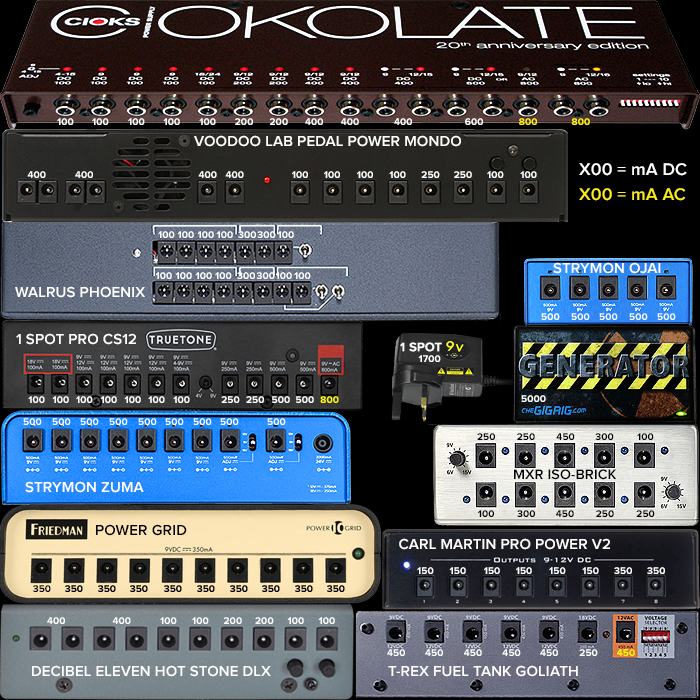
A really solid and dependable power-supply for me for a number of years now - I have two of those deployed on the board currently, alongside 2 x NUX Zeus types, and 3 x Cioks ones - those 3 brands are at the top of the power supplyy game really - with Cioks being overall the most technically proficient and versatile.The new NUX Zeus has also overshadowed the Zuma a little bit - with one further outlet, and variability across 4 of its outlets, versus just 2 on the Zuma - al three mentioned brands are top-tier - and Strymon power supplies are still among the very best!