

Xploration • Curation • Recommendation


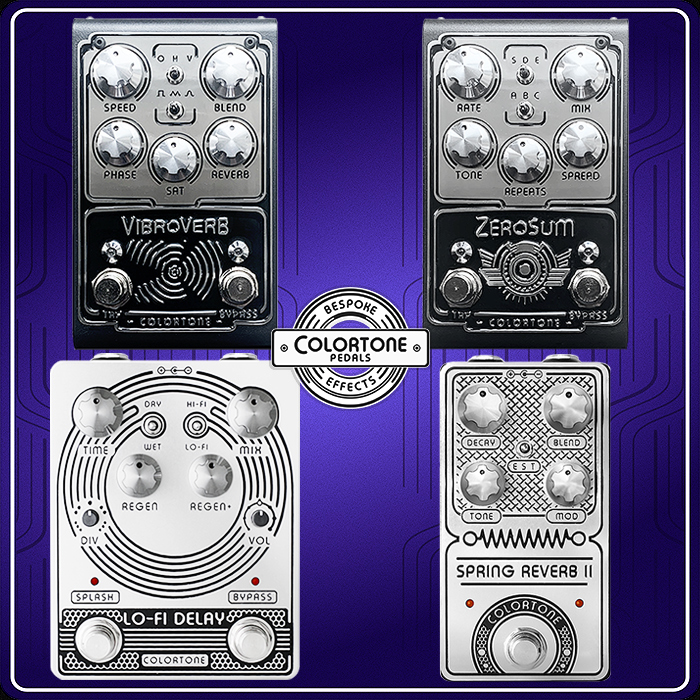
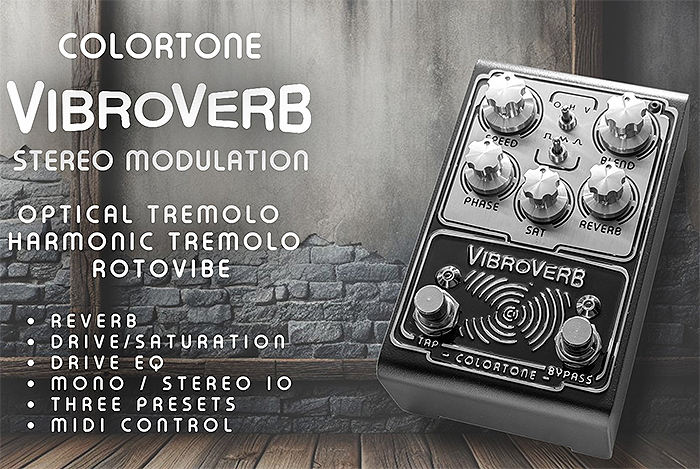
Colortone's VibroVerb is a really smart and lush sounding full stereo LFO Multi-Modulator with Optical Tremolo, Harmonic Tremolo and RotoVibe / Rotary Modes onboard - and 3 Presets


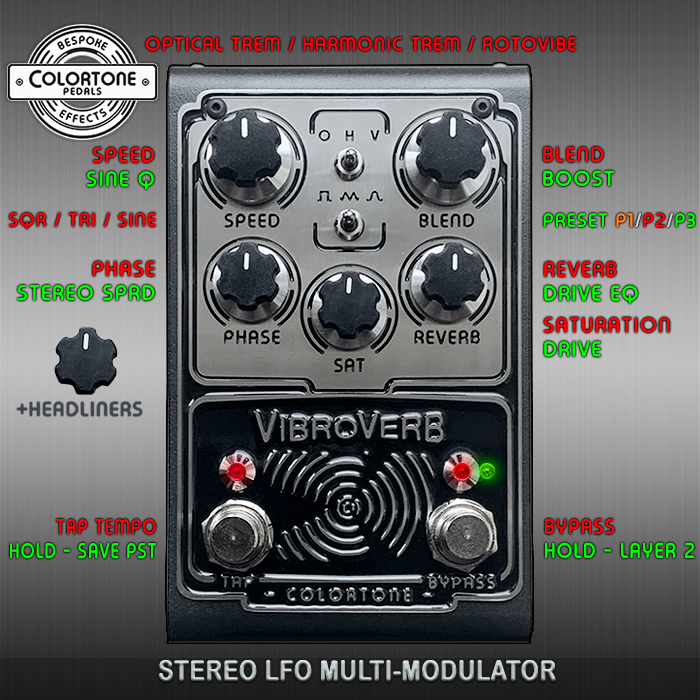
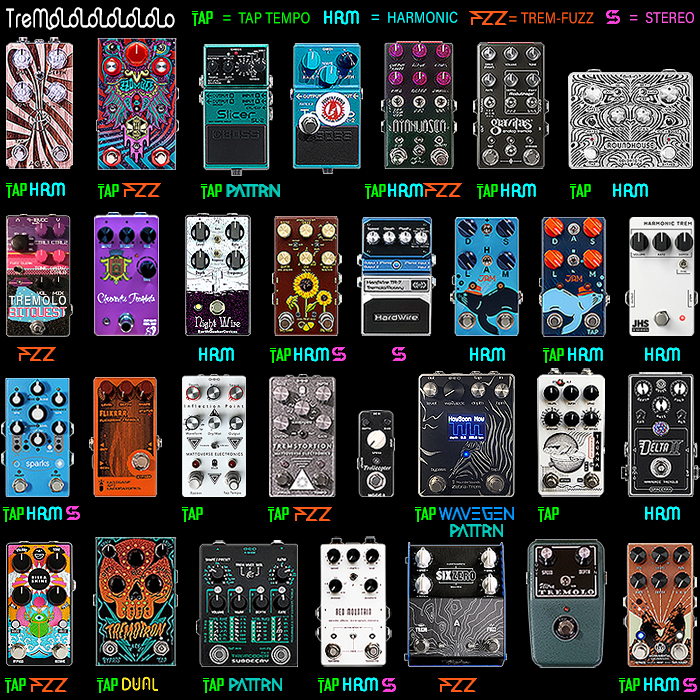
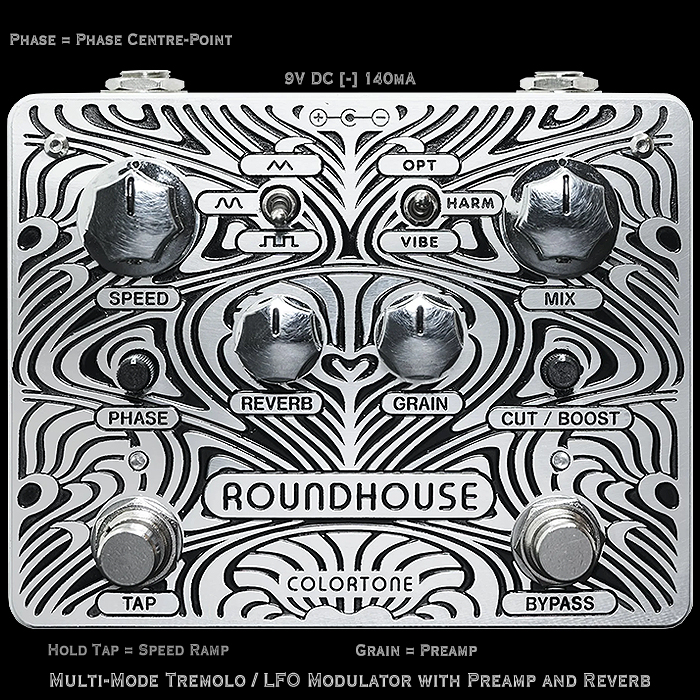
The VibroVerb is essentially a massively extended range reboot of the Colortone Roundhouse pedal - but with some very significant changes.
As its heart - this is a Stereo LFO Multi-Modulator with markedly expanded control parameters - across 2 layers of operation. The 3 core waveforms remain - Square, Triangle, Sine - where we also have further shaping of the Sine Wave (’Q’) via secondary setting on the Speed knob.
We have 3 exquisite Modes here - Optical Tremolo, Harmonic Tremolo, and RotoVibe - each progressively more textured - while all 3 Modes sound incredible to me - albeit they sometimes requite dialling in a little differently - particularly for the 3rd RotoVibe / Rotary Mode.
I really liked the Roundhouse - where my main critique was that it ran a touch too subtle at times. AD has significantly elevated the output profile here for the VibroVerb - to make it juicier and fuller sounding - and more reminiscent of a JAM Pedals modulation. We have a number of saturation controls now, alongside Phase and Reverb also - which serve to both accentuate or soften the output - to however you best like it.
I would issue a caution on the use of the Drive and Boost parameters in particular - as they can quite quickly add in artefacts that alter the nature of the output texture. There will be more details on how I set up this device - under the Controls and Ports Section below.
All Modes really sound beautifully textured to me - and are a touch more vibrant than on the Roundhouse. My preferences is the Sinewave form across all those 3 Modes - I use the Triangle waveform quite a bit too - but not so much the Squar Wave - while each of those waveforms sound really solid - I just like the extra nuance in the Sinewave mostly - which sounds particularly lush for this device!
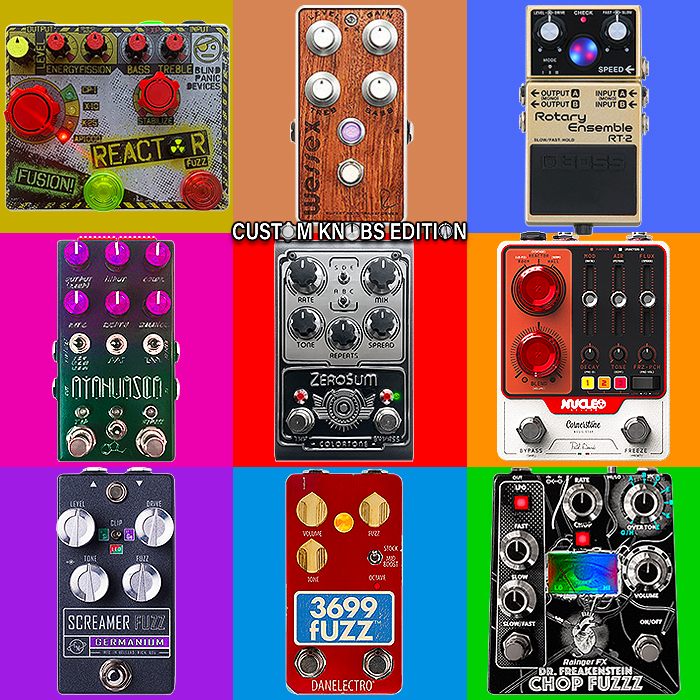
These are some of my favourite Tremolo and Rotary Sounds - where the RotoVibe mode gets incredibly close to my current champion of that genre - the Boss RT-2 Rotary Ensemble.
The Controls and Ports
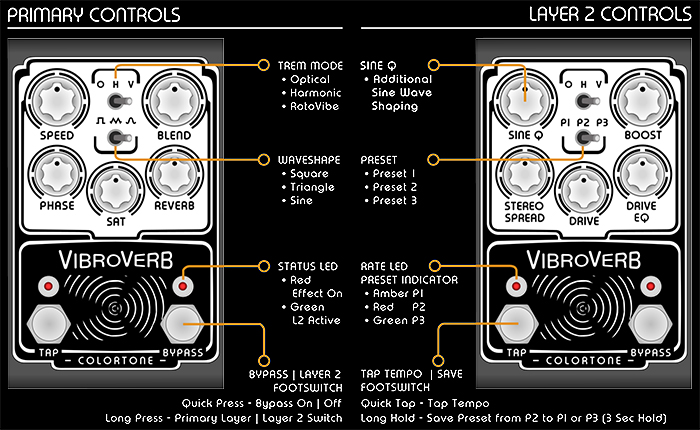
Layer 1 Controls - Speed (Rate), Mode : Optical Trem / Harmonic Trem / RotoVibe, Waveforms : Square / Triangle / Sine, Blend, Phase, Saturation, Reverb, Left Tap Tempo Footswitch, Right Bypass Footswich, Press-Hold for Layer 2 Green LED.
Layer 2 Controls - Sine 'Q' (additional Sine Wave shaping), Presets : P1, P2, P3 [Waveforms switch], Boost, Stereo Spread, Drive, Drive EQ, Left Tap Tempo Footswitch - Long press is Preset Save, Right Footswitch is Bypass - Long Press for Layer 1 Red LED.
As I mentioned - there are sort of 2 Layers of 7 Controls here - as indicated above, by default you get the Red Layer 1 types per the labels. And then when you hold down the Bypass to trigger the Green Layer 2 - you get 6 additional controls (Mode switch is only single layer) - Sine 'Q', Presets 1-3 (Waveforms switch), Boost, Stereo Spread, Drive and Drive EQ.
The Drive and Boost controls can be sensitive - and you can get unwanted artefacts if you push beyond the natural threshold - which requires some delicacy - I tend not to take the boost above the half-way mark, and the Drive is mostly all the way dialled back or around 8 o'c depending on whether I want to make use of the EQ!.
My preferred settings across most modes tend to be Speed / Rate mostly between 10 o'c and / or 2 o'c (the latter for the Rotary Mode), Blend @ 3 o'c, Phase Off (CCW), Saturation Off (CCW), Reverb @ 9 o'c.
Note that for the RotoVibe Mode I like a bit of additional preamp saturation - and ramp that control up to around 9 o'c. As mentioned, you need to be very careful about how you apply Saturation, Boost, Drive and Drive EQ parameters - as they can significantly alter the output profile - and add in various distortion artefacts relatively quickly along the taper of those knobs.
On Layer 2 (Green), I have the Sinewave 'Q' elevated to around 3 o'c. Boost on very moderately - usually never more than 9 or 10 o'c where you start to get artefacts - certainly if you go above noon! Stereo Spread sits mostly in the middle - that seems to deliver the best texture for me - if you go to wide it starts to thin out the sound a little. Drive is on very minimally - barely at 8 o'c - as that is needed to be able to use the Drive EQ. And you can then further shape the output. With Drive wound all the way back - the Drive EQ does nothing pretty much!
So may of these parameters can quite significantly adjust the output profile - the Saturation, Boost, Drive and Drive EQ can all add unwanted artefacts if you don't apply them too diligently. I also mostly preferred the Phase and Saturation Parameters Off - apart from the RotoVibe Mode - where a little extra Saturation can be very useful. That's similar to the Boss RT-2 device - which needs the preamp set to high - to deliver those syrupy hammond / barrel organ style tones.
So mostly you get away with having most of the same settings here - and just ramping up Saturation for the RotoVibe Mode!
I tended to start with controls in the middle and then add or subtract from there. For some reason I mostly preferred using the Speed knob, and did not rely to much on the Tap Tempo for the most part.
I genuinely was able to achieve fantastic tones on each mode, and found it difficult to pick out an overall winner - they all sound so good. The one element that really stood out for me was the Sinvewave Waveform - I liked that the most right across the Modes. While I found it impossible to pick out just one of the Key Modes - my favourite was largely dependent upon mood, and how rich a texture I was after at the time. The RotoVibe sounds fabulous with Saturation aplied - and crisps up very nicely - while he Optical is pristine and delicate, and equally exquisite, and the Harmonic Tremolo is kind of the Goldilocks Mode right in between the Optical and RotoVibe.
It took me a couple of sessions to fully gel with the pedal - once you've figured out how to get the best out of the Modes - it's one long continuous delight - such a great selection of LFO textured tones - and some of my favourite modulations for sure.
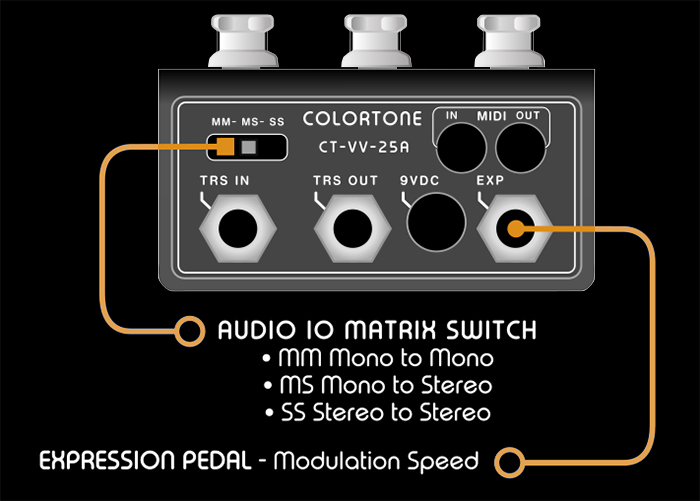
Rear Ports - Audio Matrix : MM (Mono) / MS (MISO) / SS (Stereo), MIDI In, MIDI Out, TRS In, TRS Out, 9V DC [-] 145mA, Expression : Modulation Speed.
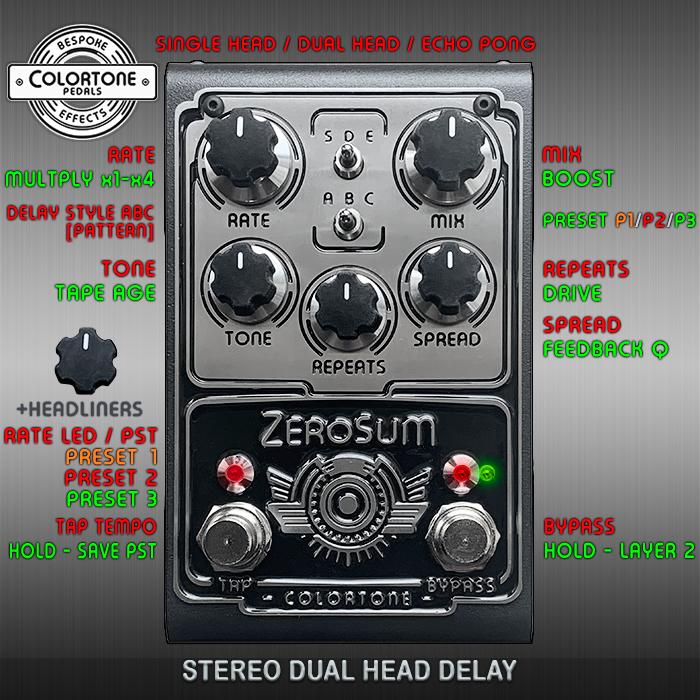
The rear Ports Section is superbly engineered - and is consistent across both this VibroVerb Modulator and he ZeroSum Delay. You access all the ports you need in one handy area - where the first thing you see is the :
Audio In/Out Matrix Switch : Mono to Mono / Mono In Stereo Out (MISO) / Full Stereo.
You also have MIDI In & Out, TRS In, TRS Out, 9V DC [-] 145 mA, Expression CTRL (Modulation Speed).
The Presets
As for the ZeroSum - Presets are a little bit of a work in progress currently - accessing them is relatively straight forward, You just need to enter the Green Layer 2 secondary functions operating mode (Hold Bypass) - and then the A/B/C Waveform options become the 3 Presets - which light up in 3 different colours :
A ] Preset 1 (amber)
B ] Preset 2 (red)
C ] Preset 3 (green)
So trigger Layer 2, and then move the toggle through the different presets.
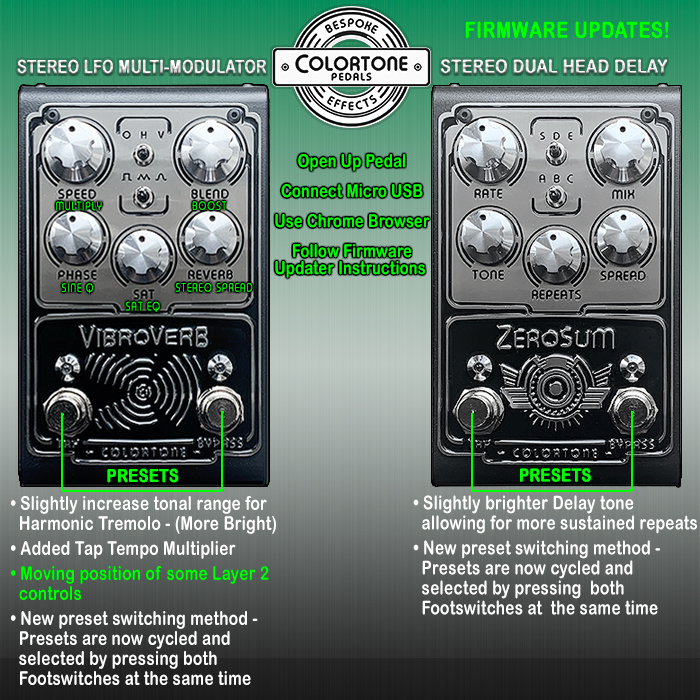
I've asked AD to add the feature that you can scroll through the Presets via pressing both Footswitches concurrently. As it's slightly clunky at the moment how you switch Presets via solely the Toggle-switch - which doesn't really allow for on-the-fly Preset flipping.
One of the most obvious ways to use Presets is for the 2 Speed Variations you normally apply to the RotoVibe Mode - would be cool to have an easy way to ramp up and down on the fly!
I seem to need to dial in the device very specifically for my preferences - as none of the onboard stock Presets really does anything for me.
You should consider the Presets to be a still Work-in-Progress - with a better version of that arriving via USB update real soon!
The core select and save functions well enough - it's just a little clunky currently!
I often like to use a Leslie style ramp up/down function - which appears on a few of my other modulation pedals. Would be nice if we could at some stage have some way for applying ramping.
Final Thoughts
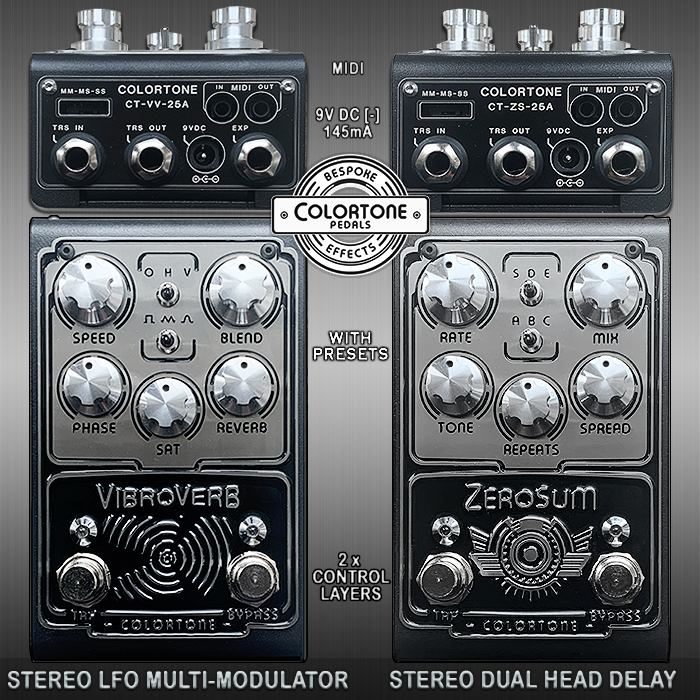
Both the new Colortone devices are amazing - while the ZeroSum is the more instantly satisfying. I found it incredibly easy to dial in for the most part - and I was quick to discover my favourite Dual Head Settings. Which as reported are supremely musical and rhythmic - with a really unusual fluttery tail - which really enhanced the repeats.
By contrast it took me a few sessions to really get the potency of the VibroVerb. As mentioned it's a more full-on and vibrant take of the previous Roundhouse device. The Roundhouse erred towards subtle a lot of the time - while the VibroVerb delivers a more full-on JAM Pedals style experience - where the waveform is almost tactile!
As mentioned - the Boost, Saturation, Drive and Drive EQ parameters can be problematic at times - you need to apply those with a degree of finesses - or else you relatively quickly get into overblown territory - with certain distortion artefacts present in the signal. I would advise you to apply that particular set of controls very carefully.
The ZeroSum is pretty much instant satisfaction - while he VibroVerb is easily capable of those same impressive levels - it just makes you work for it a little more at the start! And where the Rounhouse take could be a little too subtle - we seem to have a lot more low-end frequencies in the mix for the VibroVerb - which is mostly great - but at times gets a little bit boomy. I personally would have preferred to have a Master EQ where the Phase element is currently - as I don't use the Phase much. And there are times when I just want to roll off a little of the low-end output.
There is a sort of remedy via using the Drive parameters very minimally, and then using its Drive EQ to further shape the output - that works to a degree. I'm still not clear on why we need 4 gain controls on this pedal essentially - Boost, Saturation, Drive, and Drive EQ.
As for the overall output - I really cannot fault it - as when you have it dialled in perfectly it sounds superb. It's just the initial process of getting to grips with the circuit's output , and how each of those controls impacts on that profile.
I really like the Reverb part of the circuit - while I always have a core Reverb on my main signal in any case - but this control further refines the Output Profile for those Tremolo and Rotary stounds - and a little reverb works great.
I didn't really find a particular use for the Phase control - it mostly seems to soften the peaks of the waveforms - so mostly I have that parameter dialled out.
Initially I was dazzled by the instant satisfaction of the ZeroSum - but the VibroVerb is a real grower. I needed a few sessions to get the best out of it - and it's really sounding fantastic for me now. But it took quite a bit of trial and error to get the very best out of it.
It's genuinely a fantastic LFO Modulator - all 3 Modes can sound pretty exceptional. And for my current settings - these are some of my favourite Optical Tremolo, Harmonic Tremolo and Rotary tones. The RotoVibe gets me very close to my favourite Boss RT-2 sound - and the Saturation and Drive controls are particularly significant for that 3rd mode - which really texturally benefits from that extra saturation.
Mostly I can use the same settings across all 3 Modes - and mostly on the Sinewave form - while for the RotoVibe I always turn up the Saturation a little! This is such a great sounding pedal - and I feel it will be every bit as popular as the ZeroSum - Imagine the ZeroSum as an Earworm - where the VibroVerb is more a longer term impact player - it takes a little more time to get the best out of it - but that patience is wonderfully rewarded when you hit those right settings - as I did just a few sessions ago.
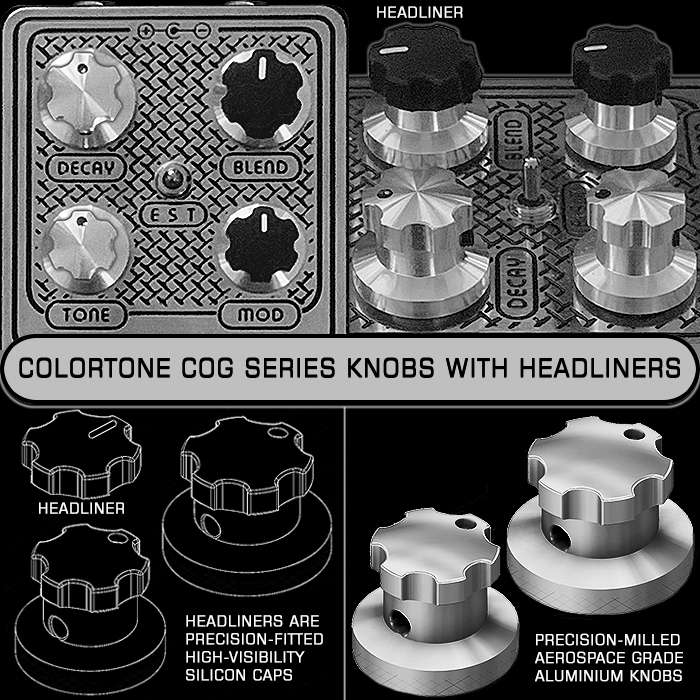
The VibroVerb is just $249 / £187 direct from the Colortone Pedals Webstore (plus shipping) - which is superb value for what you're getting. Everything about this pedal is custom - the enclosure, the knobs, and the custom Electrosmith chip onboard. Every part oozes quality and evolved design principles. And each of those Modes is top tier in its quality and profile of sound
My good friend AD Hauser has done a quite wonderful job of realising this latest iteration of Colortone Pedals - which are the 4th major design iteration since I got involved with the brand. Every couple of years AD massively levels up. These two pedals are the epitome of ergonomic and modern pedal-design - with every aspect considered from every conceivable angle. And they sound every bit as good as they look.
Once the Preset switching is updated - this will be a wholly perfect device. All of the different ingredients in the mix here make this a must-have device. I use Tremolos and Rotary sounds quite a lot in my setup - and these are some of my favourite flavours - you really think this is a fully analog pedal at times - it's output profile is so rich and vibrant, and nuanced - and all round incredibly achievement. Everyone will want one!
Demos