

Xploration • Curation • Recommendation


Crazy Tube Circuits essentially spins out its Constellation Multi-Fuzz / RangeMaster into a fully granular Multi-Mode Triple-Stacking Boost / Octave + Fuzz + Drive - Vintage Sounding Masterpiece


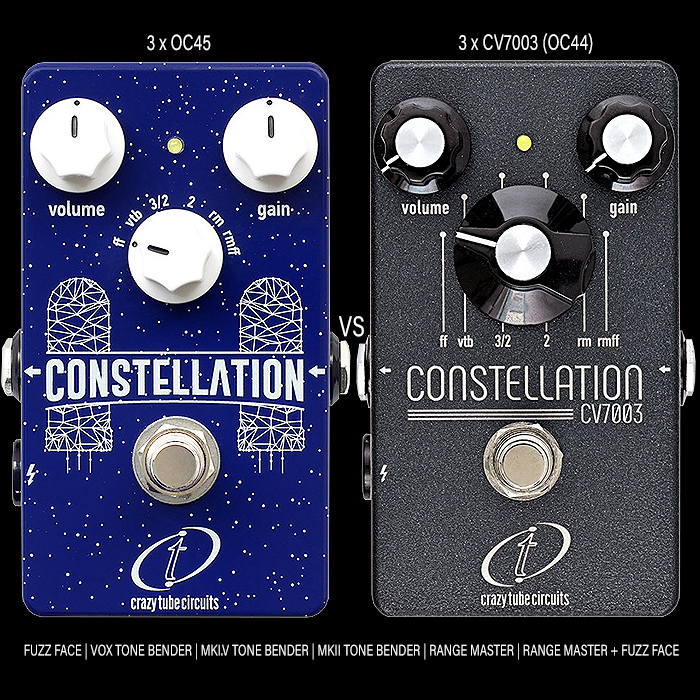
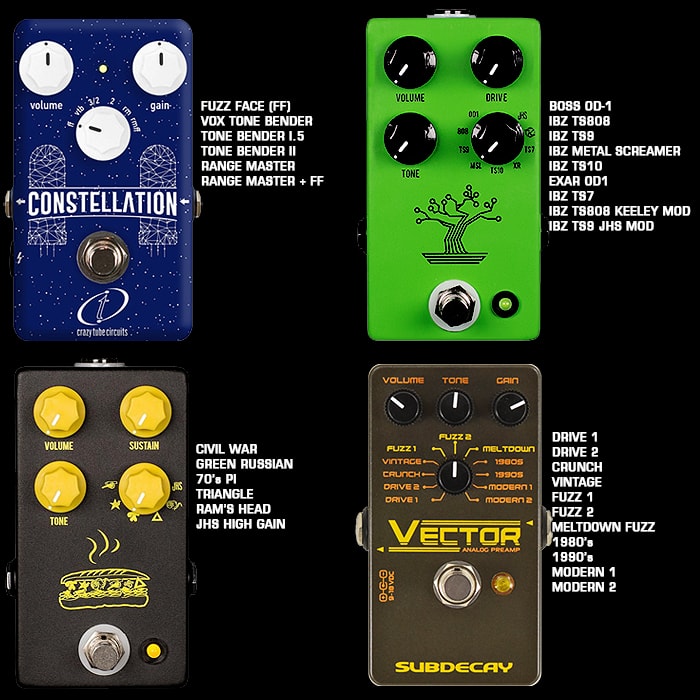
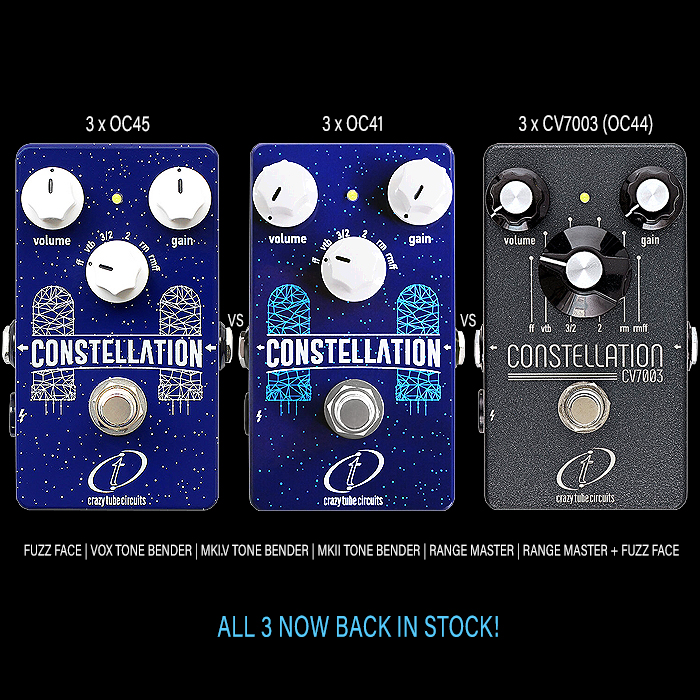
I am a huge fan of the Crazy Tube Circuits Constellation Series - where I own each of those 3 rare Germanium Editions - OC45, OC41, and CV7003 (Milspec OC44). Those were relatively simple devices with just a variable Volume and Gain Control, and then a 6-way Rotary that took you though the different modes :
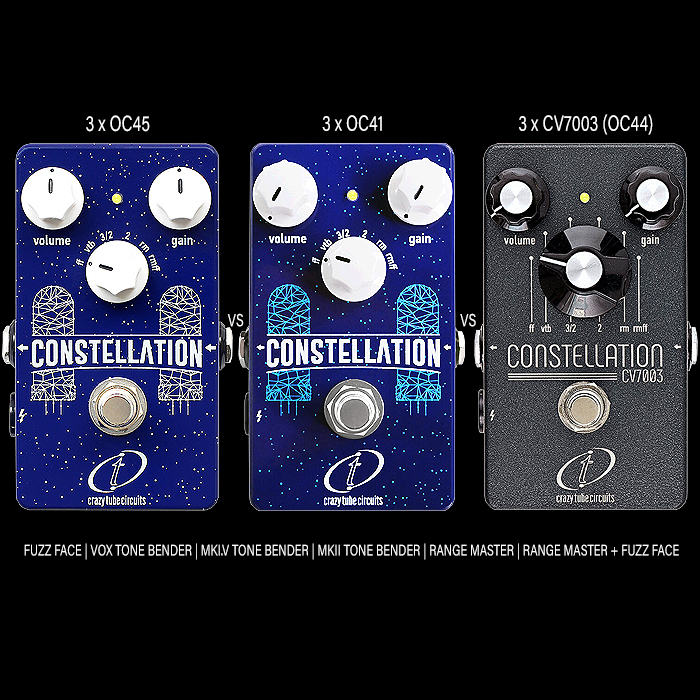
Fuzz Face | Vox Tone Bender | MKI.V Tone Bender | MKII Tone Bender | RangeMaster | RangeMaster + Fuzz Face
Once the Germanium Transistors ran out, I'm sure CTC's Christos turned his mind towards how best to deliver a Silicon variant with equivalent vintage Germanium sensibilities. I discussed this with Christos back in the day - and he was exploring several possibilities. I never imagined he would spin the Constellation into quite such a clever device.
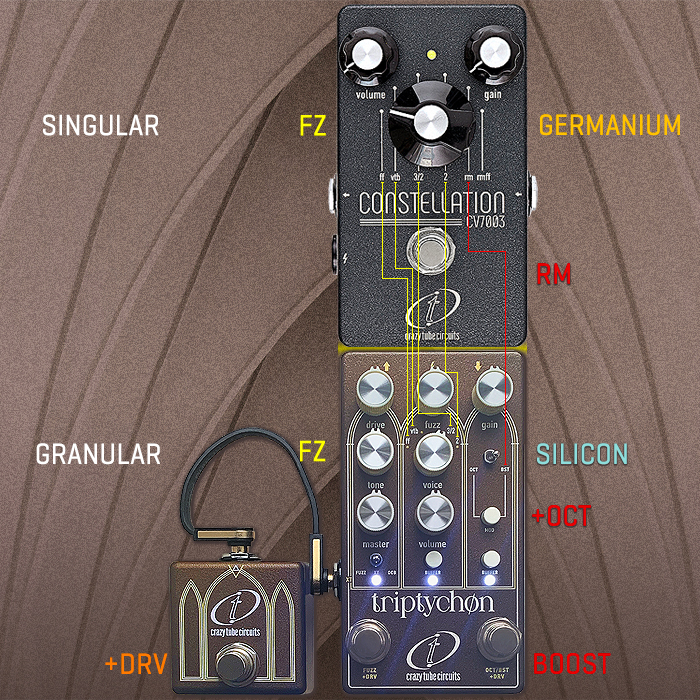
Where for starters Christos' first move was to split out the RangeMaster / Treble Booster and put that on a separate footswitch as the first gain stage - such that you could use that independently with all 4 of the Fuzz Modes.
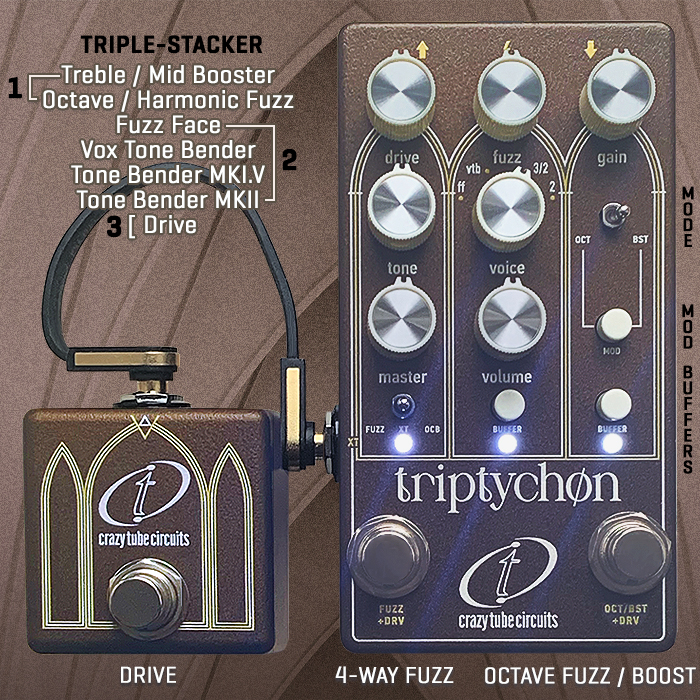
Obviously that wasn't deemed enough - and he further decided to add in a Mode switch for that first stage - which allowed you to flip over to an Octave - initially Octavia style. But then upon further consideration he added in the MOD switch - so you have Alt MODs for each of the two Stage 1 Modes :
- Treble Booster or Mids Booster [MOD] and
- Octave / Foxx Tone Machine style Harmonic Octave [MOD]
Generally I like the MODs better than the originals - so I tend to stick to Mids Boost, and Harmonic Octave - with that MOD push-button pretty much permanently set in / on.
Gain Stage II is those same core 4 Fuzz Modes from the Constellation - Fuzz Face | Vox Tone Bender | MKI.V Tone Bender | MKII Tone Bender - but made with an array of piggy-backed Metal-Can Silicon Transistors - to replicate Germanium dynamics and clean up - and boy has Christos done an amazing job there. Note that all the modes are quite different - and have different degrees of compression and different gain structures so you pretty much need to adjust most of the dials every time you flip mode.
The Fuzz Face and Vox Tone Bender are the easiest to dial in, but in some ways MK I.V and MK II can be the most fun. Not all Modes pair as readily across all 3 gain stages. I generally found it easiest when stacking Fuzz Face or Vox Tone Bender options - but the others get a little much with the Boost and Overdrive applied at the same time.
So Stages I + II use an array of 6 piggy-backed Metal Can Silicon Transistors, and there are further Transistors in secondary rolls.
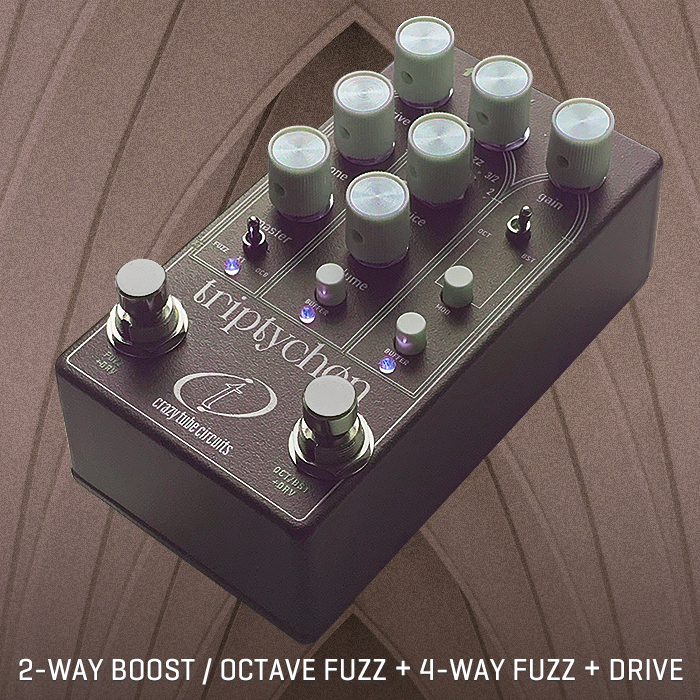
Gain stage III is an OpAmp Drive / Saturator - which essentially replicate a Pushed Amp - or an Amp at the point of Breakup - where you get such a cool interaction with vintage style Treble Boosters and Fuzzes. So the Drive warms up and saturates the signal and combines beautifully with all the Fuzz voices and the Boost / Octave - while if you're triple-stacking - you have to be really careful - and really dial some of those elements down - particularly for the MKI.V and MKII Fuzz Modes.
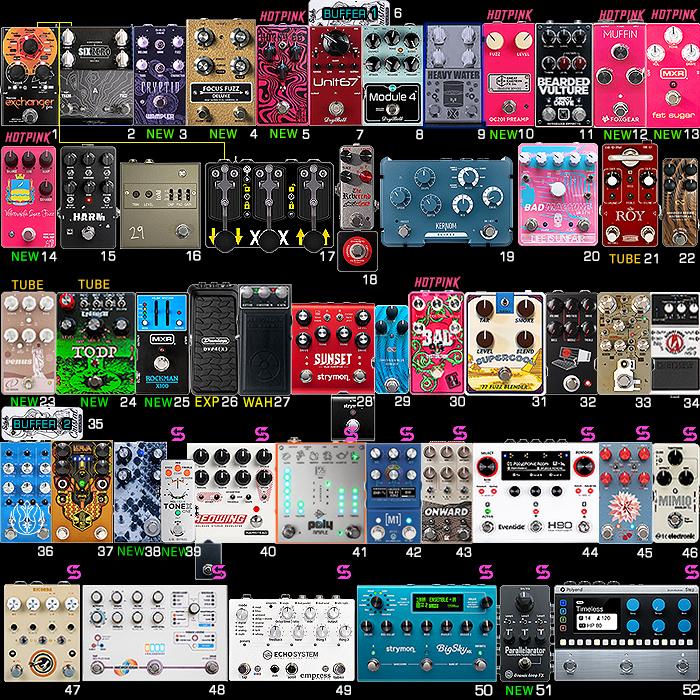
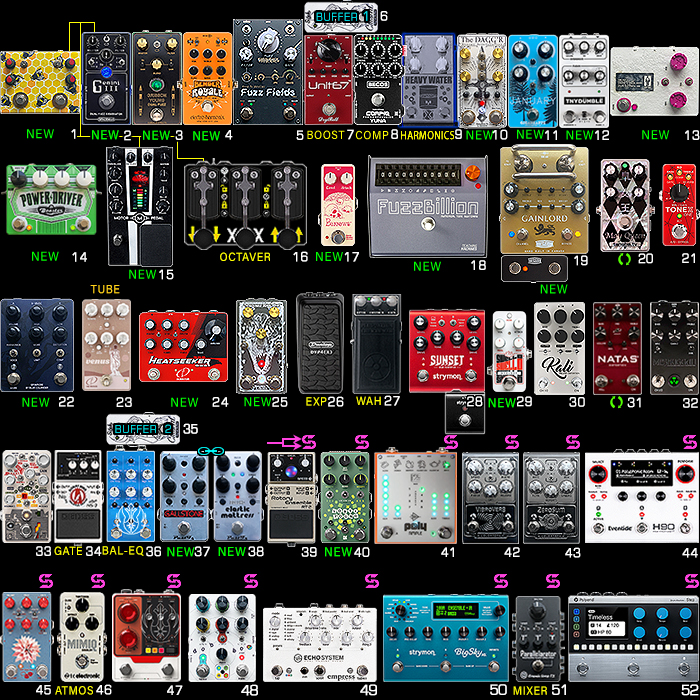
There's also a couple of Buffer switches for when you deploy the Triptychon further up the chain - for me it's the second one in line - and things sound much better without those Buffers - but it gives you options if you need them - the Triptychon is second in my chain after the BJFE Mystery Fuzz - which seems to have some sensitivities about it if it's not in the earliest slot. There are some vintage silicon style circuits which need to be near / nearer the front - and that is one of them. The Triptychon sounds exceptional where it sits currently.
The Triptychon is not always the easiest to dial in - particularly when triple-stacking - as you are typically adjusting a few dials in tandem - and in that sense - the Constellation was a somewhat simpler proposition. While the Triptychon is really quite marvellous in how it carries a sort of Germanium quality and dynamics - which owes everything to that piggy-backed transistor array. Cleanup on the Fuzz is really exceptional - a little less so if you're running all 3 Gain Stages together!
There's one switch I've not mentioned yet - which is at the base of the Drive section. That is for if you elect not to buy the optional Remote Micro-switch - which gives you independent control over the Drive circuit / Stage III. Without it - you need to select if the Drive comes on with the Boost/Octave or the Fuzz Footswitches on the main unit. I thoroughly recommend you get the Micro switch for the full granular and dynamic experience.
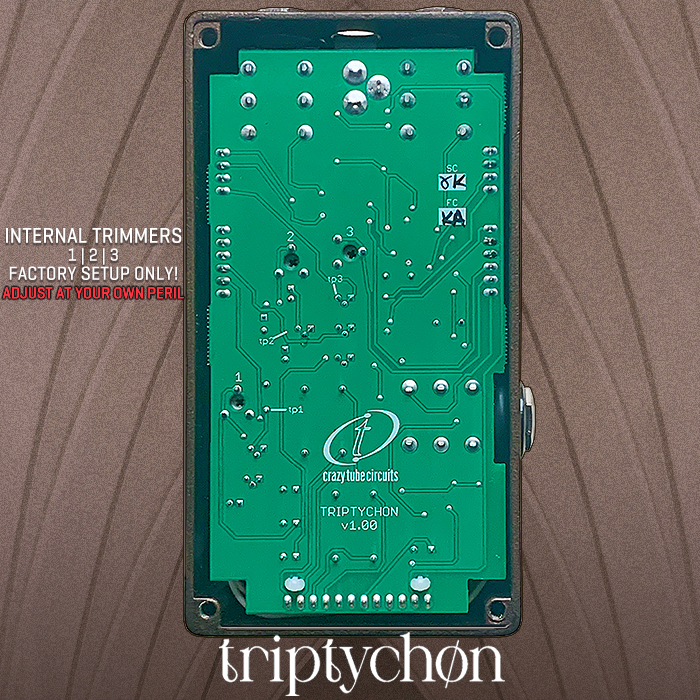
If you take the back off the pedal you will notice two things - firstly - it is a reverse PCB assembly - so you cannot see the key components - without taking all the jacks and knobs off too. Furthermore there are 3 trim-pot ports visible - numbered 1 | 2 | 3 - those are intended for factory setup only - touch those at your own peril! If you feel you have to - Christos advises you mark in their current positions with a marker - so you can dial back to the correct default settings.
I've only had the Triptychon for around a week - so I'm still kind of skimming the surface with it - as mentioned I immediately found successful triple-stacking combinations for Fuzz Face and VTB Modes - while I'm still feeling my way forward with the latter two - the TB MKI.V and TB MKII.
All in all this is a fantastic pedal - which goes straight into my Top 10 Fuzz list - the Constellations were amazing - and there are some of those modes / variants that I prefer in isolation - but as a fully granular vintage Fuzz system - the Triptychon is currently unparalleled - and especially at this compact size.
I love that Christos has squeezed all that smart functionality into a compact enclosure + micro remote. For a super neat form-factor. For me the remote is essential really to properly enjoy this circuit.
If you loved the Constellation - you should really love this even more - as it delivers those same kind of tones but more - and in a more granular way - for even more versatility and variety. It's for sure one of the releases of the year!
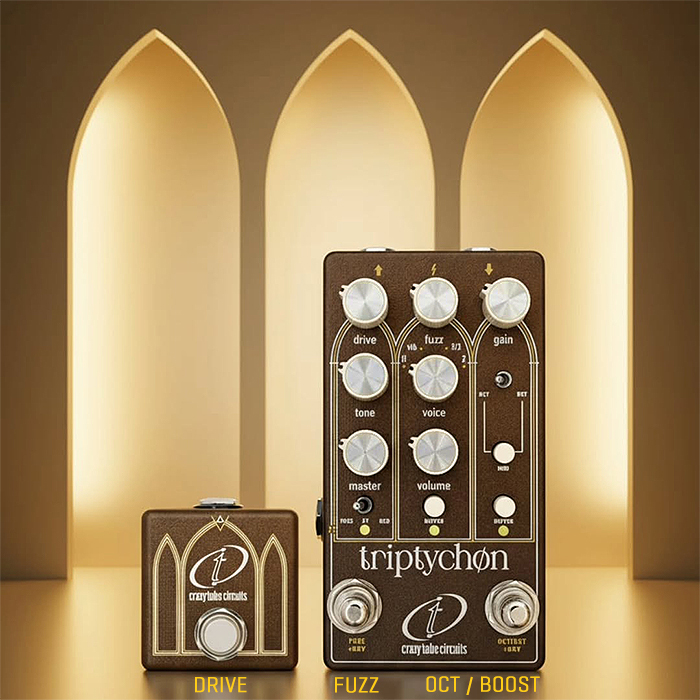
The Triptychon was originally teased at NAMM - and I've been excited about it since that time. It is quite obviously inspired by the Constellation - and has massively evolved from that simpler Germanium format - to deliver an incredibly versatile complete triple-stacking system of complex tones - with those Vintage sensibilities and dynamics.
It's a marvel of pedal engineering - and I feel no one else would have built it to this genius compact format - most would have snuck all that into a much larger and far less pedalboard-friendly enclosure.
The Constellation was already a genius pedal - but the Triptychon is even more so. It must have taken a lot of time to hone and tweak those separate elements into the final format. No wonder the release was pushed back a few times - this product has an incredibly complex development path - and it's an absolute triumph. And yet - ti delivers superior sounds in spades - and while some of the dial-ins can be a little tricky to get spot on - it's nonetheless easy and quick to adjust and deploy.
The Triptychon goes for €299 and equivalent on the Crazy Tube Circuits Store - and should be winging its way out to international dealers too. I thoroughly recommend you go for the remote Micro switch too (€49). I except there to be a run one these - in a similar way that happen to Christos' last runaway bestseller - the Venus Tube Driver - which still remains on my board!
I'm not yet at the point to be quoting numerous favourite settings - that takes more time - while I think most will find it relatively easy to mix up the 3 Gain Stages with the core Fuzz Face voicing - I recommend that as your starting point.
Props to Christos and his team - this is another masterpiece for sure!
Demos




Content Subscriptions