Xploration • Curation • Recommendation


Hangman fx's The Dancing Plague Stereophonic Time-Travelling Bi-Modulated Tri-Delay is a magnificent box of wonders - probably the best ever Compact Delay!


It’s tricky to know where to start here - as this pedal covers so much ground - and there’s so much to detail about the wonderful way in which it works.
I explained previously that ’The Dancing Plague’ name is derived from an event / phenomena that took place in Strasbourg in 1518 - where a woman in some kind of fevered trance state started dancing in the streets, the dance somehow went on for days, and she was gradually joined by hundreds of fellow residents who danced away with her throughout those days - with several succumbing to exhaustion and dying from heart attacks and similar conditions. The dance eventually petered out - but left many dead - and no one’s ever figured out what caused or triggered that dance - whether it was some kind of disease of the body or mind, or just a sort of social construct Middle Ages flash mob! - hence ’The Dancing Plague’!
It is described as being a ’Stereophonic Time-Travelling Bi-Modulated Tri-Delay’. Stereophonic on account of its MIMO / MISO / SISO input and output routing; Time-Travelling because of its amazing triple ’Clock’ functions including Sample Rate Reduction which morphs the pedal’s output in various ways; Bi-Modulated, as it combines touch-sensitive Tremolo and TouchSwirl Modulations (Chorus and Vibrato); and ’Tri-Delay’ as it has as many as Three Taps to its output! There are numerous modes of operation and playback here across those 8 controls. For a compact unit - this covers a kitchen-sink amount of features and functionality!
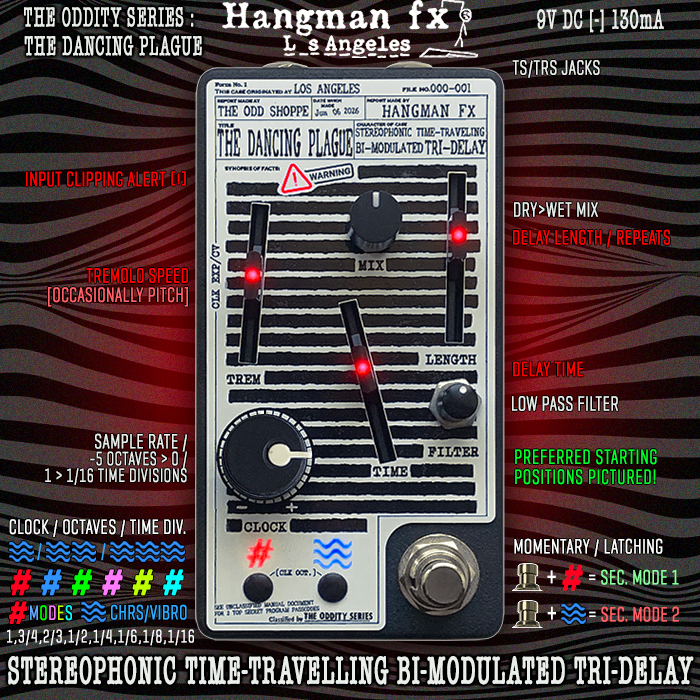
I was pretty close in my initial main visual for the release post - but on the updated one above I have indicated my ideal starting positions - essentially pretty much every control at the mid-way point, bar the Clock knob - which I have set to a 3/4 turn / 3 o’c. The Clock starts at full fidelity fully clock-wise, and degrades in resolution counter-clockwise. So Root is actually Clock at Max! And when you apply Expression it default lowers the Clock / Resolution.
So we’ve established ideal starting positions - I actually then typically nudge up the Delay Length / Repeats slider to give me a few more repeats - around 3/4 of that slider taper, occasionally as much as 4/5ths.
And then via my incredibly dextrous big toe! I can advance through the 6 core Modes via the Left # push button. I am also able to hit the ’〰’ push button which activates / deactivates the TouchSwirl Modulation (Chorus or Vibrato per Mode). The one thing I can’t do here is activate the 2 Top Secret Modes - as I need to combine Footswitch Press with a press on either of those buttons - which would mean having to use both feet / big toes on the pedal simultaneously - just not practically possible! I wonder why the Mode limit is on a total of 6, and why in Spinal Tap fashion - the Mode switch couldn’t just go to ’8’ with the 2 Top Secret Modes tagged on the end!?
In any case - we need to explain the different modes next - which as mentioned combine Triple Tap Stereo Delay with 2 touch-sensitive Modulations, Pitch-shitting and other stellar, kind of sci-fi ambient effects!
With my core preferred settings - as already detailed, I can flip from Mode to Mode - and they each sound stellar on those default settings. Of course you can then tweak the sliders and knobs to make thing more extreme or more tempered! I really like the Clock at around 3 o’c as it just slightly softens the output, but leaves the resolution still pretty close to full fidelity!
Surface Controls - Input Clipping Alert LED ⚠️, Tremolo Speed, Dry>Wet Mix, Delay Length, Delay Time, Low Pass Filter, Clock [Sample Rate] / -5 Octaves > 0 / 1 > 1/16 Time Divisions, # Mode Button : 1-6, Chorus / Vibrato / 〰 TouchSwirl Modulation Button, [Click on Mode + Modulation buttons for different Clock Knob Function].
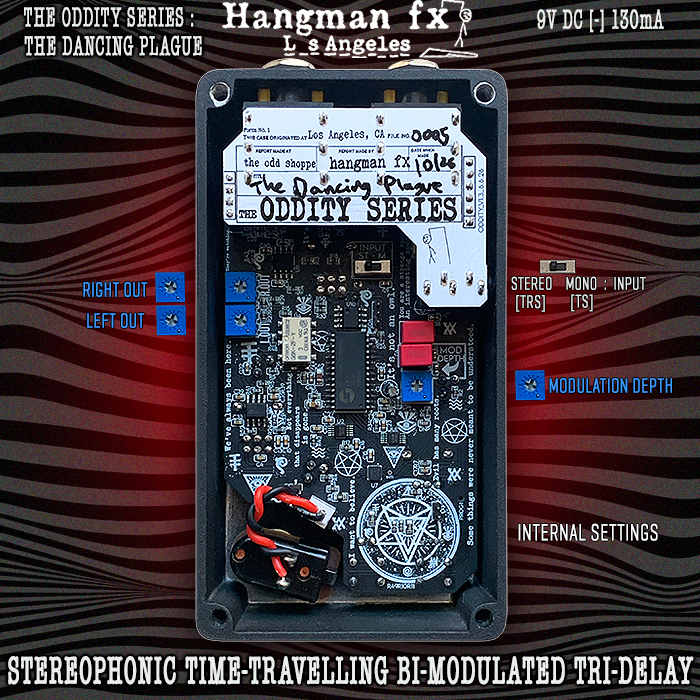
Internal Controls - Left Output Trimmer, Right Output Trimmer, Input Mode : Stereo / Mono, Modulation Depth Trimmer.
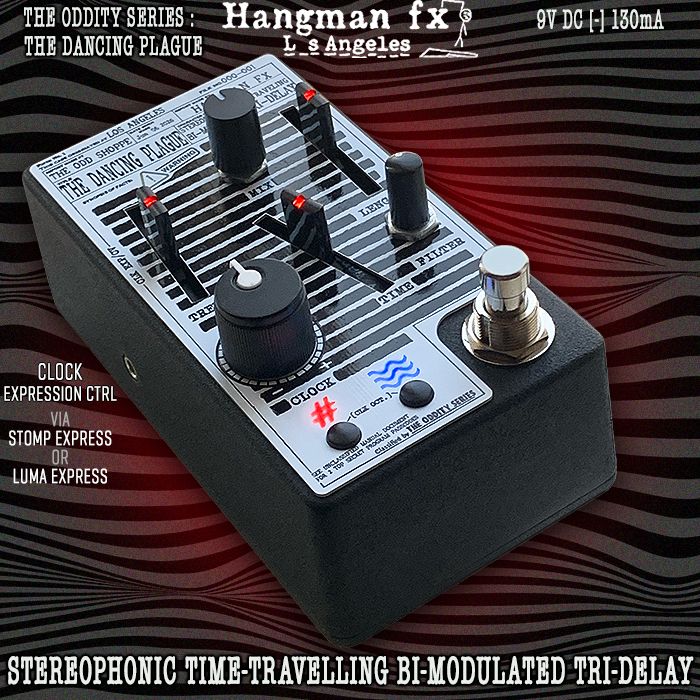
Ports - 1/4" TS/TRS In, 9V DC [-] 130mA, 1/4" TS/TRS Out, 1/8" TRS Clock Expression / CV In (works great with Hangman Stomp Express and Luma Express).
So here are the 6 Key Modes again :
The first segment below is the LED colour / hue, then the Delay Timing - where Divergent is similar to the Cluster effect on the Chase Bliss Big Time - adding in further taps for a more tape-like-style of delay - what I sometimes refer to as a skitter-delay!
So next is the Output Nature of the delay which is Dual-Mono or Ping-Pong, Then the Depth of the TouchSwirl Modulation (Low/Medium/High), TouchSwirl Type (Chorus or Vibrato), Tremolo Depth (Low/Medium/High), and Tremolo Output Type - which is either Dual-Mono or Ping-Pong in a similar way to the actual Delay.
So rather than Modes - there are actually more Presets - that predefine all the internal smarts of the pedal, and delivery different combined delay and modulation parameters.
HUE | DELAY TIMES | DELAY TYPE | 〰TOUCHSWIRL DEPTH | 〰TOUCHSWIRL TYPE | TREM DEPTH | TREM TYPE
- Red | Divergent V1 | Dual-Mono | High | Chorus | Medium | Dual-Mono
- Blue | Divergent V1 [3rd Tap on Trem Slider] | Ping-Pong | Low | Vibrato | Low | Ping-Pong
- Green | Divergent V2 | Dual-Mono | Medium | Chorus | Low | Dual-Mono
- Pink | Divergent V2 | Ping-Pong | High | Vibrato | Medium | Ping-Pong
- Yellow | Double Tap [Synced 1/4 notes] | Ping-Pong | Low | Vibrato | High | Dual-Mono
- Aqua | Single Tap | Dual-Mono | Medium | Chorus | Medium | Ping-Pong
I genuinely love each of those - while I tend to favour mostly Blue #2 as my default delay, then Pink #4 for light and airy fluttery delay, and the more straight-laced Aqua #6 Single Tap delay. Every Mode has its purpose and serves a different style of playing or music.
The Green #3 Mode has some really interesting low frequency action. I've pretty much used all of those at one time or another - while the one that gets the most play so far is Blue #2.
I've played this pedal a whole lot within the week of my receiving it, while I haven't spent too much time on the Octaves and Time Divisions.
Those are controlled by different Clock Modes - where a dual press on #+〰 buttons gives you between one and three blue 〰 flashes - which indicate if you're on Clock Mode 1 (Sample Rate / Resolution) / Clock Mode 2 (Octaves) / Clock Mode 3 (Time Divisions). You get a corresponding one 〰, two 〰 〰 or three 〰 〰 〰 flashes to indicate which Clock Mode you're in. The Octaves go down to -5, and there are 8 x Time Divisions as indicated in my visual : 1 , 3/4 , 2/3 , 1/2 , 1/4 , 1/6 , 1/8 , 1/16.
As I mentioned, I just spent a cursory time on Octaves and Time Divisions, most of the time was spent locked in a groove on one of those 8 Modes, including the following 2 Top Secret Modes! :
The 2 x Top Secret Modes
You get to the Secret Mode by switching effect off, then hit the Footswitch + the first # button for Secret Mode I, and Footswitch + 〰 for Secret Mode 2. Secret Mode 1 is indicated my a Faint / Faded-Green Hue, and Secrret Mode 2 is indicated by a Faint / Faded-Red Hue, as follows :
Top Secret Mode 1 : Footswitch + #: Faint / Faded-Green | Rainbow Machine? | Single Delay with Trem as Pitch-Slider with repeats continually moving from -1 to +1 octave, below the mid-way point of the slider the direction is downward, and above the mid-way point the direction is upwards.
Top Secret Mode 2 : Footswitch + 〰 : Faint / Faded-Red | The Haunted Alien Raindrop Delay | Spacey Ringside Raindrop Tones with Trem Slider controlling the Pitch of Repeats - more like a clangy / metallic sci-fi delay for me.
3 of my favourite settings
Default - Trem @ Middle, Mix @ Noon, Delay Length / Repeats @ 2/3rds, Delay Time @ Middle, Filter @ Noon, Clock @ 3 o'c, TouchSwirl almost always on - for every Mode! The Defaults work great on each of the 6 Key Modes, you need different settings for the Top Secret Modes.
Top Secret Mode 1 - Trem (Pitch) @ Max (all the way UP!), Mix @ Noon, Delay Length / Repeats @ 3/4rs, Delay Time @ Middle, Filter @ Noon, Clock @ Max Fidelity.
Top Secret Mode 2 - Trem (Pitch) @ Min (all the way DOWN!), Mix @ Noon, Delay Length / Repeats @ 3/4rs, Delay Time @ Middle, Filter @ Max, Clock @ lowered fidelity, c. 11 o'c.
Paul gets some really interesting Symphonic Textures on Secret Mode 1 (presumably somewhat Rainbow Machine adjacent!), while I overall prefer the fantastic metallic clangy rhythmic sci-fi nature of the Secret Mode 2 - I could play that for days!
I do still wish that the Secret Modes were just tagged on to the normal function of 1-6, to make #1-8. While presumably there was a technical reason for doing it in the manner that it appears here.
It's such a super smart pedal in any case, and I feel very privileged to have landed the two very best Delay Pedals released this year - with first the Chase Bliss Big Time, and now this incredible Dancing Plague.
This is such a beautifully textured constantly perpetually moving dancing delay and ambient modulator - it really is next level for a relatively simple looking compact delay. It's as impressive an engineering achievement in its own way as the Big Time. They both yield the same degree of delight!
They also both have a bit of noise floor, not particularly noticeable, but noticeable compared to all my other delays. And for The Dancing Plague the noise occurs also on bypass - as said pedal is fully digital, and doesn't have analog dry-through. It doesn't really impact the core sound of my analog signal - but it does produce a softly faintly audible noise. For a short time I thought there was something wrong with my Amps! Interestingly the Big Time which is Analog Dry-Thru - is whisper quite on bypass and slightly noisy on active duties, while The Dancing Plague is actually a touch quieter on its playback than when in bypass.
Note also that if you have the Stomp Express connected to The Dancing Plague and not powered on - that does some weird things to The Dancing Plague's output - of course that disappear as soon as you apply power to the Stomp Express! Just a handful of observations really, just indicidentals - none of which mar the enjoyment of this pedal in the slightest!
Internal Controls!
Inside the mostly SMT and DSP construction - per the above visual - you have 4 controls at your fingertips!
First a couple of Trim-pots which allow you to fine-tune the Output Levels of the Left and Right Outputs. Next you have a 2-way Slider Switch which selected Stereo or Mono Input. Stereo obviously requires TRS input cable too - as is the case for my instance. And finally we have. A Modulation Depth Trim-Pot to adjust the TouchSwirl Modulation Intensity.
I didn't feel the need to adjust any of the trimmers, while as the 2-way switch is default set for MISO - I needed to flip that across for Stereo Input!
Other than the inputs there's not too much to see on the inside - all very neat and tidy!
Overal Impressions
There's no real menu diving here - yes a couple of Secret Modes, and an Alternative Pitch Function on the Trem Slider, and 3 Functions on the Clock knob. While the nature of those Mode / Presets means you're up and running in no time - particularly if you apply my starting settings. I had actually just set all the controls in their mid-way positions for the initial photograph - and that then turned out to be very fortuitous when the pedal went on the board!
I do prefer the Clock / Fidelity knob mostly just knocked back a touch, for a very slight softening of the effect, and the Delay Length / Repeats set at around 2/3rds of the length, sometimes as much as 3/4rs.
The instruction manual is pretty decent, but it jumps around a little, and it took Paul pointing out some details I had overlooked to get the full picture. While generally I was up and running in no time at all. The Big Time has a lot more of a learning curve to all its functions - as you have in effect at least 3 layers of controls, and multiple functions per each control.
While for The Dancing Plague - a lot of the heavy lifting is done by the Modes / Presets, and only really the Clock and Trem controls have Alt settings. You really pick it all up incredibly quickly.
So for starting up this is a fantastic instant satisfaction device. While unearthing some further refined areas of operation, and quirks and serendipities will take a touch longer.
This is possibly the most fun I've had with a Delay Pedal! Its core Rhythmic Dancing nature just suits my playing style perfectly. And it's so dynamic in how the TouchSwirl Modulation reacts when you dig in. In fact the whole thing is beautifully reactive and touch sensitive.
I'm still acclimating to the Stomp Express. That's actually surprisingly sensitive - it impacts a lot of travel during the early taper of the footswitch motion. I'm pretty good at adding in subtle stabs, and some incidental Lo-Fi action. While I'm a long way still from mastering the Stomp Express fully, and I generally prefer my Black Mountain Expression Roller for more finessed gradual expression ramping. The Stomp Express is great for stabs!
I would have preferred it to have had Analog Dry-Through on the output - that's about the only minor niggle here. Oh and yes - the ability to switch Secret Modes with my big toe - like I can do for Modes #1-6.
In terms of its feature set, algorithms and output - this is an every way S-Tier magnificent pedal.
It swings and sways to your command and colours the in-between with washes of touch-sensitive modulations - what's not to like!
This cements Pauls's reputation as a bona fide genius - as only Paul could have come up with this Delay, and only Paul would have named it The Dancing Plague. Which is actually a most suitable moniker. I personally struggle to stop playing this - it's highly addictive / addicting - so much fun. Where because The Dancing Plague mixes up so many things simultaneously - that is so much more interesting that your typical delay effect!
Paul has really baked in some extraordinary magic into this device - I really love every part of it. And while the Top Secret Modes 1 & 2 are probably a little specialist. Modes #1-6 are incredibly musical and usable.
This is one of those instant magic pedals that immediately makes everything sound more exciting and dynamic! I can't speak highly enough about this pedal, and I've only had it for a week!
The Dancing Plague goes for astonishingly fantastic value of $230 from the Hangman fx - I don't understand why it's not sold out already and with a massive backlog - it really is that good! In terms of its individual components it's not as feature packed as the Big Time, but in many ways it delivers more! Certainly in the area of instant satisfaction. And the fact that Paul has already dialled those 6 killer presets in for you - which he refers to as Modes! Means that most of the heavy lifting has been done for you already.
There's obviously no User-definable presets or MIDI here, some people go for those kinds of things, while neither I nor this Dancing Plague really needs them.
This is a whirlwind of a mini adventure in pedal format - get involved now, or suffer as the back of a long backlog in a month or two's time!
A quite stunning feat of intricate musical engineering.
Demos