Xploration • Curation • Recommendation


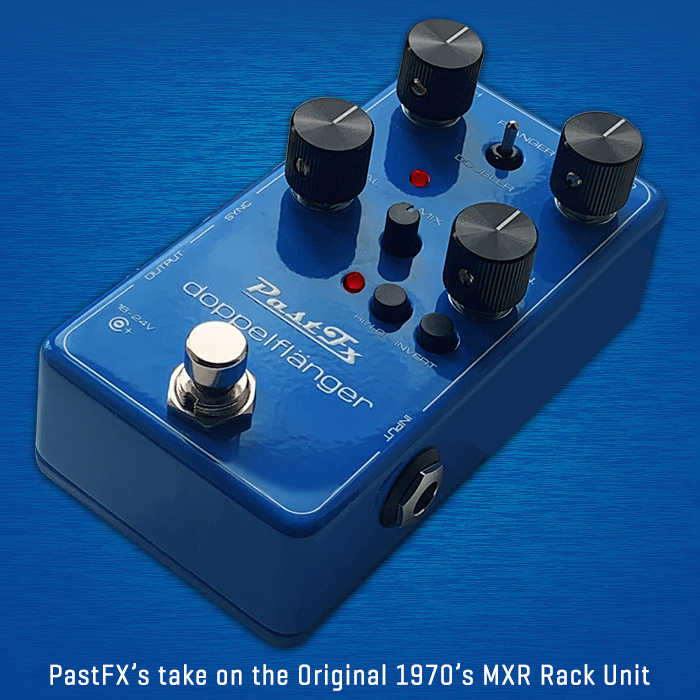
PastFX unveils the doppelflänger - its own exacting vintage specs, high headroom, compact take on the original 1970's MXR flanger/doubler Rack Unit


Key Points
PastFX’s doppelflänger recreates the 1970s MXR flanger/doubler rack unit with Panasonic MN3007 and Xvive MN3005 BBDs, 18/24V operation, Vactrol, high headroom and its original quirks. The MXR M226R uses a modernized 9V circuit. As of the stated pricing, the price was £220; the article also lists $399 AUD/$280 USD for doppelflänger and $333 USD for M226R.
Controls include Width, Speed, Manual, Mix, Regen, HI/LO, Phase Invert and switchable CV. The reviewer preferred its Flanger voice, while using TC Electronic Stereo Mimiq for doubling.
PastFX offers six Flangers and 15 Modulations; this was the reviewer’s 35th PastFX pedal.
NOTE - that there were some inaccuracies in the original overview - which have been set right by leading MXR Engineer Jack - as annotated, clarified and corrected here below. Those who already read this intro section - will need to read it again!
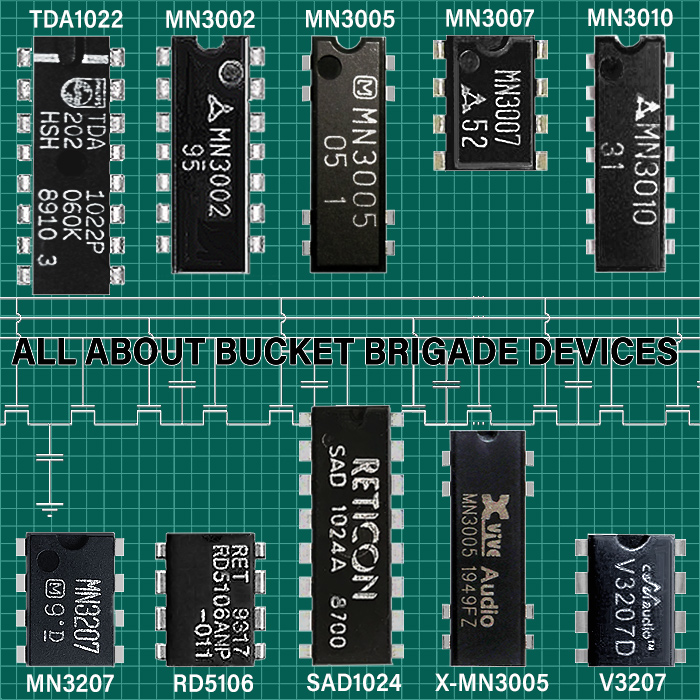
The original MXR flanger/doubler Rack Unit which emerged in 1976 - used a Reticon SAD1024 BBD chip for the Flanger effect (actually a dual 512 Stage), and a RD5101 chip (4096 Stages) for the Doubler. It had a ±12V power supply or a 24V swing as such. It also had a Vactrol / Light-Dependent Resistor onboard, and a certain slight level of noise floor at higher intensities along some other minor idiosyncrasies and quirks.
All those somewhat vintage components combined to deliver a very flavourful, slightly metallic-tinged output. Which ended up becoming a significant tone component and guitar rig favourite for artists including Dimebag Darrell, Zakk Wylde, Eric Johnson, Eddie Van Halen, and Billy Corgan.
Dimebag was the most consistent user of the Doubler, while the other artists mixed it up a little more; and Eric Johnson mostly used the Flanger Mode supposedly. The device is essentially a delay-line manipulator with the two modes delivering different short delay times courtesy in part of those 2 different Bucket Brigade Device chips.
I’ve relayed many times on this blog that with different delay timeline manipulations (approx!) 0.1 to 10ms delay will give you Flanging, 10ms to 30ms delivers Chorusing, 30ms to 50ms essentially double-tracks the signal near enough, and 50ms to 150ms gets you into Slapback territory. Those are the broad brush-strokes - which of course have some degree of overlap too.
Past FX is using equivalent NOS Panasonic MN3007 (monolithic 1024 Stages) for the Flanger, and an Xvive MN3005 (4096 Stages) for the Doubler. It retains the higher voltage power supply - with a minimum 18V power requirement, but also covering the 24V swing of the original rack unit, and indeed also having a Vactrol onboard - which is visible when you remove the pedal’s back plate.
PastFX’s Verlie has done everything to make her doppelflänger pedal sound identical to her own vintage MXR flanger/doubler rack unit that the pedal was based on (see first Leon Todd video below!). So while she doesn’t have any suitable Reticon SAD1024 or RD5101 type BBD’s in stock - she has replaced them with equally high quality / high voltage and similar spec equivalent MN3007 and MN3005 chips. She has then meticulously calibrated and matched the output of her doppelflänger pedal to deliver the same exact sounds as the original rack unit - with all the quirks of the original fully intact.
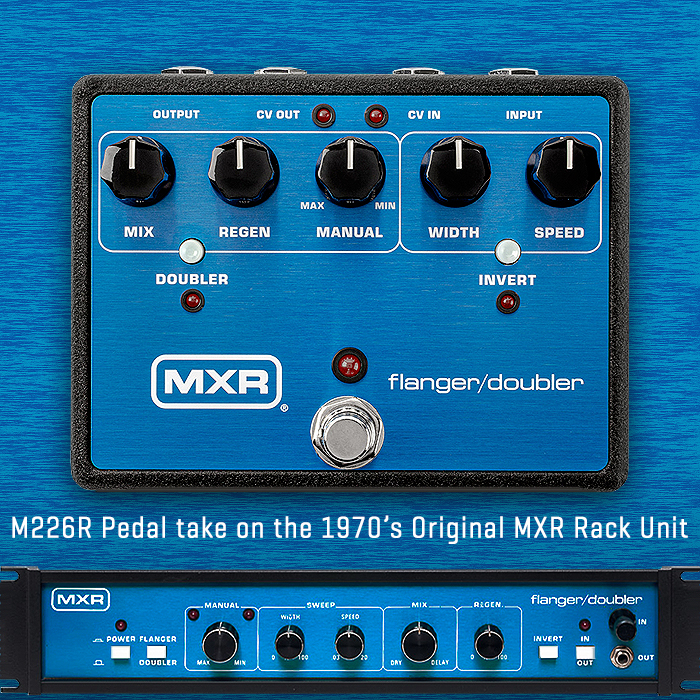
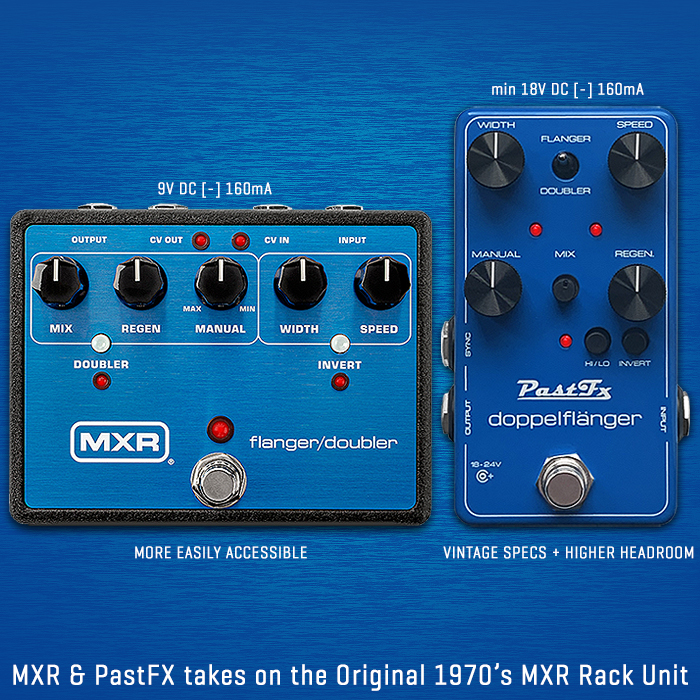
MXR has rolled out its own slightly different circuit take that in part removes some of the quirks and most of the noise floor apparent on the original. The MXR works off a 9V input, and utilises a pair of 3204 chips for the Flanger and another pair of 3205 chips for the Doubler, it’s MXR policy not to reveal exact component models - to give them more flexibility for longer-time manufacturing - while you can work it out for yourself if you see the M226R gunshot that is already doing the rounds.
Both builders as such have arrived at very similar outcomes via slightly different means, and the advantage of the MXR M226R is that it can run off a more convenient 9V supply. The MXR pedal converts the incoming 9V to +/-12V internally, achieving the same 24V swing of the original rack unit without requiring a 24VDC power supply.
Interestingly the MN3007 is typically considered somewhat limited in its output vs the SAD1024 - as Verlie tells it - "Yes generally speaking going off the data sheets all Panasonics can go up to is 100 kHz ( but that’s based around their own MN3101 clock chip)" - with some clever layout engineering BBD’s can indeed be clocked very high - which took a wee while to achieve, but did get the PastFX’s circuit to the same performance specifications. It’s mostly just about different philosophies and approaches really - both devices perform brilliantly and really do hit the same heights of the original - while each brand very evidently had somewhat different criteria, and MXR always has to have one eye on mass-manufacture - and how to make said circuit relatively easy to roll out in higher numbers, While PastFX are rather more making them to order as such!
The M226R pedal has omitted the Vactrol since those no longer meet RoHS compliance standards for many countries, and it has therefore been replaced with a better performing VCA filter instead.
Both devices are superb - and obviously the MXR 226R is a little more easy to deploy on account of its 9V supply, while the PastFX doppelfänger has the footprint advantage, For sure the MXR226R is more readily available and accessible too - via multiple international dealers!
In terms of pricing - the MXR M226R flanger/doubler is $333 USD, and the PastFX doppelflänger is $399 AUD or $280 USD equivalent. So the PastFX take / edition has a slight price, and size advantage.
Verlie speaks of the doppelflänger as being more of a Studio style effect, and the MXR M226R more of an everyman / more mainstream pedalboard variety.
Both devices are excellent each in their own way. I am though and always will be a PastFX loyalist, and I have to say I’m very satisfied with my choice - it sounds superb! And very much comes in my preferred size format. Who’s to say I won’t have the MXR M226R some day too!
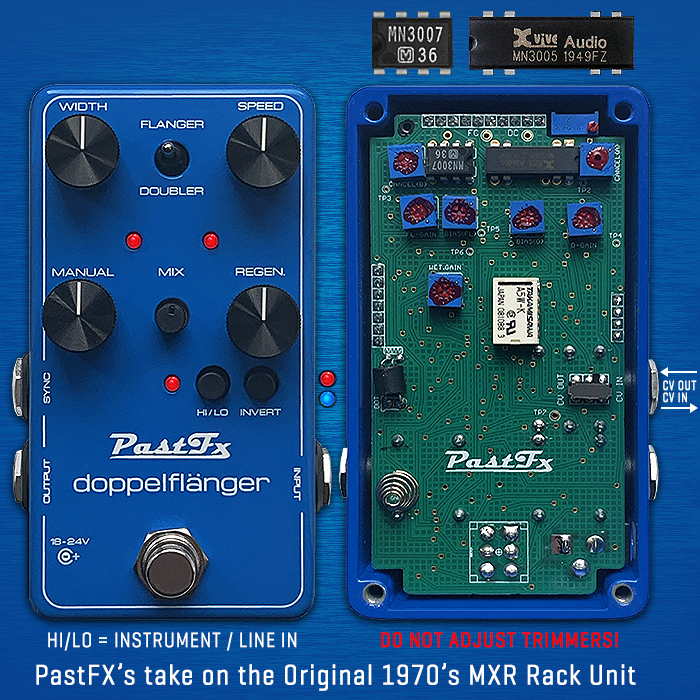
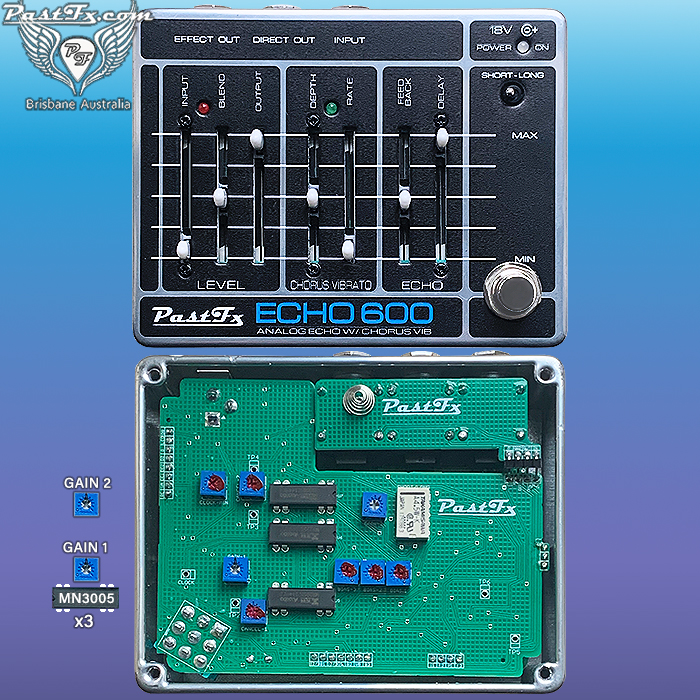
Operation of the two devices is pretty much identical (bar the power supply requirements) - with both having the equivalent controls. The Instrument / Line Level Input Switch is on the top of the M226R unit, where the doppelflänger has a HI/LO push button on its front facia. Also - the M226R has separate CV IN and CV OUT ports - while the doppelflânger uses the same Port - and you switch its function via internal slider switch, as illustrated above.
Controls - Width (Depth / Intensity), Mode [BBD chip] : Flanger / Doubler, Speed / Rate, Manual (Delay Time), Dry > Wet Mix, Regen (Feedback), Hi/Lo Switch (Instrument / Line In), Phase Invert Switch.
Internal CV Port Switch - < CV Out | CV In > .
I already have the TC Electronic Stereo Mimiq as a permanent fixture on on my board, so the Doubler option is not going to get much use really. I did though try out Dimebag's typical settings - Mode : Doubler, Width and Speed @ Noon, and Manual, Mix and Regen all at 9 o'c. You get a lot more subtle metallic edge to the output on Doubler Mode - but it is still there, and works particularly well with Higher Gain pedals. Indeed Boss's MZ-2 Digital Metalizer is based on a similar premise. So it's a cool effect for sure, but that particular Doubler is never going to threaten the 3 Stereo Overdubs of my TCE Mimiq!
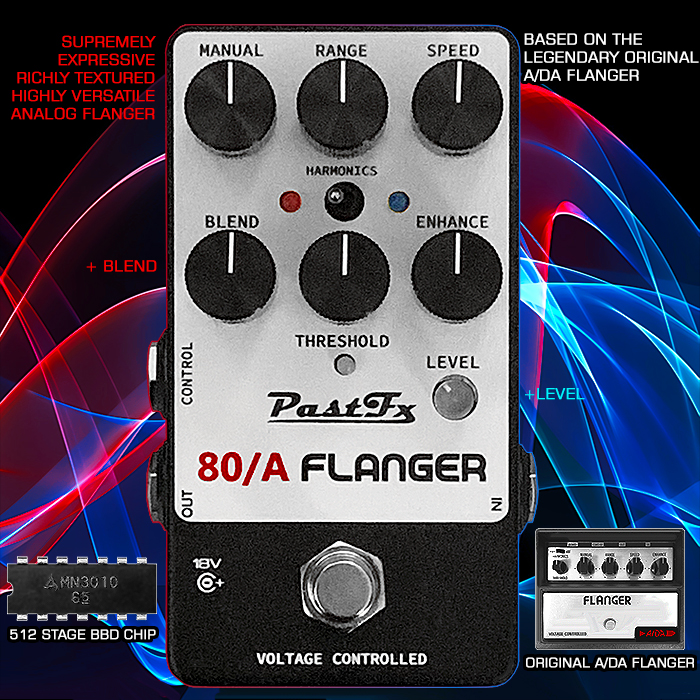
The Flanger voicing is superb though, while it doesn't have the full versatility of my favourite PastFX Flanger - the 80/A, but it does have its own very distinct voice - which sounds fantastic.
For my Flanger voicing - I have Mode on Flanger, Width @ 3 o'c, Speed @ Noon, Manual @ 9 o'c, Mix @ Noon, and Regen @ 3 o'c.
I entirely leave the HI/LO button switch well alone, while I do occasionally Invert the Phase - to get that more hollow hoover-phonic sound. But in the main those 2 push button switches don't get touched.
It's a distinct and unique sounding Flanger within PastFX's extensive range / repertoire - they're all excellent really, but I do slightly prefer the 80/A and Reticon Flangers.
If you're trying to recreate the tones of those famous artists named above - then of course this and the MXR M226R are the perfect tools for that purpose - and you have different criteria to decide upon here. I came very close to getting the M226R, while the doppelflänger is definitely the right choice for me!
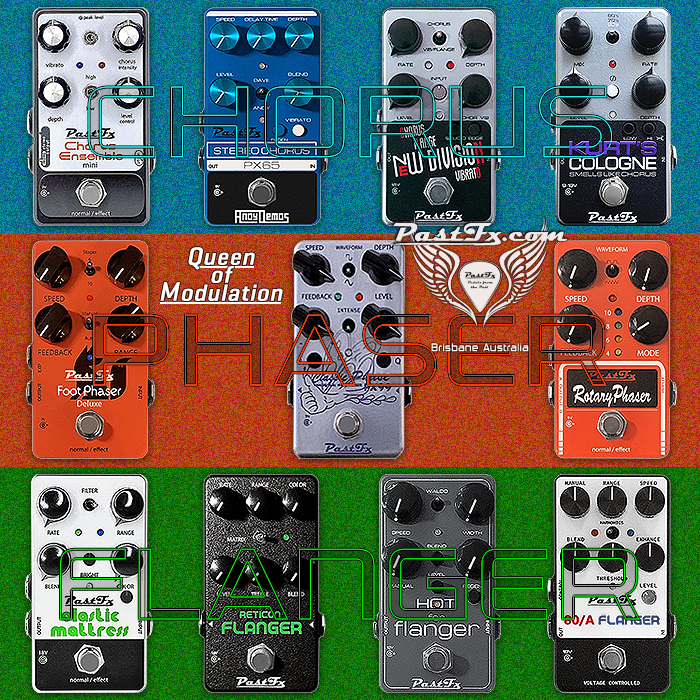
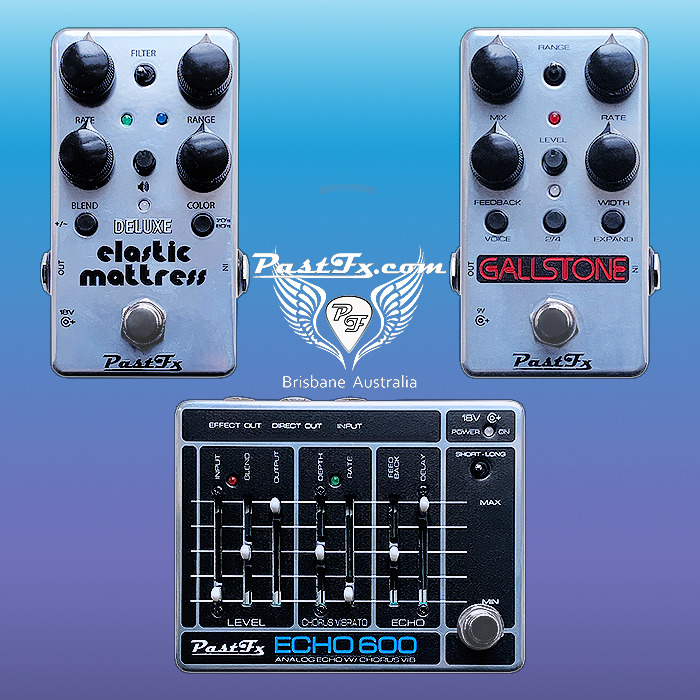
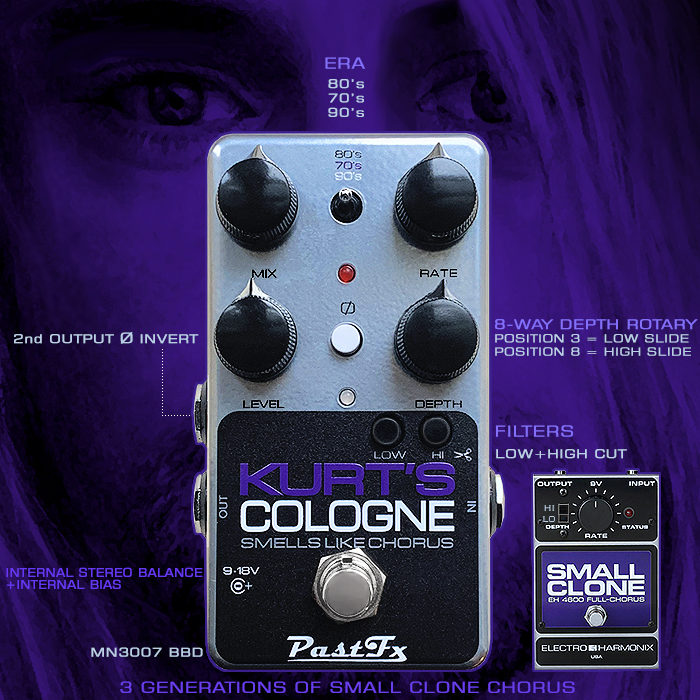
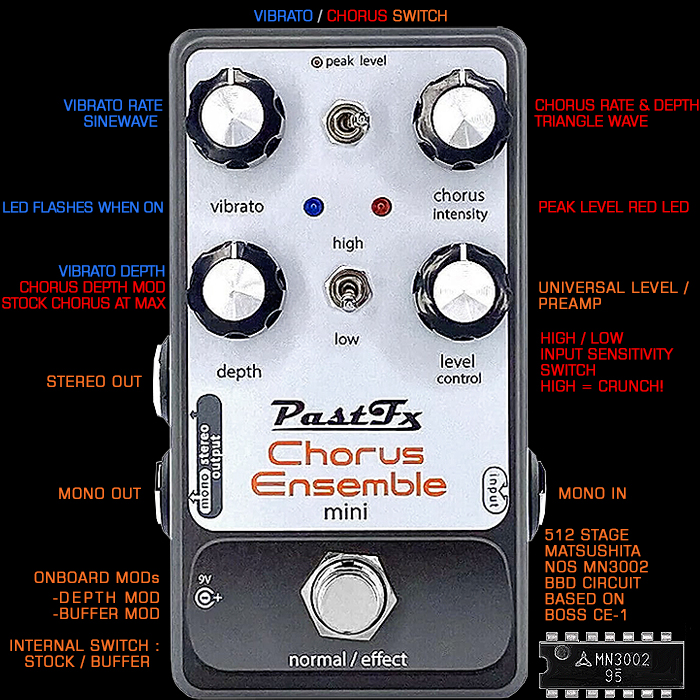
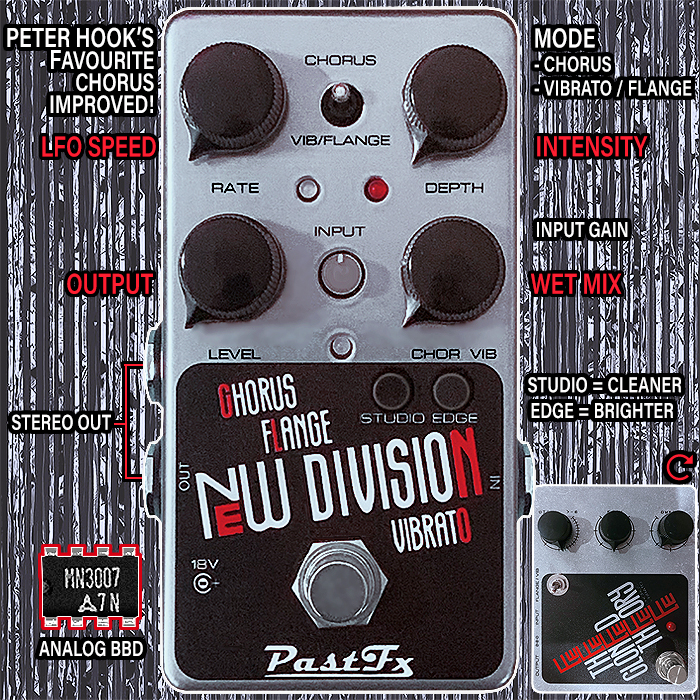
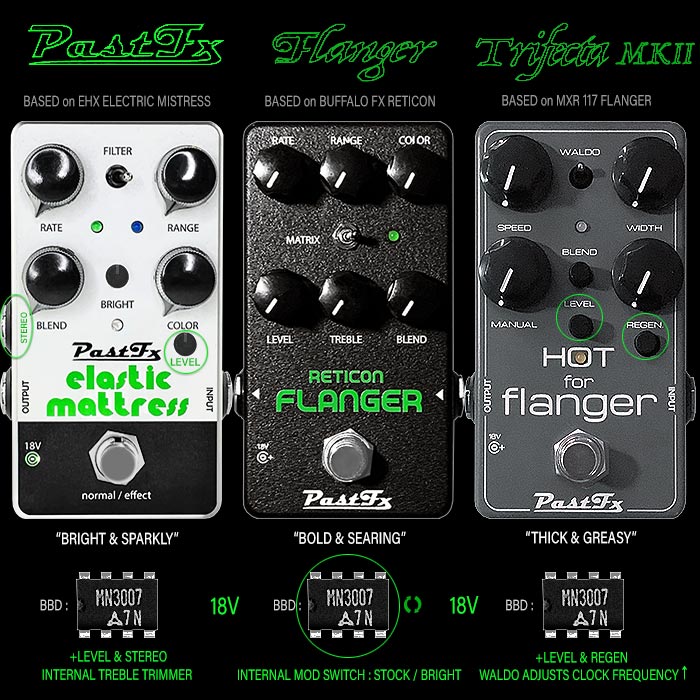
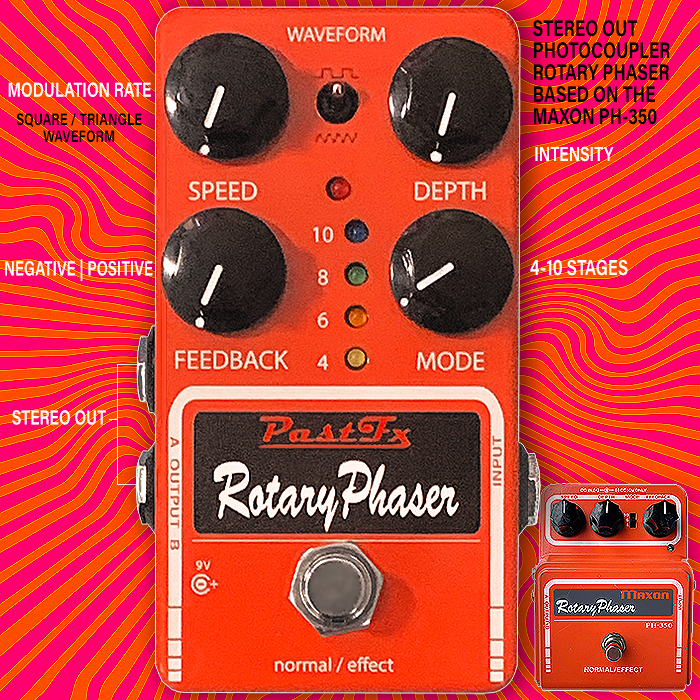
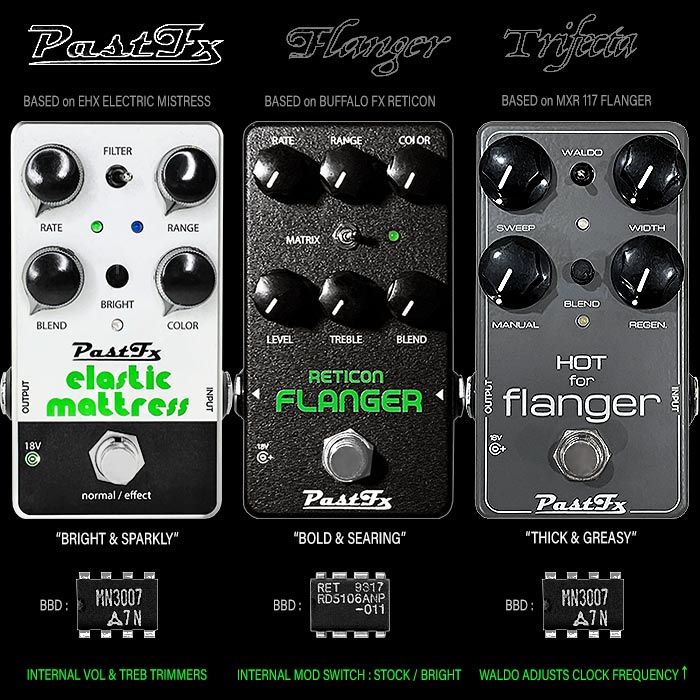
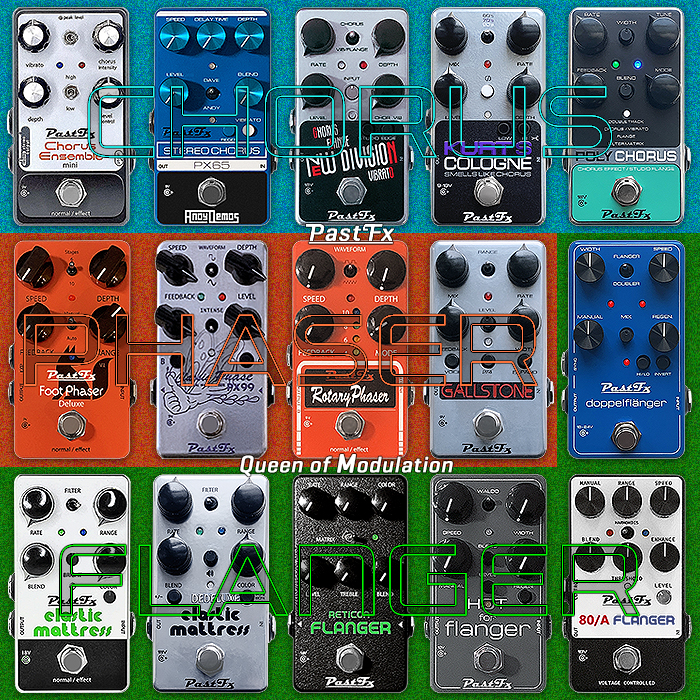
PastFX has been particularly strong on Choruses, Phasers and most significantly : Flangers - where there are now 6 of those Flanger varieties, and 15 Modulations overall within that group - as you can see in the below visual. Several of those have had multiple iterations.
I have loved every single Modulation Pedal PastFX has released - which is why I call Verlie the 'Queen of Modulation' no one really comes close to that depth of coverage and consistent quality and fidelity. And you soon get used to running most of those modulations at 18V - I have plenty of native ability within my power-supplies to switch voltages. While a lot of the time I just use one of my several Xotic Effects Voltage Doubler Adapters - which take a 9V supply up to 18V very nicely! (It also has the less useful 15V option). Would be cool to have one that does 12V / 15V / 18V!. Truetone and Voodoo Lab also have more straightforward adapters - while the Xotic is best a far as I'm concerned - I've been using those for years!
I've been consistently wowed by each of PastFX's modulation releases, and this one is no exception. Verlie really is a master at replicating those vintage circuits - using all the best, and mostly Vintage / NOS parts for her purposes.
The MXR flanger/doubler seems to be somewhat in vogue at the moment, and as soon as I saw the M226R, I hoped Verlie would have her own take out soon - indeed as Leon Todd mentions in my Sound Sample Reference video below. So those dual releases are somewhat coincidental - as Verlie had also been working on that circuit for a while.
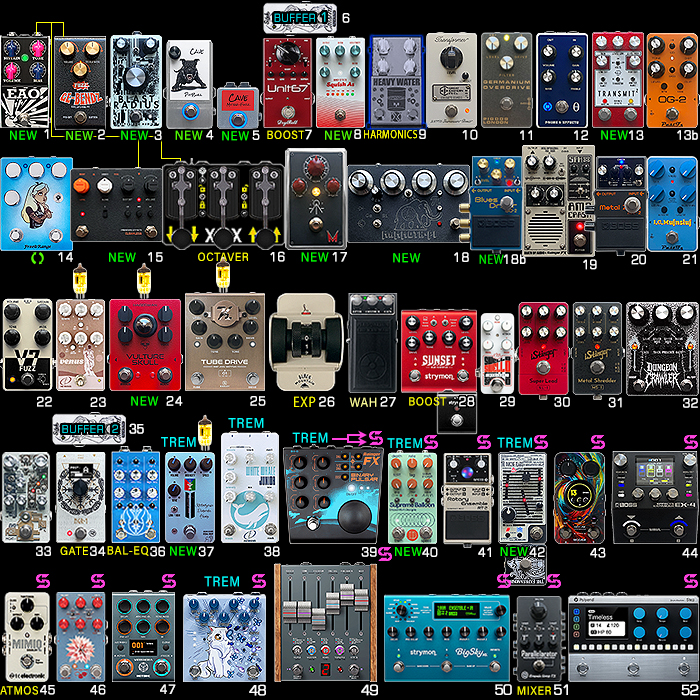
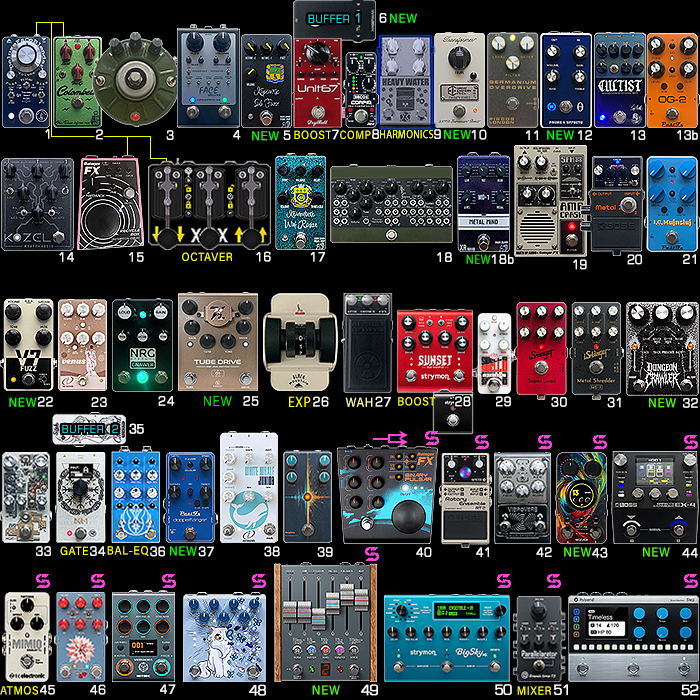
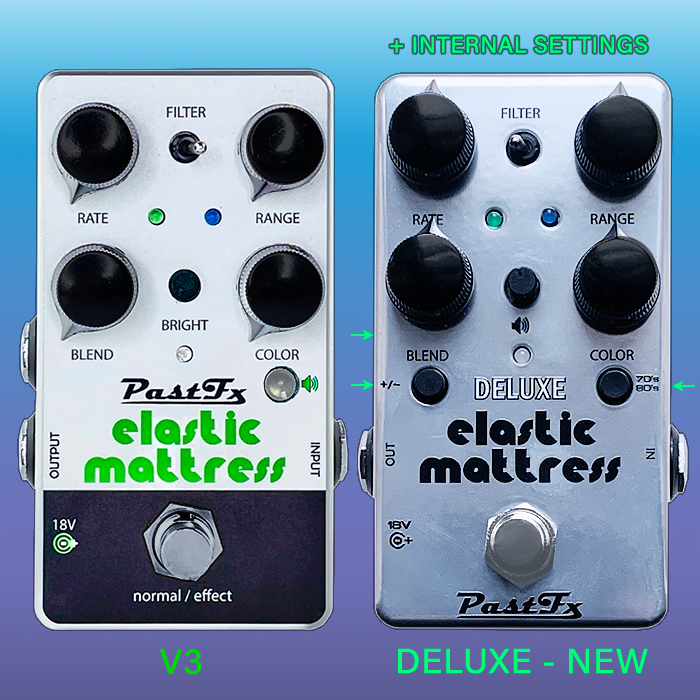
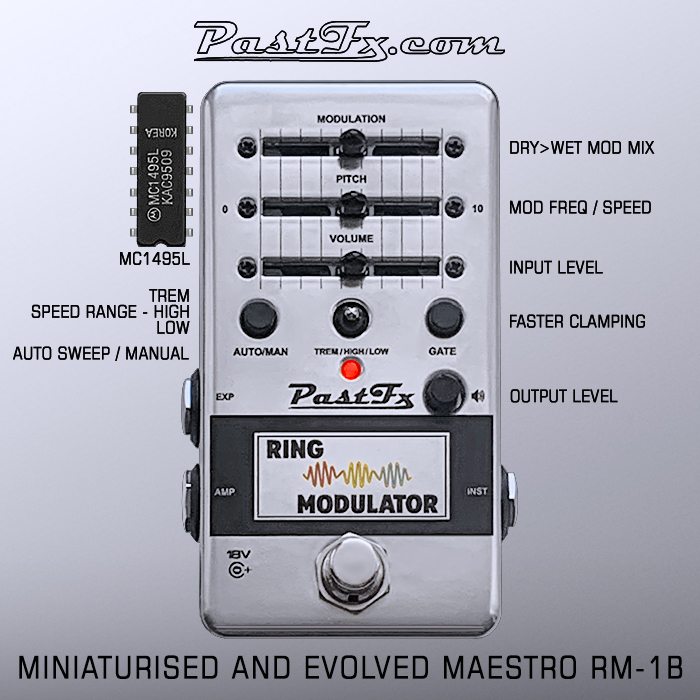
I can't fault a single one of Verlie's pedals - pretty much all of those are magnificent, and with this doppelflänger I now have a total of 35 PastFX Pedals in my reference collection. Including the 15 featured in the visual below, alongside the recent Ring Modulator, and PX-101 LowPass Filter. Interestingly I have 2 iterations of the Elastic Mattress, and Hot For Flanger. So my Total for PastFX Modulation Pedals now stands at 19!
As mentioned at the top - the doppelflänger goes for $399 AUD on the PastFX Webstore - which equates to $280 and £220. Very good value as always as far as I'm concerned.
There is no demo out yet for the doppelflänger while Leon Todd's review of Verlie's original Rack Unit below should provide you with some suitable equivalent sound samples - as that is the very unit the pedal was based on! UPDATE! I have hadded a couple of YouTube Shorts below!
Sound Sample Reference
Demos