

Xploration • Curation • Recommendation


Valeton issues a formidable challenger to the ToneX One with its GP-5


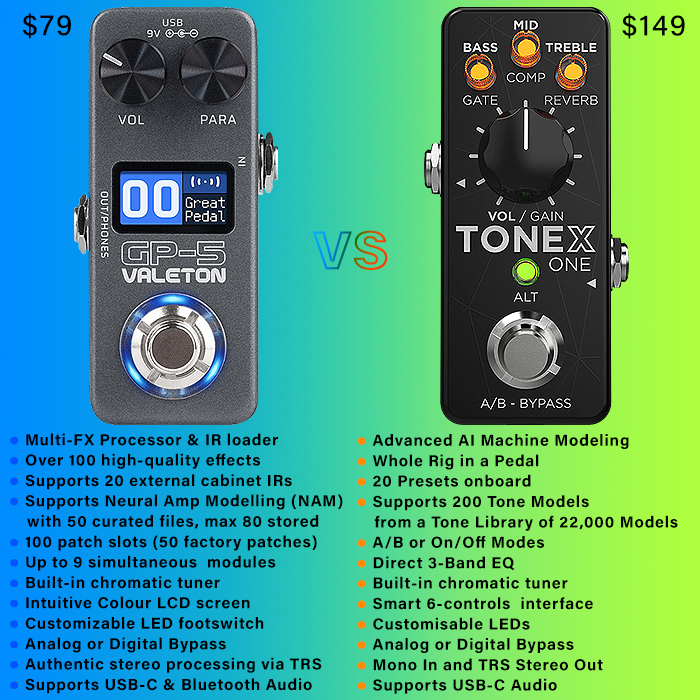
I would like to start by saying that the best feature set doesn’t necessarily result in the best tones - while a more intuitive interface can be a major motivator for many. It seems like Valeton read my critique of the ToneX One and set about solving those challenges and recommendations that I set, which it seems to have done admirably with this GP-5 unit. I suggested for instance that the ToneX One would benefit from a small screen, and Bluetooth-App connectivity - which the Valeton GP-5 has!
I’m not even going to labor the pricing component here - one is very obviously half the price of the other - and comes with more presets onboard, a properly intuitive Colour LCD screen and Bluetooth. I believe the ToneX One is designed and manufactured in Italy while the Valeton is likely from South-East Asia - meaning different core cost centres.
I still feel that the ToneX One interface is really smart - and the fact that you have hands-on 3-Band EQ cannot be understated - that is something that is notably missing on the GP-5 - where a single Parameter Rotary Encoder controls the screen real estate - and where presumably there is a fair amount of menu diving for the pedal. While the Bluetooth-connected App simplifies the dialling in process - It’s something I’ve become very familiar with for my Katana : GO. Notably - most agree that the Boss Katana : GO is the best sounding of those mini headphone amps, the Fender Mustang Micro Plus has the best App interface, while the Nux MP-3 Mighty Plug Pro has the largest feature set! I typically end up on the side of the best sounding device - while sometimes the intuitiveness and ease of the control topology rules supreme - so while the Valeton GP-5 has much the better feature set - you may still discover better tones on the ToneX One device.
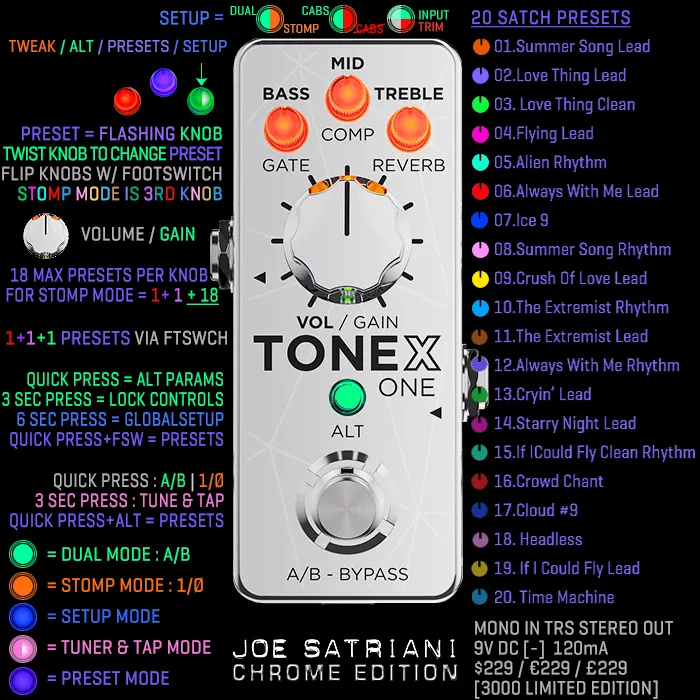
I own and love the Joe Satriani Chrome Edition of the ToneX One - I’ve gotten used to how it works, and I mostly like how it sounds.
As part of an overall user experience tough - the Valeton GP-5 may delivery a better ownership and operator experience - regardless of the tones. The ToneX One has a far deeper legacy, and a lot more reference tones (Tone Models) and presets that you can call upon. Overall these two devices overlap to a very significant degree.
I would very much like to check out the Valeton GP-5 to see how I get on with that. It allows for far more Presets onboard - with 100 patch slots.
Both devices are variously AI-Enhanced - particularly on the modelling / IR side - they’re obvious direct competitors and each retains certain advantages. I’m not going to do a blow-by-blow head-to-head here - rather I’ve tried to focus on the similarities as well as differences - and provide you with all the essential and salient details you need - in order to make the right decision.
As I always say - there is no substitute for trial and error - and a device with a better features set - does not always deliver better results - so all needs to be weighed up and considered correspondingly. I’ve already ticked off the ToneX One - and I will be checking out the Valeton GP-P at the earliest logical opportunity. I have plenty of priorities that I need to juggle around!
Here follow the Demos and Feature Lists for each device :
Valeton GP-5 Demos
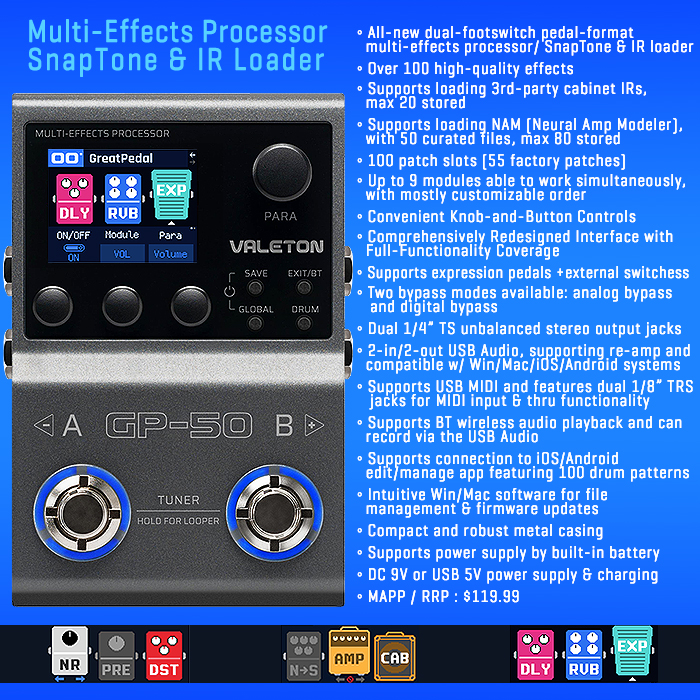
Valeton GP-5 Key Features
- Super compact multi-effects processor/Sound Clone & IR loader
- Over 100 high-quality effects
- Supports loading 3rd-party cabinet IRs, max 20 stored
- Supports latest Neural Amp Modelling (NAM), with 50 curated files, max 80 stored
- 100 patch slots (50 factory patches)
- Up to 9 modules able to work simultaneously, with the order of some modules being customizable
- Sensitive built-in chromatic tuner
- Color LCD screen presents an intuitive, user-friendly UI
- Customizable LED footswitch compatible with 4 usage modes: Patch, Songlist, Stomp CTL, and Tuner (Bypass)
- Two bypass modes available: analog bypass and digital bypass
- Authentic stereo processing, 1/4″ TRS unbalanced stereo output jack
- USB Audio, supporting re-amp and compatible with Win/Mac/iOS/Android systems
- Supports Bluetooth wireless audio playback and can record via the USB Audio
- Supports connection to iOS/Android edit/manage app featuring 100 drum patterns
- Intuitive Win/Mac software for file management & firmware updates
- Compact and robust metal casing
- BT Wireless: 5.0 Dual-Mode (BLE & audio)
- Analog Input: 1/4″ unbalanced (TS) Input Impedance: 1M Ohms
- Analog Output Connection Output: 1/4″ unbalanced stereo (TRS), compatible with headphones
- Output Impedance: 100 Ohms
- USB Recording:
- USB 2.0 Type-C Port
- Sample Rate: 44.1 kHz
- Depth: Supports 16-bit
- Size and Weight
- Dimensions: 93.5mm(W) x 42mm(D) x 52mm(H)
- Unit Weight: 237g
- Power Requirements: DC 9V center negative or USB 5V (not included)
- Current Consumption: 200mA (9V)
- MAP / RRP : $79 | €79 | £79
ToneX One Demos
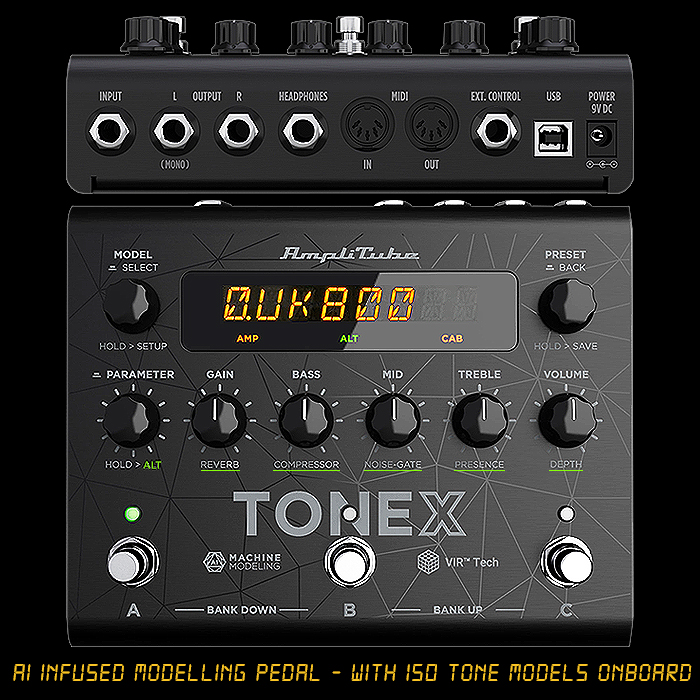
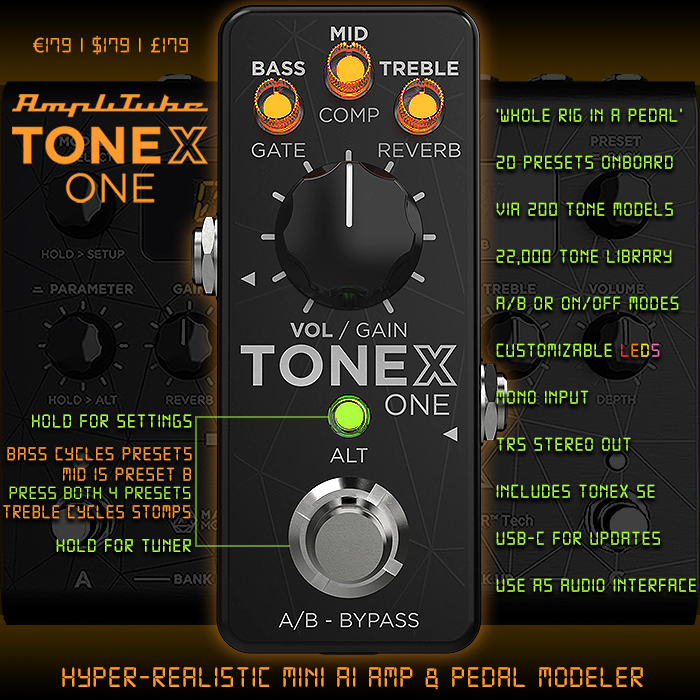
ToneX One Key Features
- Advanced AI Machine Modeling™ technology for hyper realistic Tone Models
- Play models of amps, amps + cabs, combos or pedals like: distortion, overdrive, fuzz, boost and EQ
- Built-in USB port doubles an audio interface for recording and for preset management
- Exclusive VIR™ multi-IR cabinets and custom IR Loader, Noise gate, EQ, compressor and 5 stereo reverbs
- Store up to 20 presets with 3 assignable slots
- Two Performance Modes: Stomp or Dual presets
- TRS output: Stereo, dual mono or headphones
- Customizable RGB retro-illuminated micro knobs for each preset
- Access to over 25,000 user Tone Models on ToneNET
- Includes a tuner with 2 modes: Thru and Mute
- Connects to real amps, PA systems and FRFR Cabs
- No editing lost with 'always saved' behavior
- Safe mode to protect accidental parameter change while playing
- Auto save mode for making adjustments on the fly
- Global cabinet bypass option
- Add Premium, Signature or Tone Partner expansions
- Model your own rig (amp, cabinets, pedals) using the TONEX modeling software
- Includes TONEX SE software all-in-one player, modeler and librarian and AmpliTube 5 SE software
- Preloaded with 12 bonus Tone Models from TONEX MAX/Reg
- Compact design to fit on any size pedalboard
- Power : 9V DC [-] 120mA
- Dimensions : 48mm x 94mm x 53mm
- Weight : 160g
- RRP / MAP : €179 | $179 | £179
Final Thoughts
The one challenge that still remains for both these devices is the MISO situation - Mono TS In with Stereo TRS Out - meaning that this device is entirely designed as a stand-alone unit and is intended to be connected directly with your guitar. It's a singular pedal rather than one of many. You can follow it with secondary Stereo Delays and Reverbs - but there's no Stereo Input - which is kind of a problem for me - in that it becomes the one cross-over pedal in the signal chain that bridges the Mono to Stereo divide! I have way too many MISO pedals - where you can only use one of those on the board at them time - and it always has to be part of that Mono > Stereo Bridge - and so has limited versatility.
The advantages of the Valeton GP-5 are numbers - but you'e heavily reliant on the BT-App - unlike for the ToneX One - where you can accomplish most functions on the actual device. Obviously the ToneX One has direct hands on controls for 3-Band EQ, Noise Gate, Compession, and Reverb - while for the GP-5 you will need to menu dive and mostly rely on the Bluetooth app of substantive changes. For the ToneX One there are a few extras you can accomplish via the USB-connected App, but you really have fully control over near all the key functional areas - via the onboard control topology.
I feel the other advantage of the GP-5 is easily knowing what preset or mode you're on - via the screen - while on the ToneX One - you need a pretty strong colour-sense to be able to quickly and accurately decipher what's going on - while the EQ is clearly visible at all times.
I already like the ToneX One device - despite some heavy scepticism at the start. I will need to live with the Valeton GP-5 for a while now - to establish if it's as much fun - or more fun even to use than the ToneX One - and what the comparative quality of its output is.
When the ToneX One originally launched it was at the $€£179 mark, while the price has dropped latterly to $€£149. That compared to the significant undercutting of the GP-5 - which is incredibly available at the same price as a basic tuner - or just $€£79 !!! A whole $100 less than the ToneX One at launch.
The ToneX One has been incredibly popular, and rightly so, while the Valeton GP-5 looks set to outsell that eventually. While as mentioned price point and feature set are not necessarily in direct proportion to output quality!
Overall the Valeton GP-5 looks and sounds pretty fantastic - I look forward to reporting back on that when I've had some prolonged hands-on experience with said innovative unit. It solves most of the challenges I had with the ToneX One, but offers up a couple of new ones - and doesn't solve the MISO > SISO situation - which kind of matters to me!





Content Subscriptions