Xploration • Curation • Recommendation


Alexander Pedals' Marshmallow Pitch-Shifter and Sugarcube Stereo Chorus/Vibrato/Rotary make for a Formidable Pair of Tone Sweeteners


Key Points
Alexander Neo Series: digital pedals with 4 onboard presets (16 via MIDI), Neo Morph, MultiJack for expression/Neo/MIDI, Ramp footswitch, Select button, MIDI/USB control — MultiJack allows up to 6-parameter control and supports El Garatge.
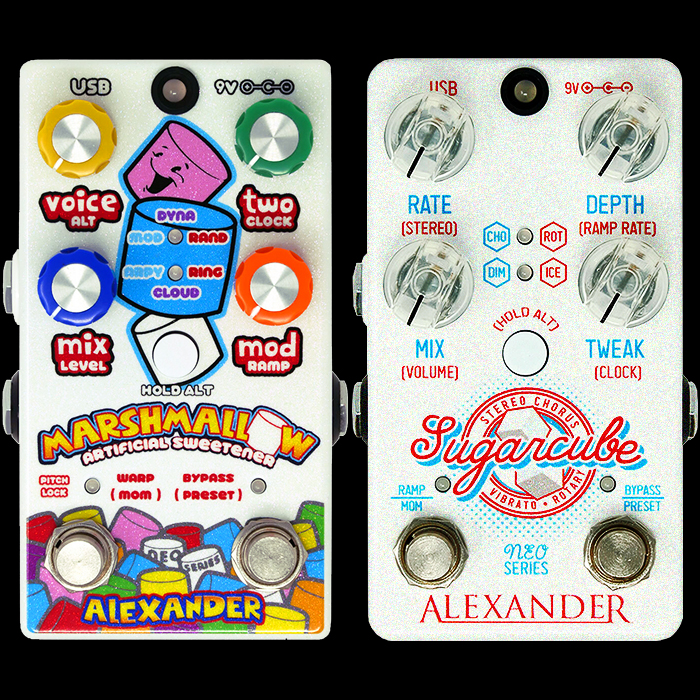
Marshmallow Dual Pitch‑Shifter (Rainbow Pride): 6 modes — MOD, ARPY, RAND, RING, DYNA, CLOUD; controls Voice/Alt, Two/Clock, Mix/Level, Mod/Ramp; Pitch Lock: Off (violet), Chromatic (yellow), Major (cyan), Minor (green). As of 2026-07-13, the price was £199.
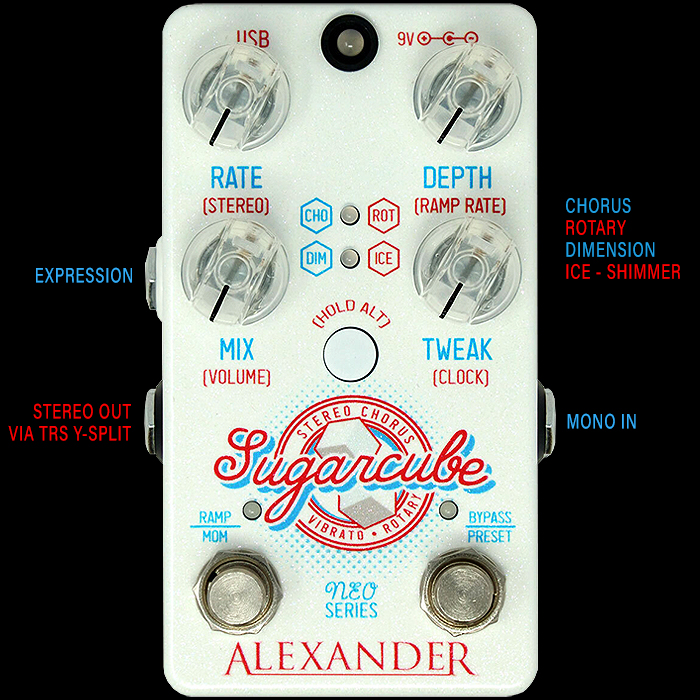
Sugarcube Stereo Chorus/Vibrato/Rotary: 4 modes — CHO, DIM, ROT, ICE; controls Rate/Stereo, Depth/RampRate, Mix/Volume, Tweak/Clock; stereo rotary with MultiJack/TRS output; sparkly finish. As of 2026-07-13, the price was £199.
Those sharp-eyed among you will have noted that I singled out the Alexander Sugarcube Stereo Chorus/Vibrato/Rotary during this year’s Virtual Winter NAMM - as a pedal of interest. I’m of a mind that any half-decent Rotary pedal really has to have Stereo output to be effective. And apart from the DigiTech Ventura Vibe - there are really very few compact-size Stereo Rotary pedals out there. So I was very excited when Alexander introduced this one.
It’s obviously been on the wishlist for a while and has been traveling up the list of priorities. Especially since I’m working with friend Oriol Domingo on his smart El Garatge pedal enhancement devices - the Expression Knob and Echo Knob - and we were looking to represent the widest possible appeal. Oriol’s devices are perfect for digital control-layer pedals - for marshalling simultaneous Multi-Parameter Expression Control. And the Alexander Neo Series Pedals allow you to control up to 6 parameters simultaneously via the top-left MultiJack / Expression socket.
I’ve also previously praised the Rainbow Pride edition of the Marshmallow Twin Pitch-Shifter - which has a full 4 colour print job not just on the main facia, but the pedal’s 4 sides too - a really cool and colourful edition. Note that the Sugarcube’s enclosure has a sparkly flake in amongst all that white - which gives it an elegant shimmer - while that is not clear in most photographs of that pedal.
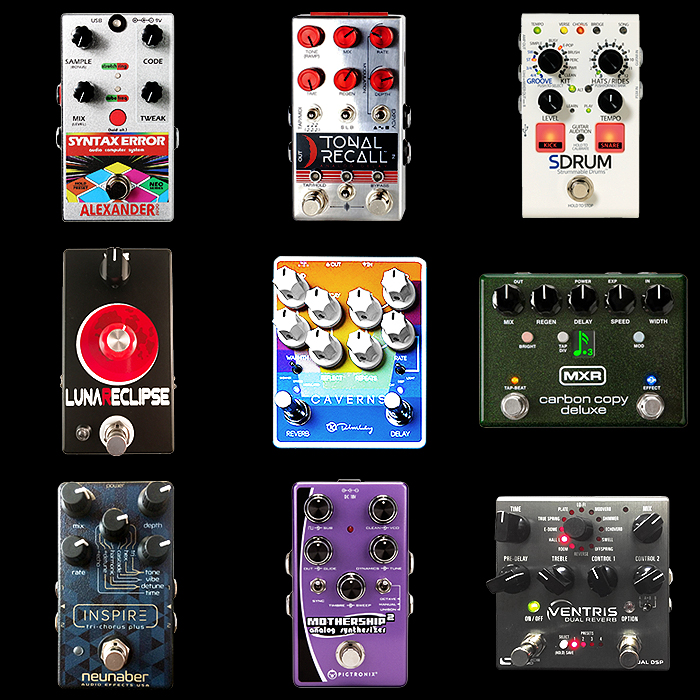
I was determined to get the Sugarcube, and as the Rainbow Pride Limited Edition was once more on offer - I thought it opportune to order that too! Colourway-wise and by way of their complementary nature - these 2 make for a very formidable pairing. Funnily though another Alexander pair have been on my wishlist for an even longer time - the Colour Theory Spectrum 8-step Sequencer, and the Syntax Error 80’s Bit-Processor Modulation. Weirdly both of those seem to be in very short supply in the UK - while they are both definitely down for me to acquire at some stage.
All these mentioned pedals are part of the Alexander Pedals Neo Series - which each come with some really smart features. These are obviously digital-type pedals with intelligent saveable parameter controls. Here are their most pertinent common features :
Common Neo Series Pedal Features :
- Presets - 4 presets onboard via right-hand footswitch, 16 via MIDI
- Neo Morph - Seemlessly morph between different knob settings on the fly - via Option footswitch, expression control, Neo footswitch or MIDI controller
- Multijack - Upper left jack socket can connect with Expression Controller/Pedal, Neo Footswtich, or MIDI controller
- Ramp Footswitch - Tap the left footswitch to trigger and latch Neo Morph, or hold it for a momentary Morph effect
- Select Button - Use central Hold/Alt button to select new sound mode, hold down to access alternative / secondary knob functions
- MIDI Control - Every knob and setting on the pedal is controllable using MIDI. Connect using MultiJack socket and Neo Link or any Disaster Area Gen3 controller
- USB Port - USB Port for MIDI control and firmware updates
Below you will find further details one each unit :
Marshmallow Dual Pitch-Shifter Modulator Limited Rainbow Pride Edition - $199
This is a really cool Twin Pitch-Shifter pedal with some truly smart algorithms including Arpeggiation, Random Modulation and Ring Modulation :
6 Modes :
- MOD - Dual pitch shift with adjustable pitch modulation. VOICE and TWO control the pitch shift intervals, MOD and ALT control the depth and rate of the modulation
- ARPY - Tweakable arpeggiator effect. VOICE, TWO, and MOD control the intervals of the arpeggio, and ALT controls the speed and direction of the arpeggiator. Set ALT near the middle for slower speeds, or towards either end for faster ones
- RAND - Dual pitch shift with random modulation. VOICE and TWO control the pitch shift intervals, MOD controls the amount of modulation from the randomizer, and ALT controls the amount of modulation signal fed to each pitch shift voice
- RING - Dual pitch shift with automatic panning between the two signals. VOICE and TWO control the pitch shift intervals, MOD controls the speed of modulation from a very slow tremolo to a very horrible ring modulation, and ALT controls the balance between the two pitch shifted signals
- DYNA - Dynamic pitch shifter. VOICE and TWO select the “quiet” and “loud” pitch shift intervals, MOD sets the sensitivity of the envelope detector. Play quietly to hear the VOICE pitch and play louder to hear the TWO pitch. Set ALT counter-clockwise to shift seamlessly between the two pitches, or clockwise to bend from one to the other.
- CLOUD - Dual pitch shift with adjustable feedback, for reverb-like washes and echoes. VOICE and TWO control the pitch shift intervals, MOD controls the feedback / texture, and ALT controls the balance between the two pitch shifted signals.
Controls : Voice/Alt, Two/Clock, Mix/Level, Mod/Ramp
Select via central Alt button + Warp/Mom Footswitch
- Pitch Lock Off (alt LED is violet) - Pitch sweeps smoothly from -1 octave to +1 octave. Non-chromatic pitches are possible including slight detuning effects.
- Pitch Lock Chromatic (alt LED is yellow) - Pitch locks to chromatic intervals from -1 octave to +1 octave. Every half-step is available from -12 to +12
- Pitch Lock Major (alt LED is cyan) - Pitch locks to a major scale from -1 octave to +1 octave
- Pitch Lock Minor (alt LED is green) - Pitch locks to a minor scale from -1 octave to +1 octave
Sugarcube Stereo Chorus/Vibrato/Rotary - $199
The Sugarcube is a rare Compact Stereo Rotary pedal in particular - which forms most of the appeal for me here - while the other 3 modes are pretty handy too. Note that this has a really cool sparkly flecked enclosure finish which is not visible in most photos.
4 Modes :
- CHO - mode is the iconic ‘70s and ‘80s analog chorus tone, with a single delay line and one voice. Rate and Depth control the modulation, while the Tweak knob adds additional voices mixed in from further down the delay line. In mono mode, up to three voices are available, but in stereo mode Sugarcube can mix up to six voices across the soundstage
- DIM - features two separate delay lines that move in opposite directions for a “motionless” chorus. This is usually much more subtle than the CHO mode and is excellent for adding space to your tone without a lot of warble. Tweak adds adjustable feedback for 'flange'-type chorus sounds popular in the mid to late ‘80s
- ROT - is the recreation of the magical Rotary / Leslie Speaker. The Tweak knob controls the mix between the upper rotors and the lower drum. We recommend you try this one with the Mix knob fully clockwise for the strongest effect, and it does sound way cooler in stereo!
- ICE - an Alexander original, this mode adds an adjustable pitch shift to the chorus voices. The pitch is selectable from -1 Octave, Detune, + 5th, and +1 Octave. Try this with two different pitch settings on the Ramp footswitch for sliding modulation effects. We also love hearing this one with the Clock knob set low for grainy primitive '12-bit' digital effects
Controls - Rate/Stereo, Depth/RampRate, Mix/Volume, Tweak/Clock, Left Footswitch : Ramp/Mom, Right Footswitch : Bypass/Preset.
Stereo Output
Via MultiJack / Upper-left socket and TRS Y-Splitter Cable - adjust by pressing and holding Hold Alt button and tweaking Rate/Stereo knob. With mono output patch cable the Rate/Stereo alt control adjusts Wet/Dry output
Note that I will be detailing particular usage scenarios for the El Garatge Expression Knob and Echo Knob devices in a forthcoming article.
Final Thoughts
There's no question that Alexander makes great-sounding digital devices - where often my preference is for analog equivalents - while in this instance - and particularly for the Stereo Rotary effect - that is sufficiently rare enough fo this enclosure size to warranty acquisition.
These pedals deserve to be lauded as much as the Chase Bliss Audio Compacts as they deliver similar degrees of smarts. I've noted before also that Alexander have a very distinctive design of enclosure - from the graphics and topology perspective - which really makes them stand out.
My quotient of Alexander Pedals is now up to 5, and I have at least a couple more to ge!
How about you readers - do you have any love for these Alexander Pedals?