

Xploration • Curation • Recommendation


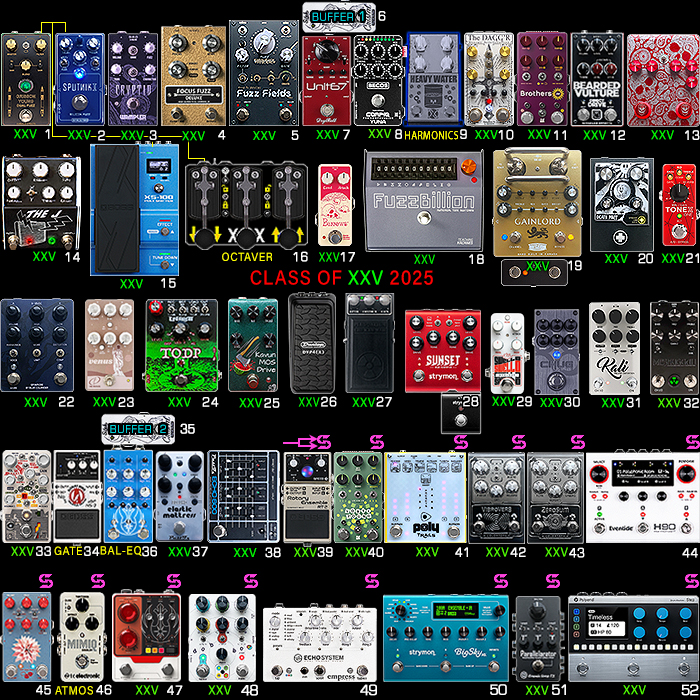
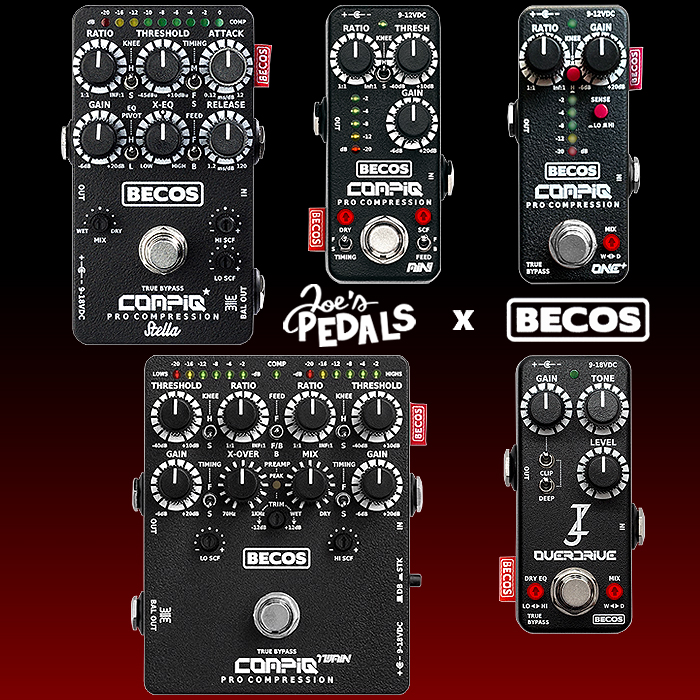
Becos FX rolls out a more streamlined, smarter compressor essentially - named the CompIQ Pro Yuna - a soft-knee Blackmer VCA Studio style Compressor which gives you full coverage with fewer controls - and with overall easier dial-in!


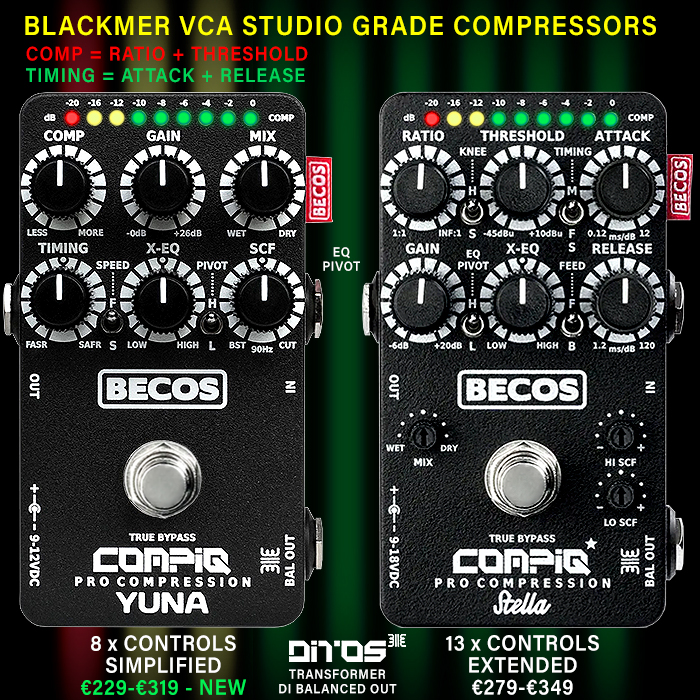
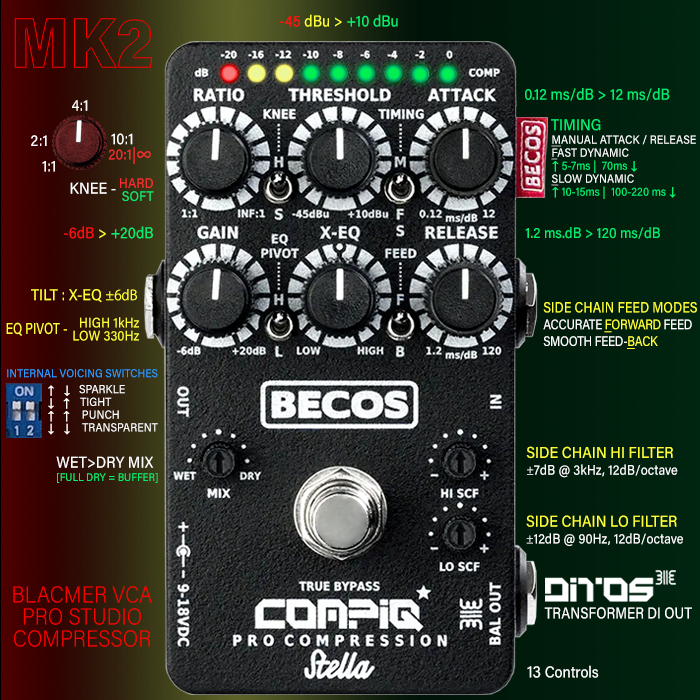
So Becos FX takes a leaf out of the DBX 163X Over Easy Compressor playbook and essentially delivers a slightly more streamlined take on the CompIQ Pro Stella - where it removes the Hard-Knee option (Soft-Knee only therefore), and combines the former Ratio and Threshold into a singular ’Comp’ control, and Attack and Release get very cleverly combined for the ’Timing’ control.
The Stella has a few more options on the surface, while the Yuna relegates some of those inside the pedal - via Jumper switches, and simplifies other options - like the separate Hi and Lo SCF controls on the Stella are combined within a universal SCF control in the Yuna. So the Yuna benefits from some really smart combined controls - which make it easier and quicker to dial-in and configure that pedal.
It’s really for those who looked at the Stella and decided it looked a little bit complicated - with its 13 surface controls, where the Yuna makes do very nicely with just 8!
Stella Controls - Ratio : 1:1 > Inf : 1, Knee : Hard / Soft, Threshold : -45dBu > +10dBu, Timing : Medium / Fast / Slow, Attack : 0.12 > 12ms/dB, Gain : -6dB > +20dB, EQ Pivot : High / Low, X-EQ (Tilt : Low > High), Feed : Feed-Forward / Feed-Back, Release : 1.2 < 120 ms/dB, Wet > Dry Mix, Hi SCF, Lo SCF [Side Chain Feed].
The Stella has separate Ratio and Threshold controls - where the Yuna combines those on a single ’Comp’ knob. There’s also separate Attack & Release controls on the Stella - where those are combined into ’Timing’ on the Yuna.
Most significantly the Yuna does not have the following controls :
Knee : Hard / Soft, Medium Speed / Timing Mode, Feed : Feed-Forward / Feed-Back (internal Jumper on YUNA), Stella also has separate Hi and Lo SCF (Side Chain Feed) controls - where the Yuna has a single universal one.
So the Stella has marginally more precision and granularity of control - but besides the Hard-Knee Compression - which only the Stella can do - both devices cover very similar ground.
The new Yuna is slightly easier to use, and quicker to dial in - wile probably overall 95% the same as the Stella - or however much you would want to ascribe to Hard-Knee Compression, and more granularity of control!
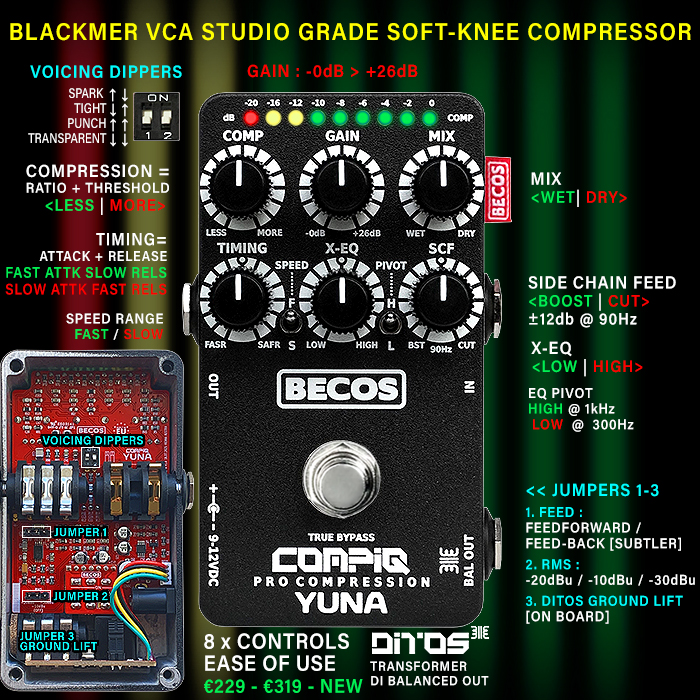
Yuna Controls - Comp (Ratio + Threshold) [Max Ratio 20:1 for Feed-Forward, 10:1 for Feed-Back], Gain (-0dB > +26dB), Wet>Dry Mix, Timing (Attack + Release) [FAST - FAST Attack Slow Release > SAFR - Slow Attack Fast Release), Speed : Fast / Slow, X-EQ (Tilt : Low > High), EQ Pivot : High . Low, SCF Side Chain Filter : Boost > 90Hz > Cut).
Internal Core Voicing Dip-Switches - same as for the Stella
- ↑ ↓ : Spark
- ↓ ↑ : Tight
- ↑ ↑ : Punch
- ↓ ↓ : Transparent
I tend to have 'Transparent' voicing set mostly - but each of the others definitely does its own thing too - so I'm occasionally on 'Punch' voicing also, and not really the Spark or Tight. Some of those are more suited to Bass players.
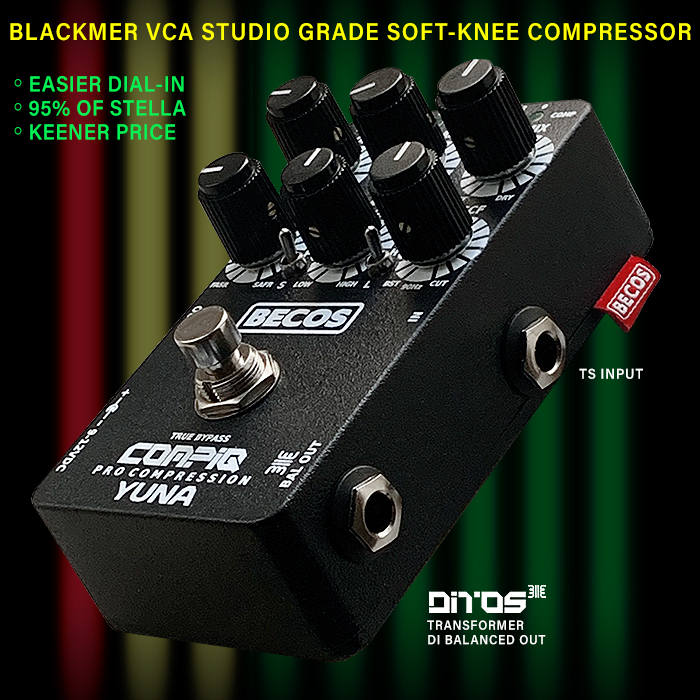
Yuna Ports - TS In, DITOS Transformer Balanced Out, TS Out, 9-12V DC [-] 60mA.
The Yuna has 3 Internal Jumpers
- Feed : Feed-Forward / Feed-Back
- RMS : -20dBu / -10dBu / -30dBu
- DITOS Ground Lift : On Daughterboard
So option #1 is in place of the surface toggle-switch on the Stella!
I really love the Stella - and I feel that is probably my most favoured Compressor to date - while I'm really enjoying using the Yuna too these last few weeks - I did though really love the precision and granularity available on the Stella - and had become very used to dialling that in.
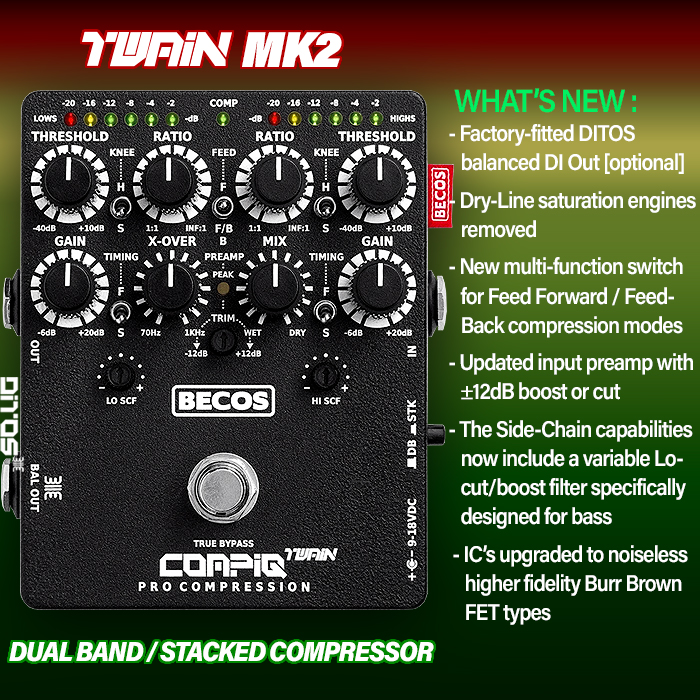
Interestingly Costel tells me that it's typically the Bass players that tend to favour the larger / more granular Stella and Twain compressors - where Guitarists more typically favour the Mini Editions - either the CompIQ Mini Pro, or Mini One Pro.
I've long been meaning to add the CompIQ Mini Pro too - while I will of course more typically favour the Stella and Yuna. I do like a full-featured compressor - because of the precision you have at your finger tips - you can so finely shape the output of he Stella in particular - while some players suffer a little from option paralysis - because of those 13 controls!
In fact most Bass Players typically have a compressor on their board, where a lot of guitarists don't. This is why the Bass Demos are always prioritised for these Becos releases / launches - as that's the main target audience.
Seems like I'm relatively rare in favouring the Stella and now Yuna - while I've had a compressor on the board for the vast majority of the time that I've been active - so many years!
Both of Becos's compact compressors do an excellent job - while the Yuna obviously leans into the softer side of things, and slightly softer on the precision too. I always say that pedals are about finding your own lane - and picking out the pedal that is the closest match to your own preferences and sensibilities.
As I've always favoured extended-range Compressors - it totally makes sense that I would gravitate towards the Stella and Yuna - while those that just want a flavour of those will go with the smaller CompIQ Mini Pro or Mini One. Many players like to keep things simple and directly 'on-task', while I typically want and enjoy having a little more in reserve - for just in in case!
My Edition of Yuna (with DITOS) is at €319 from the Becos FX Webstore, and an incredible €229 without the DITOS Board + Extra Output Socket. This compares to the Stella - which goes for €279 and €349 respectively. I feel it all depends on whether you value Precision (Stella) or Ease and Speed of Dial-in (Yuna). Becos FX seems to be building to dual options for each segment - a simpler vs more granular variant!
Note that listed prices exclude VAT. Most buyers will be subject to VAT and Customs charges when the pedal ships!
Get free International shipping with the code - GPX-YUNA
Features and Specs
FEATURES
- Full analog circuit with true by-pass
- True RMS-level detector with reference levels at -10dBu, -20dBu which is default for instrument level, -30dBu (jumper settable)
- High-performance Blackmer® VCA compression engine
- Optional DITOS board for transformer-coupled balanced output (10KΩ impedance); replaces battery operation
- Feed Forward/Feed-back compression modes (jumper settable)
- From Less compression to More compression (ratio coupled with threshold)
- Make-up Gain -0dB to +26dB
- Soft Knee compression
- Manual reversible semi-dynamic timing: from fast attack & slow release (FASR) to slower attack & faster release (SAFR)
- Fast/Slower timing ranges, with hold for peaks over the threshold
- X-EQ with selectable frequency pivot 300Hz for bass or 1KHz for guitar
- Voicing: Flat, Spark, Tight, Punch (internal DIP-switch selectable)
- Lows variable side-chain filter with progressive boost & cut below 90Hz
- Dry/Wet mix
- 8-LEDs gain reduction meter
- High-end quality Burr-Brown FET audio ICs, low tolerance metal-film resistors, Panasonic, Kemet, Cornell
- Dubilier plastic film audio capacitors, Gold-plated multi-layers PCB, Gold-plated micro-switches
- Genuine Hammond black-powdered aluminum enclosure
- Runs on standard 9V internal battery or 9-12V DC external power supply (not included), center negative,
- 12mm long barrel plug; replaces DITOS option
- 3-year warranty (direct to manufacturer, international, transferable)
- Hand-assembled in Vienna, Austria
- RRP : €229 without DITOS, €319 with DITOS (as pictured)
SPECS
- Input impedance: > 1.1MΩ
- Output impedance: ~100Ω
- 0dB RMS-in ref. level: -10dBu / -20dBu (77.5mV) / -30dBu
- Output noise: -95dBV @0dBV gain
- THD VCA: 0.1% 1kHz, 0dBu in/out, 24KHz BW, 12VDC power, through
6th harmonic; DITOS: 0.18% - Output frequency response: 0dB from 30Hz - 22KHz
- Optimal power voltage: 9-12VDC ±10% Center Negative
- DC power plug: Ø 5.1/2.1mm, 12mm long Barrel
- Current consumption: < 45mA @ 9VDC; < 55mA @ 12VDC
- Product Size: Length: 61mm, Depth: 102mm, Height: 51mm
- Product Weight: 220 gr. / 245 gr. with DITOS DI
- Packed Weight: 330 gr. / 350 gr. with DITOS DI
- Packed Shipping Weight (one unit): 491 gr. / 525 gr. with DITOS DI
Demos





Content Subscriptions