

Xploration • Curation • Recommendation


RhPf Electronic's Mo(s)ghoul is a very distinct Articulate, Harmonic, Multi-Voice MOSFET Distortion loosely based on the peak sounds of Weezer and Smashing Pumpkins


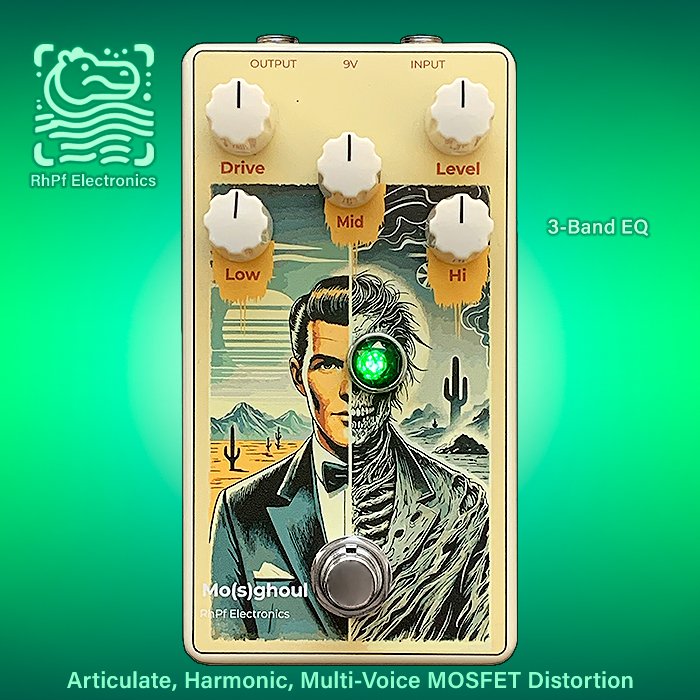
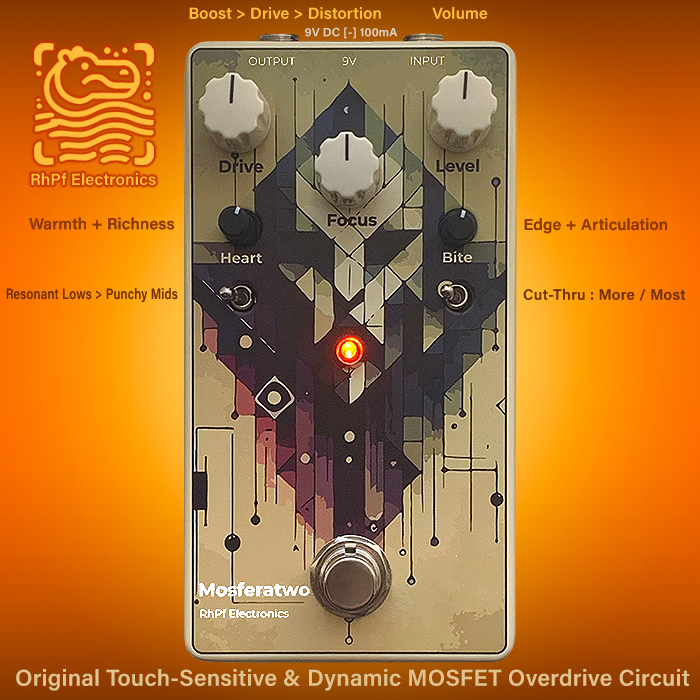
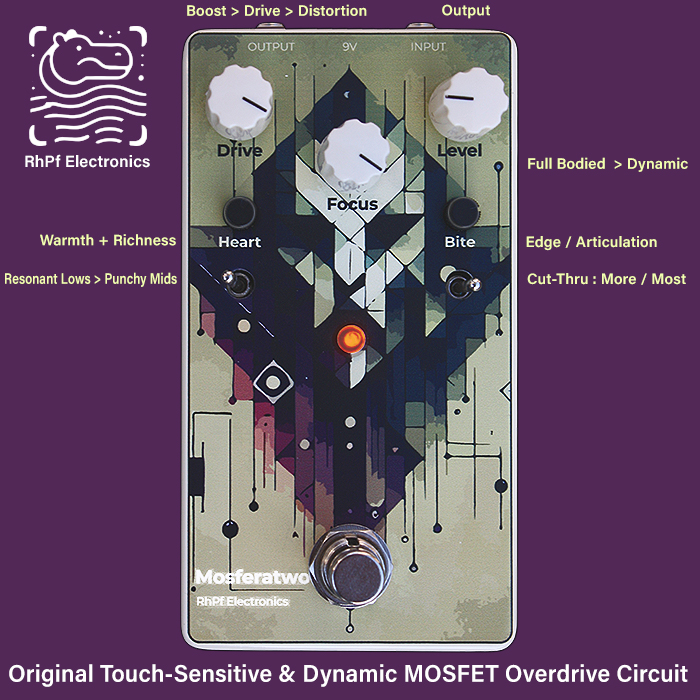
So this Mo(s)ghoul is the sibling to the previously reviewed Mosferatwo - where both are hybrid soft-and-hard-clipping MOSFET drives. But where the Mosferatwo leans much more towards soft-clipping overdrive, while the Mo(s)ghoul really sounds like a hard-clipper distortion. You get a kind of twin peaks output to the Mo(s)ghoul - where at times it sounds like 2 double-tracked guitars, and sometimes it even sounds like 3 - largely dependent on where the Mids are set.
It’s like a lower-gain HM-2 Twin Peaks effect in some ways - in terms of that kind of split frequency effect - it’s a fairly searing distortion, but by nature of its harder clipping renders somewhat thinner with some degree of volume drop vs the Mosferatwo. So that the Mosferatwo at 3 o’clock on the Level dial - sounds a lot louder than the Mo(s)ghoul does fully dimed out! I’ve decided finally - that the Mo(s)ghoul does easily reach unit volume, but in relation to its sibling seems rather underpowered - while generally it is actually pretty decent - as the Mosferatwo is rather expansive by default!
The graph of the clipping profile is very interesting - as the peaks of the waves are nicely squared-off, while the troughs are still offset curved - in quite an unusual asymmetrical clipping pattern.
The clipping hits a lot harder than on the Mosferatwo - so comparatively there is quite a significant volume drop here - and where the Mosferatwo is more rounded, bolder, and fatter sounding. The Mo(s)ghoul is somewhat thinner and edgier sounding, and for me could really do with some sort of a gain-recovery final stage - to lift the volume to fully satisfying levels for me (note - for my preferences!). You get a narrower sounding, edgier, and wirier profile - with quite a bit of sear to it, and massive amounts of sustain.
Thomas was aiming towards a more articulate Big Muff kind of sound - which he has most definitely achieved here - though it could do with a little more fatness in the output as well as a little more volume for my own preferences and sensibilities. I use my Strymon Sunset to fully bring it up to where I need it to be - with the Treble Booster mode of that applied - that makes the Mo(s)ghoul sound pretty magnificent and equal to its Mosferatwo sibling. The Sunset ads volume and girth to the Mo(s)ghoul’s profile - and significantly extends and enhances its output.
I’ve been saying that it could do with a sight volume boost, but probably also (for my preferences) something like the Keeley Phat Boost Mod would really come in handy to enhance its output profile. I often talk about how EQ’s / Tone Stacks can hit quite differently, with some being Harder and Denser Hitting - like say on the Boss OD-200, or otherwie softer, more elastic, and more open-pored impacting - like on most warm analog overdrives. For the Mo(s)ghoul - raising the Lows produces a harder denser tonality - where I’m ideally trying to get more of that vintage style slightly elastic and fat sagginess.
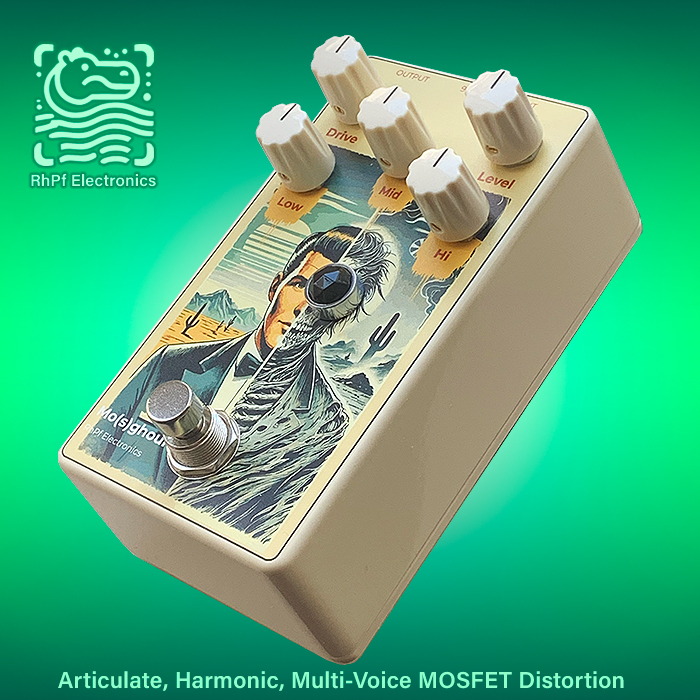
Controls - Drive, Level, 3-Band EQ } Low, Mid, Hi.
I believe the Lows and Mids are active (Cut & Boost) while the Highs are passive, the full Mids-Dip profile occurs at around 800Hz when dialled back - with twin peaks @ c. 250Hz and 1.6kHz - where with the Mids fully forward you get a peak at circa 500Hz. ACTUALLY! - all controls are Passive - so you're sweeping across a fixed scale - while it certainly impacts like active EQ on occasions!
There's still plenty of range within those tone controls - but they generally impact harder, colder and slightly denser, versus softer, warmer and more elastic.
My favourite settings are with Drive @ 4 o'c, Level @ Max, Lows @ 2 o'c, Mids @ 10 o'c, Highs @ 2 o'c. Winding the Mids back certainly helps in softening the Low end! And the range of the mids definitely helps deliver both Vintage and Modern sounds. While for my preferences I got more out of the pedal with the Mids either @ Noon, or dialled back to around 10 o'clock.
Where the Mosferatwo is pretty much instant satisfaction - it's easier and more predictable to dial in - and quicker to get to fully satisfying sounds. The Mos(g)ghoul has fewer controls but is slightly trickier on the dial-in, and I recommend if you're trying out both - then start with the Mo(s)ghoul - particularly if you're planing to switch between the Mo(s)ghoul and another drive - or else you will likely find quite a gap between the output of one compared to the other.
The Mo(s)ghoul has very much grown on me - it took a little longer to gel with - but I really like it now. It stacks really well with the Mosferatwo - and is amazing when enhanced and beefed up by the Treble Booster from the Strymon Sunset.
Looking at the other reviews - most people seem to be instantly impacted / impressed by the Mosferatwo - which is the more immediate of the two - while the Mo(s)ghoul is more of a slow-burn, and typically takes a little longer to reveal its shine.
RhPf Electronics - through an association with Rockboard - is currently including a bag of Rockboard accessories (time-limited!) - which consists of a crystal LED lens cap, a footswitch topper, and a couple of pedal dust protector plugs - which I initially mistook for some kind of earplugs! I don't really have a use for those dust plugs - but the LED cap went straight on the Mo(s)ghoul to make the right-side of the visual look more like a cyborg! The pedal looks significantly cooler with the crystal LED Lens cap in place. While the footswitch topper went onto my new ThorpyFX Peace2Keeper! It didn't look quite right on Mo(s)ghoul!
The Mo(s)ghoul takes a little while longer than the Mosferatwo to work its magic on you. I was immediately smitten with the Mosferatwo, while the Mo(s)ghoul took me a few sessions to gel with - they're both really distinct and different. Both are 'Harmonic' MOSFET gain pedals, both with hybrid-clipping - but one is a softer and warmer overdrive, and the other a darker and denser searing distortion - with a slightly thinner and wirier output profile. I really like both, while like most I have a slight preference for the Mosferatwo - which for me is absolutely perfect as it is.
When the Mo(s)ghoul is paired with the Stymon Sunset it easily reaches Mosferatwo level of satisfaction, while without it you're left wanting a little bit more from that pedal - well I am that is to say, but it's easily overcome. I feel there really isn't much that needs to be updated with this circuit, and I've decided that it does indeed easily achieve unity levels - it just doesn't go anywhere near as loud as the Mosferatwo.
The Mo(s)ghoul Reactive Distortion is yours for just $179 courtesy of the RhPf Electronics Webstore. It's another really distinct and unique effect - smartly conceived and engineered by RhPf's Thomas - who's building a reputation for really unique and stand-out effects.
I feel his high water mark to date is the Mosferatwo, while this Mo(s)ghoul runs that one fairly close in a number of ways. I'm delighted to own both.
Additional Usage Notes
The interaction of the Mo(s)ghoul reminds me a little of the Boss DS-1 - that pedal was famously designed for going into an already cooking amp, but sounds slightly compromised and thin when being used within a clean pedal platform rig like mine.
I had similar challenges with the original DS-1 - which was both my first Boss, and first Distortion pedal - where I didn't get anywhere near the classic distortion richness I was expecting. The Keeley-Modded DS-1 though has more gain, and of course his typical Phat mod - which significantly raises the profile of that modified pedal - so that said version can sound pretty stellar within a clean pedal platform - where the standard version cannot!
So the Mo(s)ghoul would seem to have a similar action / ineraction - in that it works best going into an already cooking amp, or into another preamp or similar - or in fact my Strymon Sunset as already reported. It's a great stacking pedal for sure - and in its current iteration really benefits from being paired up and stacked with other gain pedals!
Clean Pedal Platforms reveal the raw potential of a pedal - while several boosts, overdrives and distortions have been designed specifically to work with already cooking amps - and they just don't work that great when the amp is not cooking, or in fact actually clean - as is the default for my rig! This means that different users will have different experiences of that pedal - which experience is very much defined by how their rig is set up, and how much they rely on their Amp!
Demos





Content Subscriptions