

Xploration • Curation • Recommendation


RhPf Electronics' Tri-Harmonic Phalanx is a super versatile 3 x MOSFET Gain Stager Boost / Overdrive - where you balance the saturation of Low, Mid and High Frequency Band Cluster Gain Stages in parallel


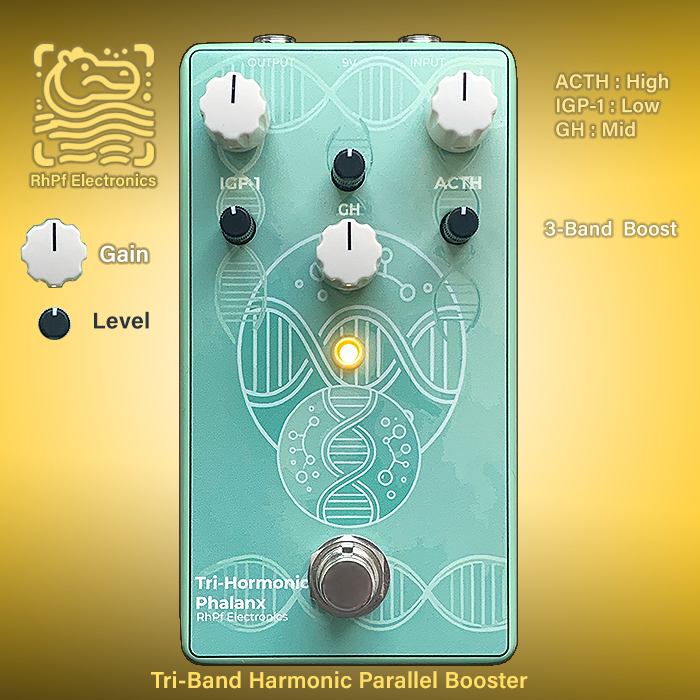
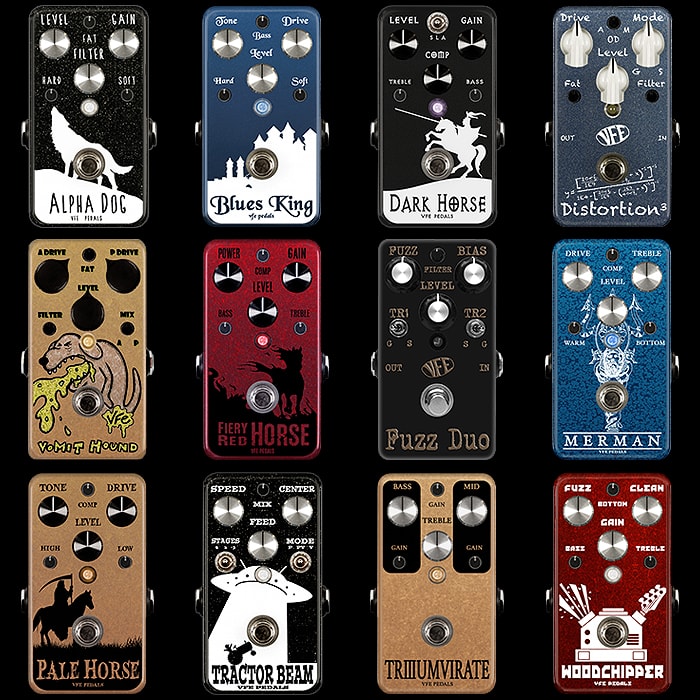
When I first clocked the Tri-Harmonic Phalanx it brought to mind the VFE Triumvirate Multi-Band Distortion - which was the fist device I encountered that split the incoming signal into 3 different frequency band gain stages that you could adjust and combine in parallel. That Triumvirate seemingly has exactly the same 6-Knobs control topology (3 Big, 3 small)!
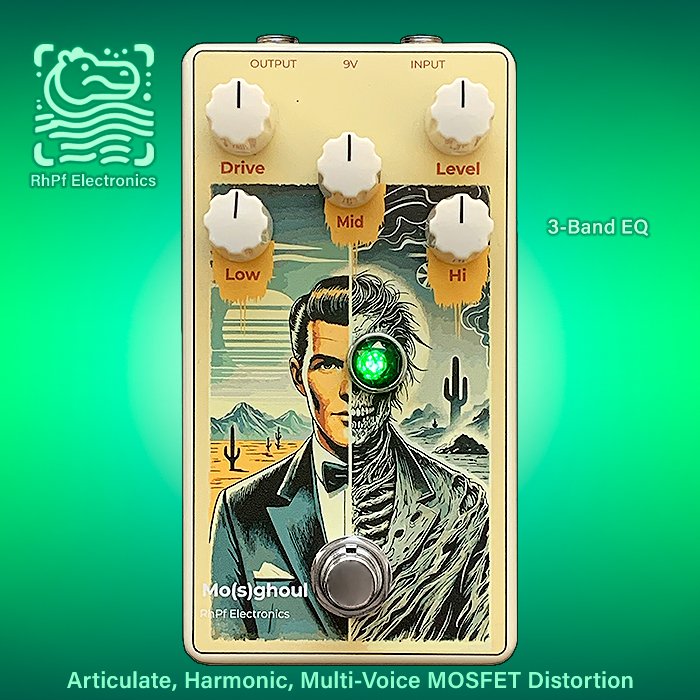
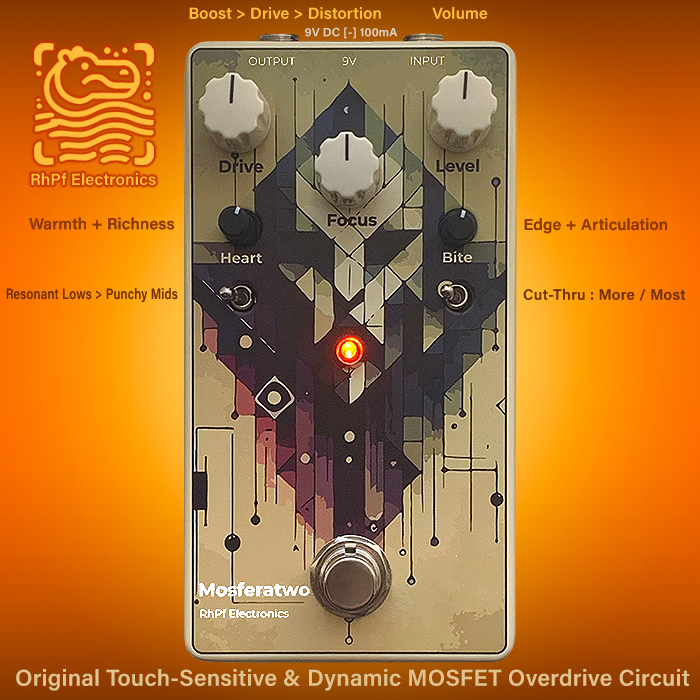
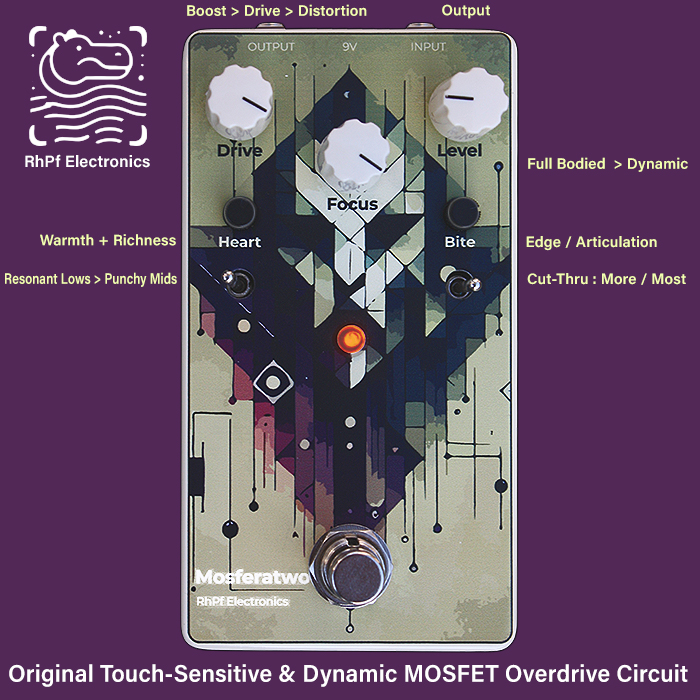
The Triumvirate is obviously a forerunner here - and that makes use of 2 x TLE2074 and 1 x TL7660 IC’s / OpAmps, and the 2 x BS170 MOSFET Transistors. While my now good friend Thomas @ RhPf is a master of MOSFET gain stages - and this is another one of his killer MOSFET circuits. Along with the previously reviewed Mosferatwo Overdrive, and Mo(s)ghoul Distortion.
This ’Phalanx’ isn’t quite as instantly satisfying as the Mosferatwo, but it may very well be my favourite of the bunch - as it’s so super versatile and dynamic - and allows you to dial-in your Gain Structure so precisely from Boost and all the way up to Fuzz levels.
You have 3 large off-white Frequency Band Gain Knobs (Low, Mid, and High Frequency Band Gain Stages), which each are accompanied by a smaller Mini Black Level knob for each of those Bands.
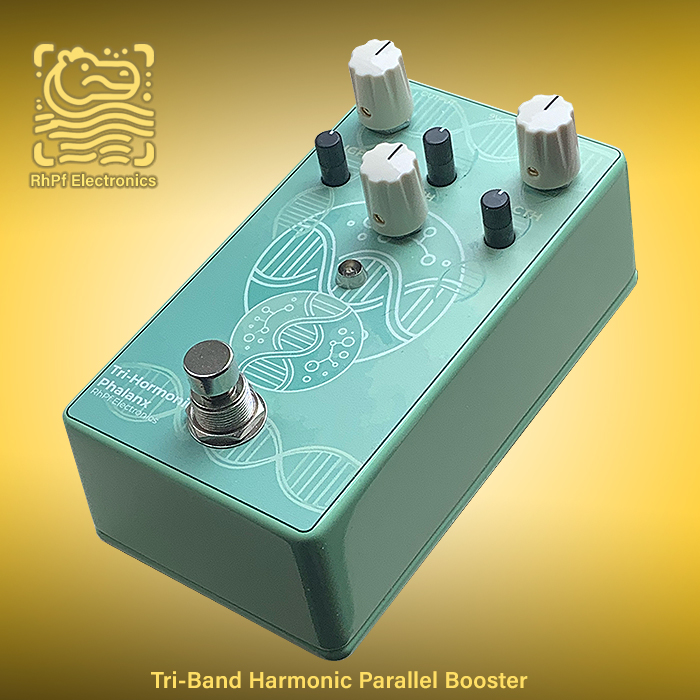
Controls - IGF-1 Low Band Gain (Centre-Frequency @ c. 200Hz), Mini Low Band Gain Level, GH Mid Band Gain (Centre-Frequency @ c. 632Hz), Mini Mid Band Gain Level, ACTH High Band Gain (Centre-Frequency @ c. 4kHz), Mini High Band Gain Level.
This is quite a delicate balance of Frequency Band Gain Stages - and some due diligence is involved here in balancing those different Gain Bands and Levels - as the output can very quickly become overblown as such.
Get the balance right though - and you have the most amazing Harmonic Output Textures - while a lot of delicacy is required here - and this may prove a little fiddly for some. The Mosferatwo is somewhat more instantly satisfying - and easier to dial in.
While deploying a little patience on the 'Phalanx' will eventually deliver superior results. You just have to get a feel for how those different Gain Stage Bands ramp up and coalesce.
The dial-in can for sure be a little bit fiddly - but compared to the say the Mosferatwo - you get even more precision and granularity with the Phalanx - while it can be tricky at times to get absolutely the right balance across those 6 controls.
The Bands act in fairly interesting ways - where the more linear nature of the Mosferatwo means that one is easier and more predictable to dial in initially. While as you get used to the Phalanx you realise how potent and granular that pedal's Gain-Shaping can be.
It's a little counter-intuitive in some ways - as I'm mostly used to setting Gain Structure / Saturation first - and then shaping the Frequencies - while here you're setting the Gain Structure and Frequency Profile in tandem - via those 3 parallel Gain Stage Bands.
A really clever circuit for sure - but one that requires a little more patience of application versus the two previously reviewed models.
Overall I really like the different tones and textures I'm able to achieve with the Phalanx - you basically whack up the Low Gain Band for a full-on fuzz onslaught - but that is the most sensitive of the Bands in some ways - and can very rapidly become overblown in its output. So you are balancing the Gain Structure of that Band with its Level of output - so you can ride high on the saturation - and then soften it all by dialling down the Level for that band!
It's a very distinct circuit, and while I feel it won't necessarily appeal to those fans of 3-Knob Boost / Drive Pedals - the proper Tone Chasers will love it!
Here follow two of my favourite settings form opposite sides of the spectrum - to indicate the versatility of the Phalanx!
Setting 1 : Everyday Harmonic Drive : Low Band Gain @ 11 o'c - Level 2 o'c, Mid Band Gain @ 10 o'c - Level @ Noon, High Band Gain @ 2 o'c - Level @ Noon.
Setting 2 : Ripped Speaker Fuzz : Low Band Gain @ Max - Level @ 3 o'c, Mid Band Gain @ Min - Level @ Noon, High Band Gain @ 3:30 o'c - Level @ 3:30 o'c.
This pedal is not necessarily for everyone - but for those that have some patience and are prepared to spend some time with this pedal - it can yield really glorious and precise output textures. You have to train your brain to work things slightly differently - but once you get the hang of it - this is a really versatile and potent Boost / Overdrive / Fuzz with myriad different deployment options.
The Tri-Harmonic Phalanx is yours for $190 on the RhPf Webstore. It's a fairly unique gain experience - and many will love its degree of versatility and precision. I for one really love it - and it's probably my favourite of the 3 RhPf pedals I have reviewed!
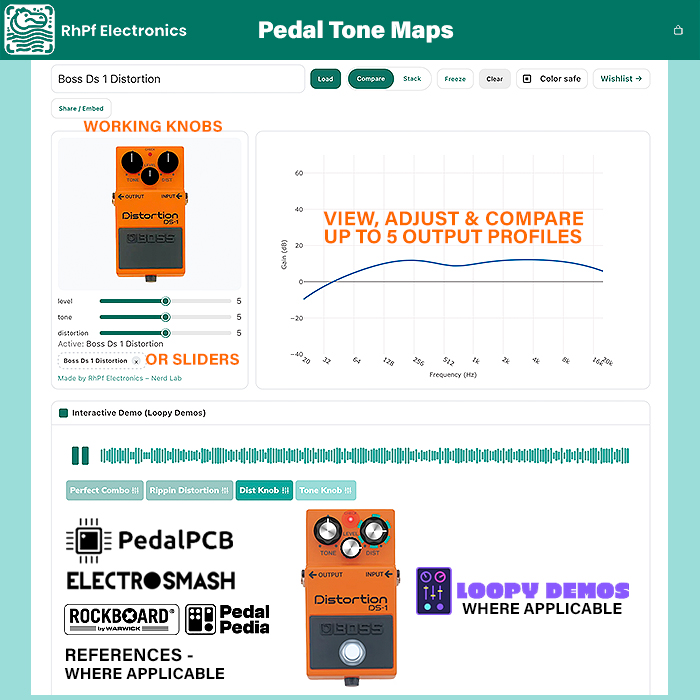
You can also read up more on the Loopy Demos website - which has a great segment on the Phalanx!
Demos