

Xploration • Curation • Recommendation


RhPf Electronics' Mosferatwo MOSFET Drive Pedal is the most beautifully balanced Original Harmonic Overdrive Circuit, with killer dynamics and touch-sensitivity


So I’m fully onboard with RhPF Electronics now, and had a great chat session with founder Thomas. The business is not yet 2 years old, having been formally founded in December of 2023 - UPDATE - I’ve been told that it was only officially launched in January of this year - so it’s barely half a year old! Off to a very good start in any case! The first question I asked was where the name came from ’RhPf’ as German for Hippopotamus is Nilpferd - literally ’Nile Horse’. So RhPf is something of a play on that - being and abbreviation for RheinPferd (Rhine Horse) : hence RhPf !
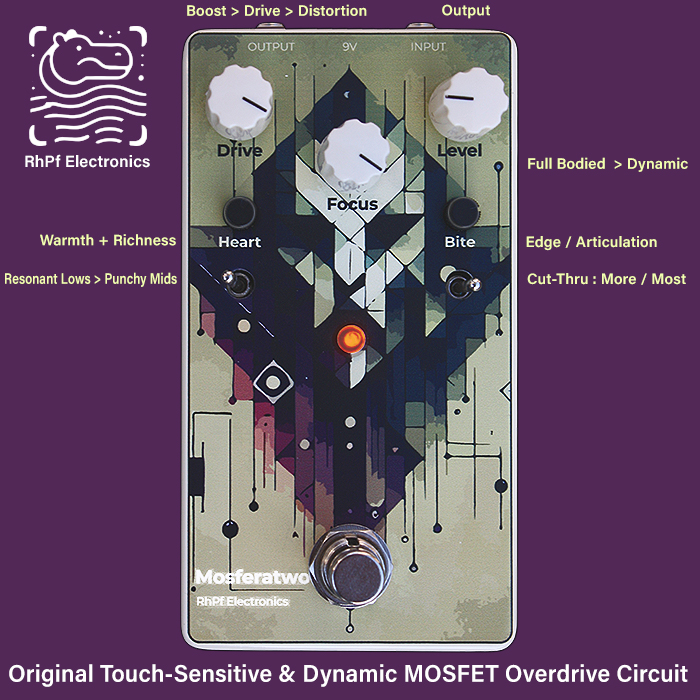
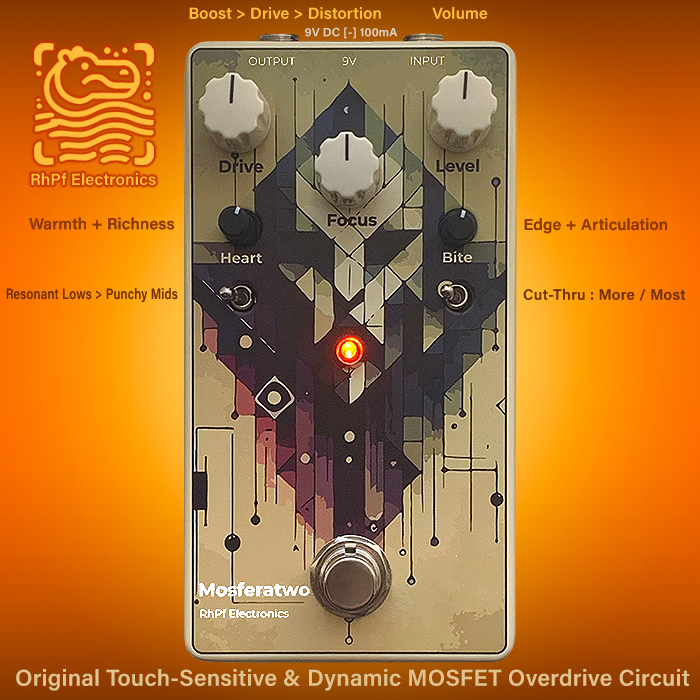
The Mosferatwo consists of a number of MOSFET Transistors - 3 x Gain Stages, plus one for the Input Buffer, and one for the Clipping I think it was. Where you have the perfect complement of controls here to wholly shape and accentuate, or otherwise smooth out the overdrive’s output.
There seems to be plenty of range on every dial!
Controls - Drive (Boost > Drive > Distortion), Focus (a sort of EQ - Full Bodied > Dynamic Clarity), Level (Output), Heart (Adds Warmth & Richness), Heart Options : Deep Resonant Lows / Punchy + Aggressive Mids, Bite (Adds Edge & Articulation), Bite Options : More Cut-Thru, Most Cut-Thru!
Technical ! : Heart switch to the left targets !20Hz, to the right its 320Hz, and for the Bite switch the values are 1kHz to the left, and 5kHz to the right.
I deciphered the control topology from various references - for my original feature - and it turns out that those assumptions were pretty much spot-on - as I’ve not found any better way to label or explain those - after I have now fully experienced the device hands-on for about a week!
I typically work from ’Boss principles’ - which means starting with the controls in the middle - and then adding to or subtracting from that default setup. All Boss pedals are engineered to sound great with everything at noon, and for me it’s always been a good position for me to explore pedals from. The first 2 things you typically adjust are Volume and Gain - or Level and Drive as labelled here - before you then tackle the EQ curve of the output. And the same applies here really.
I always seek out the richest textures and harmonics - and found that for those three main dials I gravitated towards 2 o’c for Drive and Level, and Focus was mostly sounding great at around 3 o’clock.
I then targeted the smaller dials and corresponding switches. I like both sides of ’Heart’, possibly with a slight preference towards the Resonant Lows side, while I really liked the Punchy Mids option too (switch right). For the Lows I ended up with the Heart mini knob at around 11 o’clock, sometimes lower - but not really below 10 o’c. With the Punchy Mids I prefer quite a bit more ’Heart’ and that dial seems to constantly end up at around 3 o’clock for that option.
For the Bite switch I settled on having it to the left (its less accentuating position) but with the mini knob maxed out. That seemed to deliver the best textures and harmonics for me - it became a little too much with the switch to the right - so I kind of settled on switch left and Bite maxed!
For all the sort of EQ and Texture dials - Focus, Heart, and Bite - you get more accentuation clockwise, and a more damping / smoothing impact in the opposite direction. So it really depends on that manner of tones and textures you are seeking.
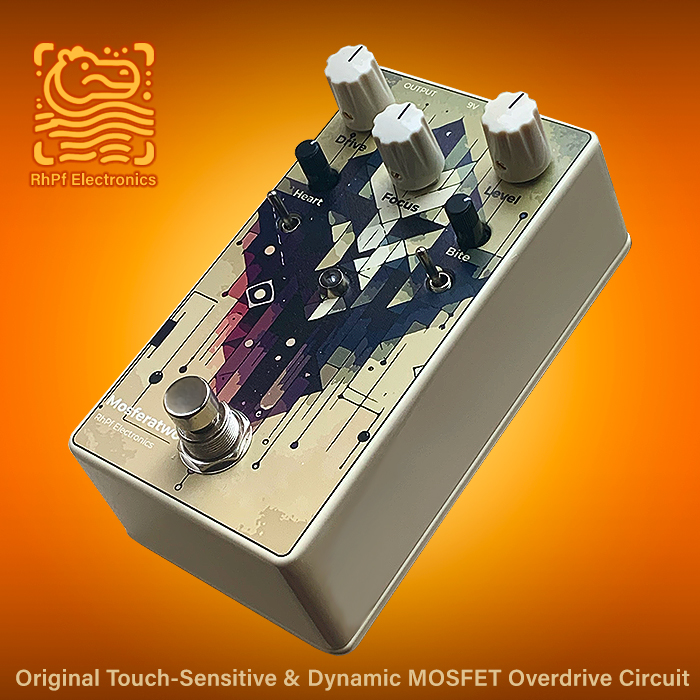
It's truly a wonderful Harmonic Overdrive - with the rich expressive textures you typically expect from Germanium Diodes. This one really has a beautiful output timbre, and you can so precisely shape its output - also with your guitar controls - for some really decent guitar volume gain cleanup.
The pedal responds beautifully to your pick attack - so that if you dig in more you get a really cool blooming of the overdrive.
I went into this with a very open mind - as I normally do - I always allow the pedals to speak for themselves - and I typically try them out at their various extremes - before I settle on my favourite tones and textures. With the 7 controls here the dial-in was super quick and easy - with very predictable tapers - you petty much knew in advance what impact each of those controls would make.
It goes from really smooth low-gain through to somehow bitey distortion - the lower half of distortion really - while there is a huge variety and versatility in this pedal's output.
It hit pretty instantly for me - with is always good news - some of these sorts of pedals really make you work for it - while this one is really effortless. There are aspects here that remind me a little of my friend Kai Tachibana of Nordland Electronics - as he has a similarly wonderful grasp on harmonics - which each of those are very distinct!
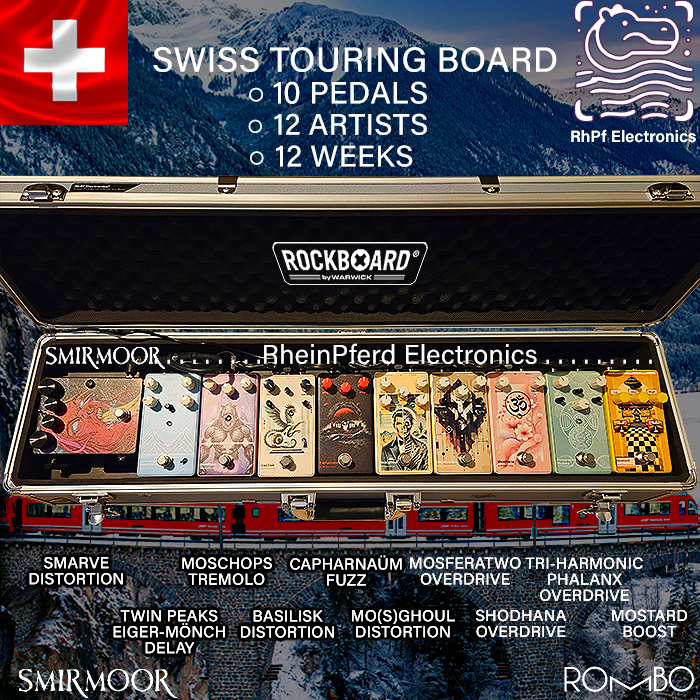
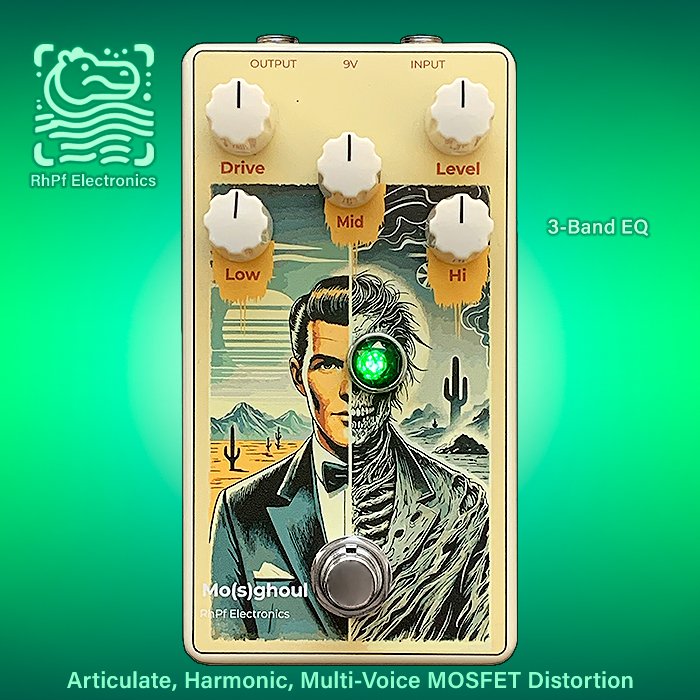
There is another MOSFET pedal in the RhPf range that I might look to try next - the Mo(s)ghoul - which clips quiet different to the Mosferatwo - and leans a lot more into the distortion side of things. There are currently 9 pedals within the RgPf range - with the 2 MOSFET ones has the flagships for sure. Both of those look a little more distinctive in the graphics department - particularly that sort of diamond shape of the Mosferatwo - for me that's a great reference for the kind of direction RhPf should be leaning more into.
I discussed with Thomas that he should use the Hippo ident on the front facia of his pedals too - for easier recognition and recall - as that's half the battle of establishing brand familiarity! It's also a kind of quality mark! So many brands out there don't really help their cause by failing on the principles of brand recognition!
The Mosferatwo Harmonic Overdrive is available now direct from the RhPf Electronics Webstore for the excellent price of $179 - this is a must-buy for me. I love original overdrive circuit - particularly the Harmonic types - as there just aren't that many in circulation!
The Mosferatwo is one of the very best if you love a richly harmonic output texture with precision tone-shaping, dynamics, and touch-sensitivity! Highly recommended!
RhPf Nerd Lab
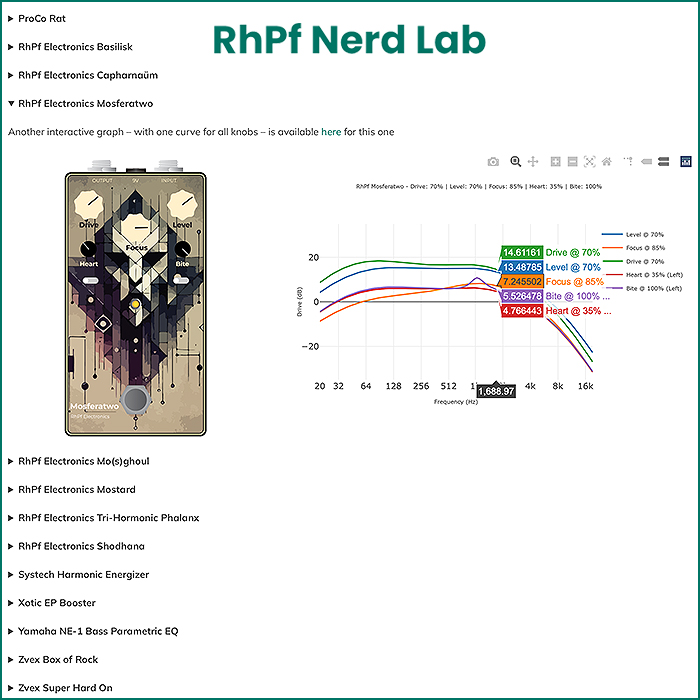
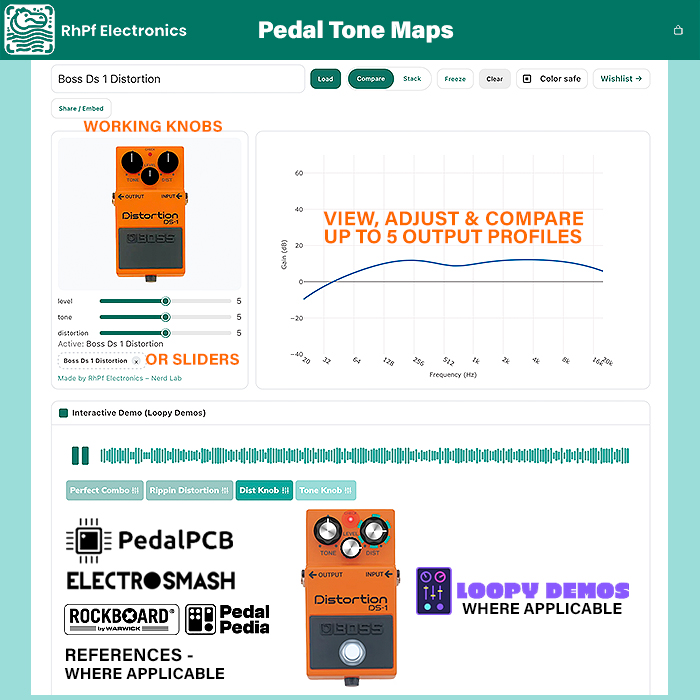
Thomas and colleagues have been incredibly busy in creating interactive frequency plots for dozens of pedals - including their own. You can move the various controls around and see what their impact is on the output frequency curves!
The RhPF Nerd Lab seems to be in two parts really - the first part is the 'Interactive Frequency Response Library' as pictured, and where the second part delves into the world of : the Diode Curve Plotter – A Visual Guide to Forward Voltage for myriad Diodes.
This is an essential resource for electronics engineers and pedal builders - where you have proper visual references for how those circuit elements shape the output profile of those devices - a really cool resource!
Loopy Demos does some excellent work on interactive demos too, and features both of RhPf's flagship MOSFET Pedals on that site - loopydemos.com/demos
Demos





Content Subscriptions