

Xploration • Curation • Recommendation


Highlights from Kane Hibberd's magnificent and wonderful 'Scale' Guitar Exhibition in Shoreditch


So I attended the ’Scale’ exhibition on one of the rainiest days of the year - this last Saturday - in fact the perfect moment for exploring such a show - with its myriad hidden depths! This is part of a global odyssey by Australian photographer Kane Hibberd - pictured below. Who has travelled the world to capture the full essence of those iconic instruments favoured by many a leading light, and in fact where the choice of instrument displayed was down to the icons / owners behind those guitars - which led to some very idiosyncratic decisions, and at times we got some odd choices - which I will touch on briefly here below! Scale is a beautiful play on that word - covering the notes acosss the 6 strings, the scale length of the instrument, and the full life-size scale / size of those vibrant photographs.
The photography is stunning really, as is the whole setup, while the many spotlights often result in a glare on those exhibits - which can make them impossible to photograph. I would have liked some anti-glare glass / perspex in place - as I needed to rely mostly on the book for my pictures - which posed different challenges! The photos themselves are fully hi-res and crisp - and reveal every surface ding, blemish and scratch. The photos are beautifully lit and framed - they are luminous, vibrant and rich in detail - in fact in some ways better than having the actual guitars there - as how they were shot kind of delivers an augmented reality take on those guitars - and where you can uniquely see the front and back of the guitar simultaneously.
The concept, execution and staging is pretty much flawless - and at times somewhat emotional and breathtaking - it’s difficult to explain how it feels to be in among all those legendary guitars - I thoroughly loved every part of this show - while I do question some of the choices - as we shall see!
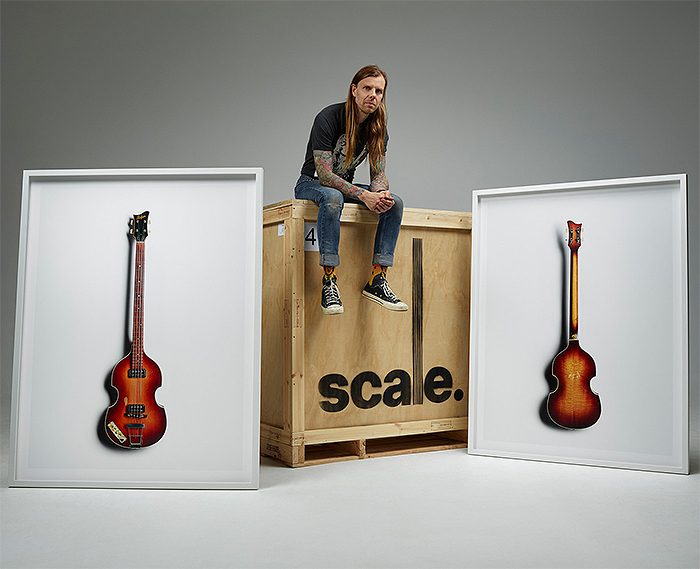
Picture of Kane Hibberd sat on one of the multitude of Scale packing crates, and in the company of Paul McCartney's legendary Höfner bass
This is so much more than a photography exhibition - rather a kind of augmented reality show about guitars - as you get a headset and audio player - where you punch in a 3-digit code which accompanies every exhibit - and then you get a full audio narrative of a few minutes to fully put you in the picture and context of each guitar. Based largely on those narratives and some other more nebulous criteria, the exhibition is segmented into 6 categories across those two floors :
- Fabled - extraordinary stories
- Guarded - passed into the care of another
- Eternals - never rested
- Bridges - connecting to the past
- Dormant - waiting for their next note
- Composed - created just got one
For me that exercise is mostly about partitioning the exhibition into distinct and more manageable chunks - for easier assimilation, while I found those categories somewhat nebulous at times, and not really needed for me. I would have preferred some floor or wall direction stickers to indicate the most natural flow through the exhibits - as both floors of the exhibition can be a little maze-like - and I occasionally found myself stuck in a loop / corner! - a little like the Seinfeld parking garage episode. It didn't mar the experience in the slightest though and the show therefore obviously gives you infinite paths through which to explore the exhibits.
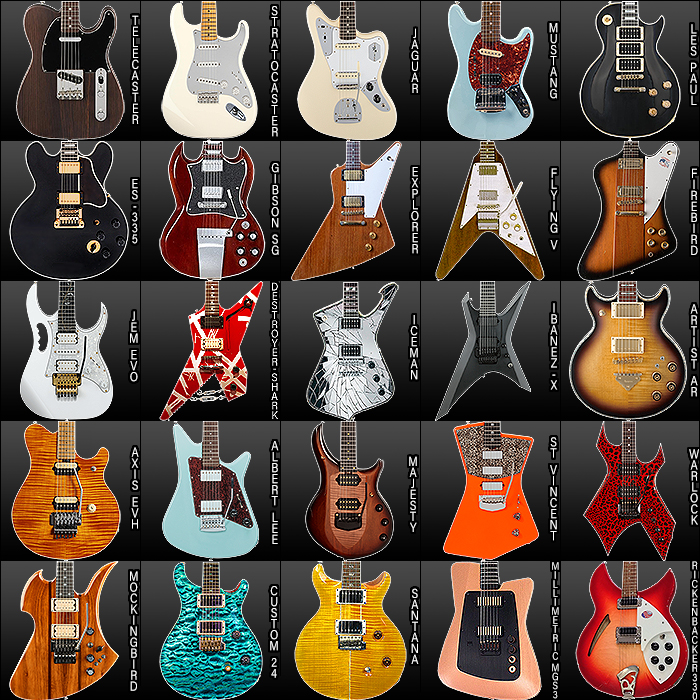
I'm not going to mention every artist covered - as I feel it's more preferable to come into the show somewhat blind, and experience the various surprises therein - live and direct. So I won't list the full guitarist roster here - that is covered on the 'Scale' Website if you really need to know - but it makes the show less fun to know in advance - instead of the artist roster listing - I will simply just reference the silhouettes for each of those 100 respective guitars (front and back!) :
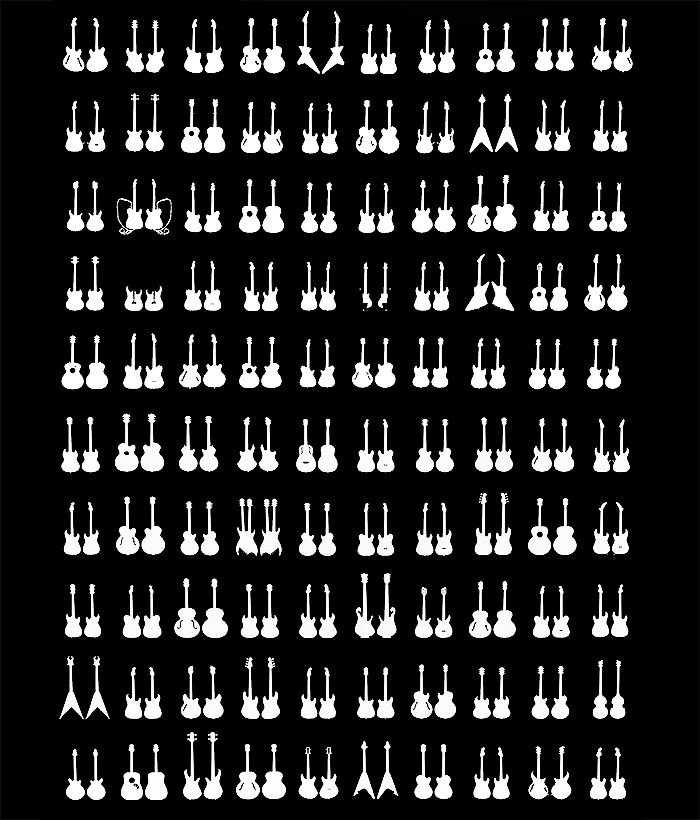
Those exhibits are beautifully staged and framed as such - leading to many halls and corridors and nooks of wonders. There's a lot of the obvious iconic ones there, but some of the more obvious ones are missing, and there are a few odd selections for me - which nicely underline how eclectic and overall unusual this exhibition is. This is the only way you will ever get close to these many legendary guitars - and as a show it really works and sparks the imagination and a whole slew of complex emotions!
And somewhat like Noah's Ark - the exhibits here are arranged two-by-two!
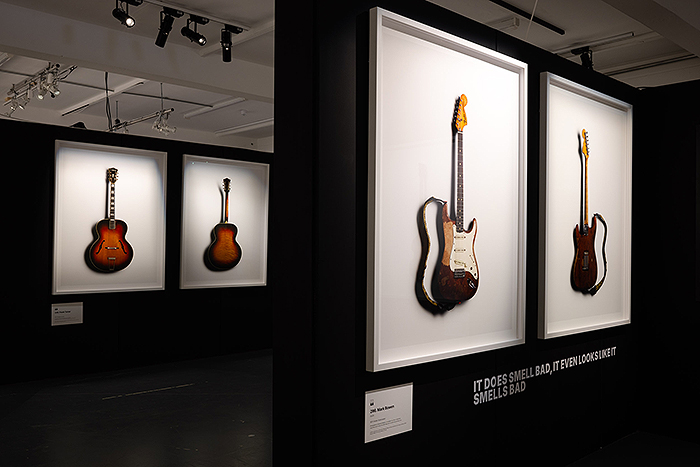
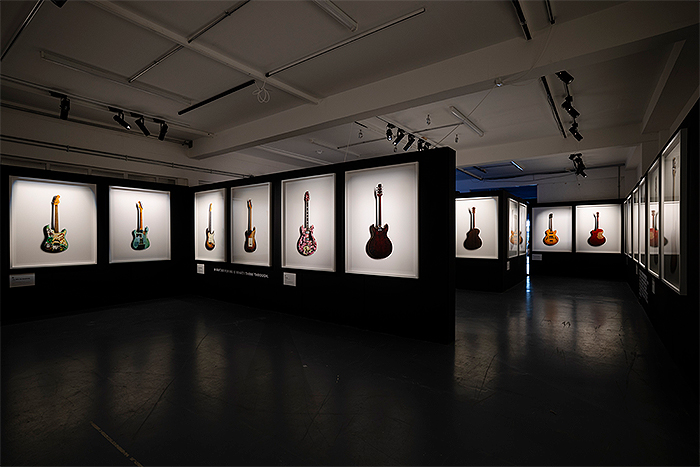
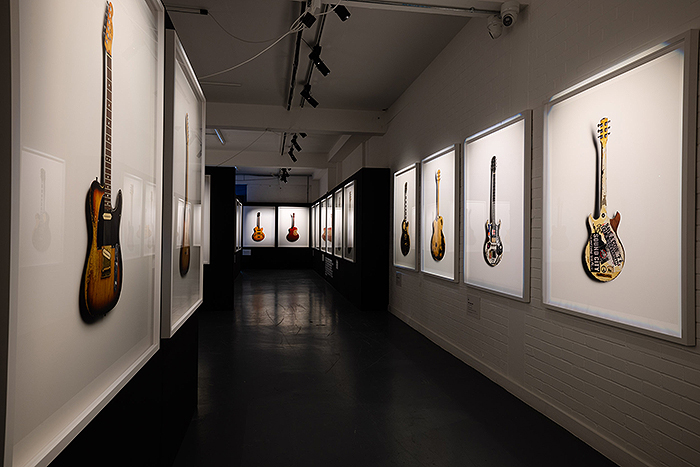
For this coverage I decided I should pick out some of my favourite exhibits - I originally thought around 10, but somehow ended up with 16 - which nicely fit into the 4 x 4 cover image, and which I believe gives the perfect insight into this exhibition. It's a selection of iconic classics - some of the most obvious ones, but also some of the more unique and idiosyncratic.
They are arranged here in a sort of alphabetical order (First name emphasis) and with pertinent summary details, sometimes with further insights.
My 16 highlighted artist / guitar roster features :
- Billy Bragg
- Brian May
- Dennis Dunaway
- Joby J, Ford
- Jónsi
- Kirk Hammett
- Matt Bellamy
- Matthew Murphy
- Nile Rodgers
- Nuno Bettencourt
- Peter Buck
- Peter Frampton
- Rat (Ned's Atomic Dustbin)
- Ross Hannaford
- Steve Vai
- Tom Morello
They're a mix of legendary and iconic guitars with a smattering of more unusual and lesser well known ones. In fact my favourite guitar of the show was the Ross Hannaford one - a 70's Australian musical legend, hitherto quite unbeknownst to me!
Understandably there are a number of my favourite guitarists in that mix too - Brian May, Jónsi, Kirk Hammett, Matt Bellamy, Nile Rodgers, Nuno Bettencourt, Peter Frampton, Steve Vai, and Tom Morello. But also a number of guitarists I'm a lot less familiar with.
The styling of those guitars - particularly the more persona' / personalised ones, typically give you great insights into the then mind state of a musical - and what that musician was all about at the time - and reflect upon the nature of their music to a significant degree! In reference to that - it would have been nice to have a list of records that those guitars featured on - or at least the more significant ones - music is often so compartmentalised to different ages and eras!
Kane Hibberd has photorgraphed somewhere between 200 and 300 guitars now I'm led to believe- and this will continue to be a longer term project - and we will likely see different 'curations' of that selection at different times - and in different lands (with more emphasis on local musicians?) - much like occurs at the Victoria and Albert Museum!
Hopefully there is enough here to whet your appetite as this show is so worth a visit - anyone with even the faintest interesting in guitars - should make a pilgrimage to said show - which is found at 118 Curtain Road in Shoreditch, London, EC2A 3AY! The venue itself is called 'Unlocked' but I don't recall seeing any signs for that - while there were Scale promotional pieces everywhere and on each of the facing walls.
Here follow the 16 individual guitarist and guitars overviews :
BILLY BRAGG - Early 1980's Burns Steer
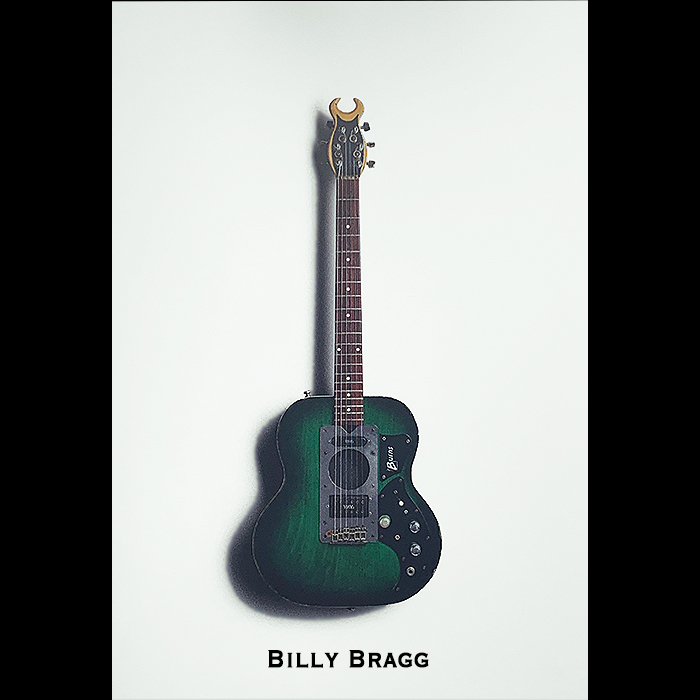
My pictures here really don't do the originals justice! I mentioned that because of persistent glare from the spotlights - I instead took most of those images from the accompanying book - which was an imperfect process. I have a few challenges with said mostly excellent accompanying book which I will detail after the 16 guitar highlights.
I'm so glad we have a representative of that legendary British brand Burns - with the very iconic Steer variety here - a sort of of electro-acoustic confection - with that 'horned' headstock, and perfect green colourway. I was never the biggest fan of Billy Bragg's output - perhaps just one or two memorable songs for me, While I'm very much into his choice of guitar here - this for me is largely what this show is about - unearthing some of those more unusual and under-the-radar gems - really like this one. It's the only vaguely acoustic guitar here that I feature - as I tend to very much focus on electric guitars, which means that most basses too are secondary concerns, hence the exclusion of Paul McCartney here...
Brian May - Red Special handmade by Brian in 1963
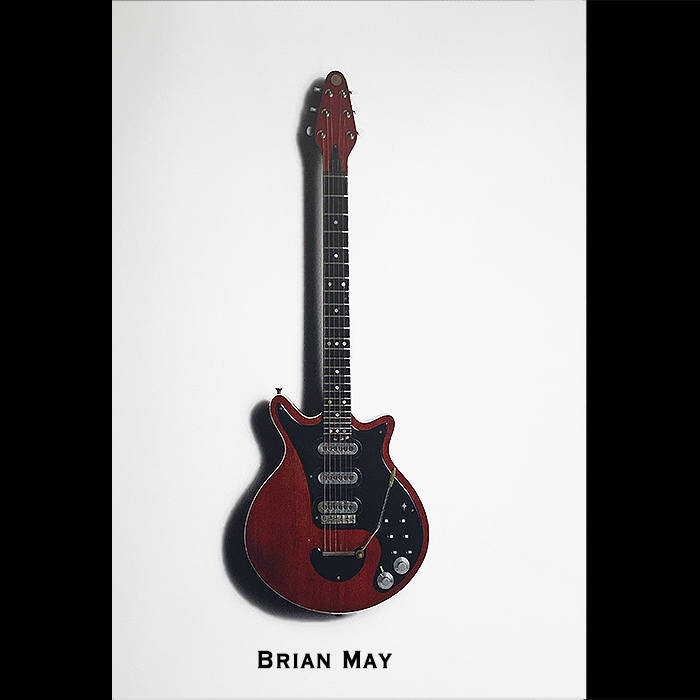
There's not much more to say about the Red Special - it has a very unique place in guitar lore - hand-made by Brian and his father from reclaimed woods - including an Oak fireplace. Build supposedly started in August of 1963, with said guitar being first aired in 1966.
Brian has had it with him his whole career - I can't think of any other guitarist who's still playing a guitar they made during their teenage years - with their father.
It's a guitar I've always much wanted - and there are so many different versions out there - some more affordable - some in the high thousands. I could never quite decide which one to go for - but possibly it will happen some day.
Everything about this Red Special is fairly unique - how you can invert the phase for each of those pickups - and how much that impacted the core Brian May and Queen sound (with a little inspiration also from Rory Gallagher!. It's a very distinctive shape - with a cool ergonomic headstock design too and a highly creative tremolo bridge - all of which I entirely approve of!
For me probably the single most iconic guitar of all time!
DENNIS DUNAWAY - 1970 Fender Jazz Bass
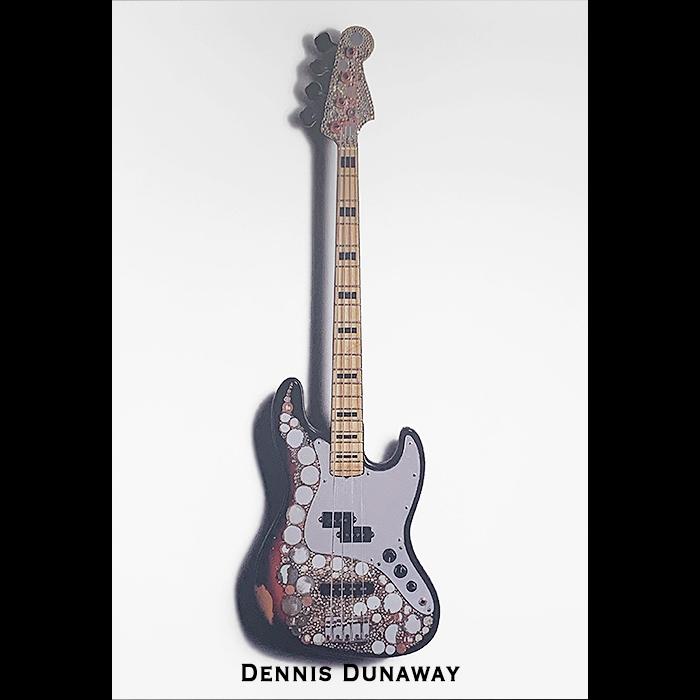
So I wasn't that familiar with Dennis Dunaway of the Alice Cooper Group - while I love his personalised take on the Fender Jazz Bass.
His design here is a little reminiscent of the similar 'mirror disc pattern' guitars of Syd Barrett and Jimmy Page - respectively an Esquire Tribute and a Telecaster. Both of those still to be photographed I suppose - fingers crossed and all that. Then we can have all 3 disc pattern examples grouped together!
For me iconic guitars can't just be wholly unadulterated guitars from the big brands - there needs to be something distinct to mark them out as extra special - and not just a special colorway or sparkle finish (yet that means you J Mascis!).
In fact I have always associated J Mascis with his somewhat ornate Jazzmaster guitars - with sort of abstract floral patterns, while his guitar of choice for this exhibition was a Blue Sparkle 1958 Telecaster - which to me makes no sense!
JOBY J. FORD - 1970/71 Ampeg Dan Armstrong Lucite Body Guitar
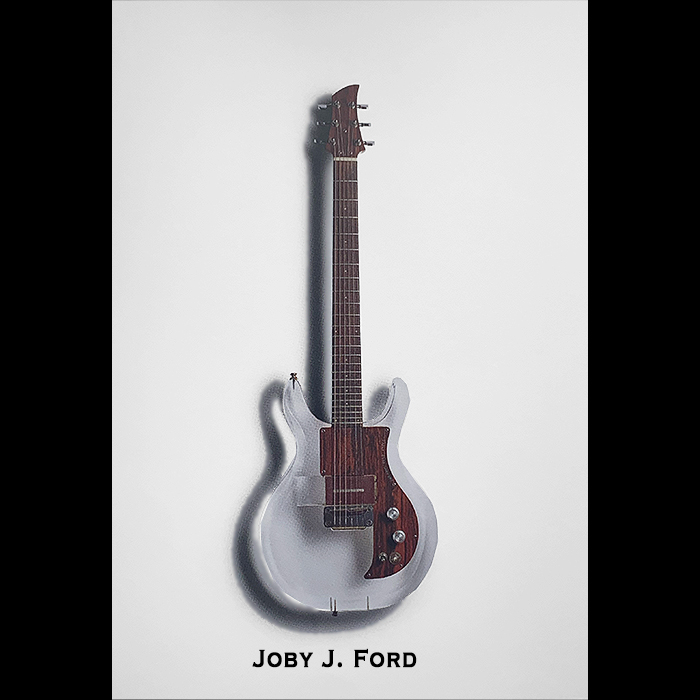
Another musician that I'm not familiar with - Joby J. Ford of 'The Bronx' band.
I really like these kinds of acrylic / perspex style guitars - where this one is actually specifically 'Lucite' and comes with really complex electronics and changeable pickups!
A beautiful clean aspect to the aesthetics - I've seen similar gutars before - but the proportions of this one are nigh perfect - and I really love the headstock design too. A gorgeous guitar, probably not so well know as some of these others - but so worth it place in this exhibition! There are a few of these for sale on Ebay - just short of $6K or thereabouts!
A recent favourite of mine - lead singer Rhian Teasdale from Wet Leg has been sporting a fluorescent green acrylic BC Rich Mockingbird guitar which is also suitably iconic - and should for sure feature as an exhibit at some stage!
JÓNSI - 2006 Dan Johnson Bird Custom
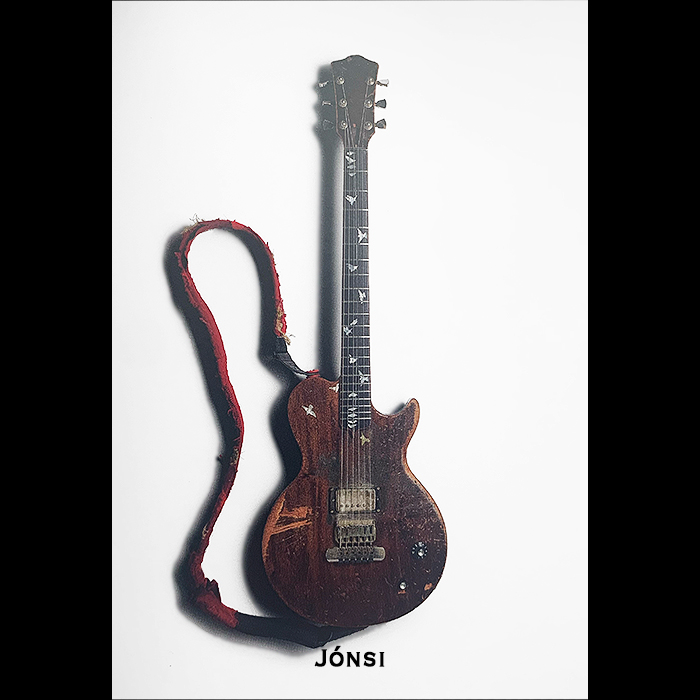
I of course had to include my fellow countryman Jónsi of one of my all time favourite bands Sigur Rós.
So many of the guitars at the show have been manhandled to a large degree, and if this happened to a person - the owner would be up for multiple charges of violence, battery and abuse.
While I will grant some exception for Jónsi here - as he's such an experimental player - and he has mostly likely thrown the entire contents of a kitchen sink into this guitar to eke out bold and unusual sounds, So I will let him off with a warning.
I handile all my instruments with kid gloves - and they're as shiny and new as they day I. got them - bar for the occasion unavoidable ding!
There was some controversy for a while vis-a-vis PRS and this bird design - while I say there's space for both, An unusual guitar here for a very unusual performer. It's a little too battered for me to receive ultimate accolades - but it is for sure a very distinct number!
KIRK HAMMETT - 1996 ESP KH-2 'The Mummy'
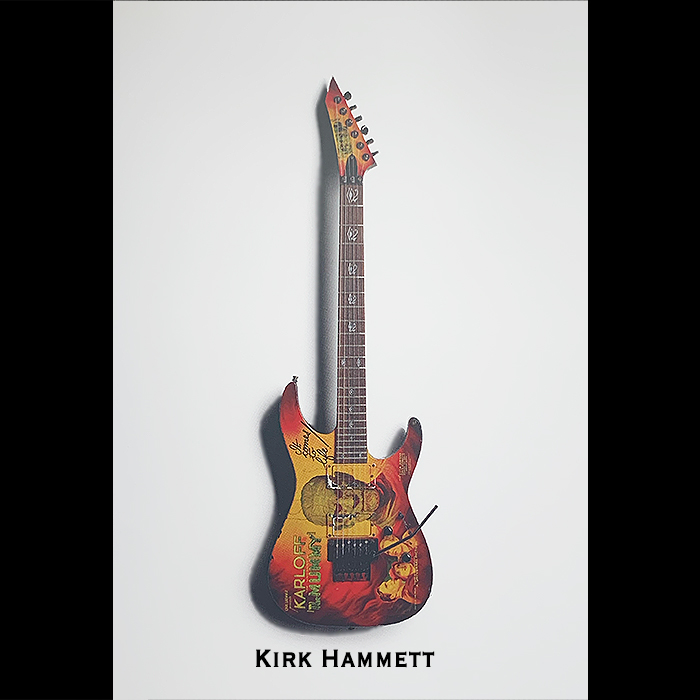
Kirk has had a lot of signature guitars over the years - several from ESP, and the Flying V and Les Paul from Gibson to name the most obvious ones. While his most enduring one is the sort of orange. / yellow and red 'Mummy' guitar - a heavily personalised edition which he's had with him for most of his career.
It's one of those instantly identifiable guitars and therefore every way an iconic classic - it's unmistakably Kirk Hammet! And is for sure one of the most striking ones you will encounter at the show - really cool!
MATT BELLAMY - 2001 Manson 007 Custom 'Blackie'
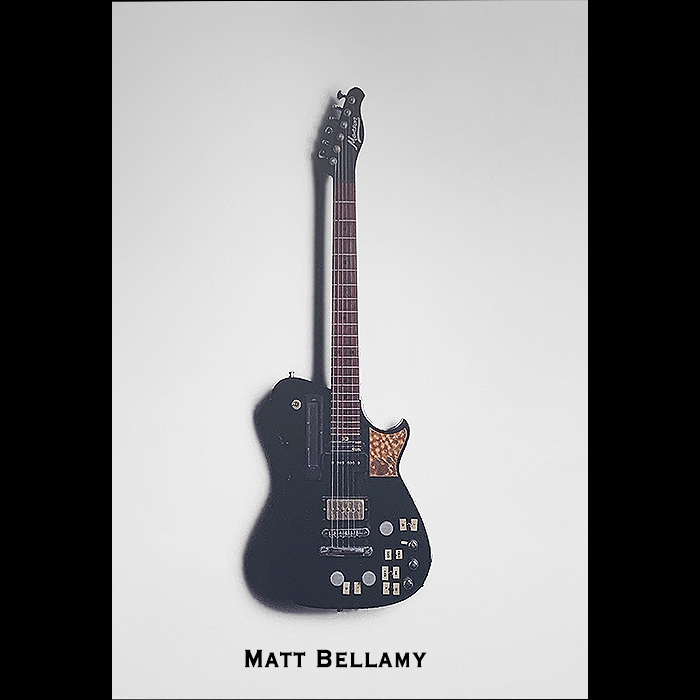
Matt has had an extraordinary relationship with Exeter-based Manson - from pretty much his earliest days - and has had a very large array of custom and bespoke signature instruments over the years.
The Custom 007 is very much a weapon's grade Studio and Recording guitar - it's a little too complex and ponderous to be featured on stage - too many things that can go wrong also.
The one thing it doesn't feature is the familar Korg Kaos Pad interface which Matt often makes use of. Otherwise it's entirely a studio multi-tool - with Zvex Fuzz Factory and Fuzz-Wah Probe circuits onboard, also a kill-switch, and control-strip for the Digitech Whammy, and 3 distinctive types of pickups - including Seymour Duncan Hot P90, Bare Knuckles Mississippi Queen P90, and Fernandes Sustainer.
It's a beast in every way! But evidently too much of a beast to be featured live. It's been best put to use on 2012's 2n Law album opener 'Supremacy' which is the closest Muse have come yet to crafting a James Bond theme!
MATTHEW MURPHY - Early 2000's Fender '69 Reissue Blue Floral Telecaster
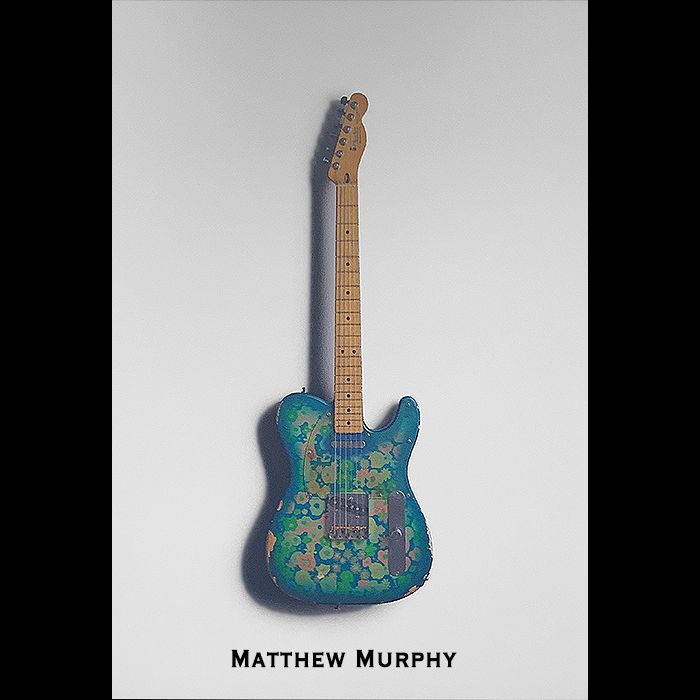
Another artist I'm not particularly familiar with - Matthew Murphy, best known for his work wit 'The Wombats',
So I don't actually know Matthew in the slightest, I know the Wombats a tiniest fraction, But am still very much in admiration of this guitar choice here. With a very distinct colourful floral design on supposedly blue background - while it leans quite a bit into the green spectrum too.
There were a lot of Fender guitars featured at the show - but few as iconic and stand-out as this one!
NILE RODGERS - 1960 Fender Stratocaster 'The Hitmaker'
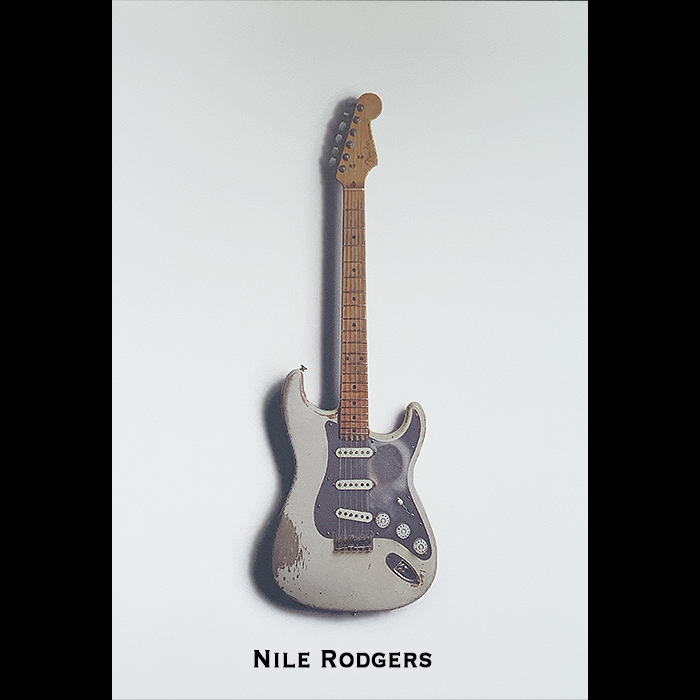
There's no way I could leave out one of my all-time favourites - superstar producer, groove machine and the world's funkiest guitarist Nile Rodgers - who has been responsible for so many hits over the years, right from the heart of the disco era - alongside the Salsoul roster and France's Cerrone!
He famously helped revive and refresh the careers of two UK stalwarts - Bowie and Duran Duran respectively (Let's Dance, and The Reflex).
He's also worked with Diana Ross, INXS, Madonna and Daft Punk - just to name a few. And everywhere he goes - his Hitmaker Strat goes there too. Said guitar is undertabdly starting to look a little worn now - but it is in every way one of the most iconic guitars in history!
NUNO BETTENCOURT - 1991 Washburn N4 Custom
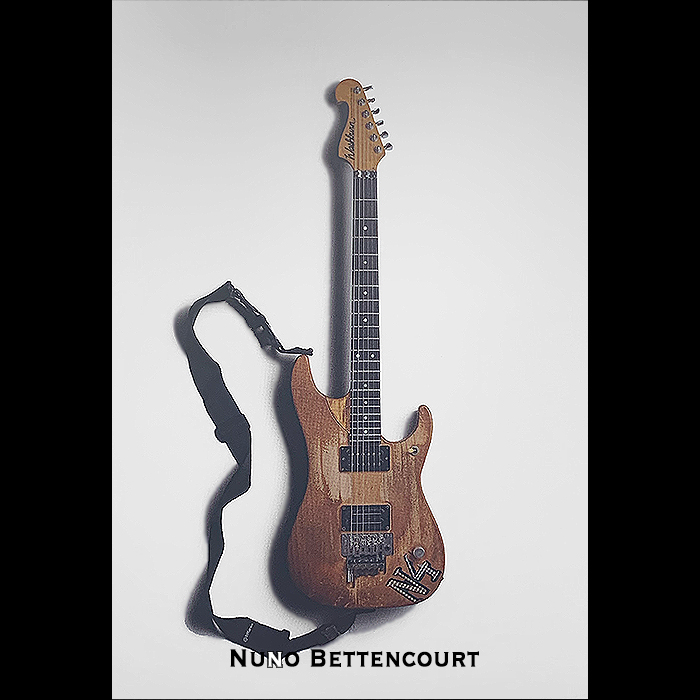
Nuno is one of the all-time great guitarists for sure - often overlooked along with Guthrie Gowan - but definitely deserves his place in the guitarists hall of fame. He is permanently associated with Washburn - in fact the only Washburn artist who readily springs to mind. And his legendary N4 Custom guitar follows him wherever he goes.
He's just enjoying another renaissance as his main band 'Extreme' has been revived once more. While I've always thought he deserved to be in a greater band than Extreme - he's the best thing about that band by far for me!
I have some challenges with his guitar - in terms of the upper fret access being blocked by a sort of faux cut-out. I would have preferred a little more of an ergonomic carve there - while mostly preserving the nature of the faux cut-out - while providing better fret access.
The guitar is entirely iconic in this particular look - which is why it will never change, and probably rightly so too. While I still reserve the right to be marginally bothered by compromised ergonomics!
PETER BUCK - 1981 Rickenbacker 360
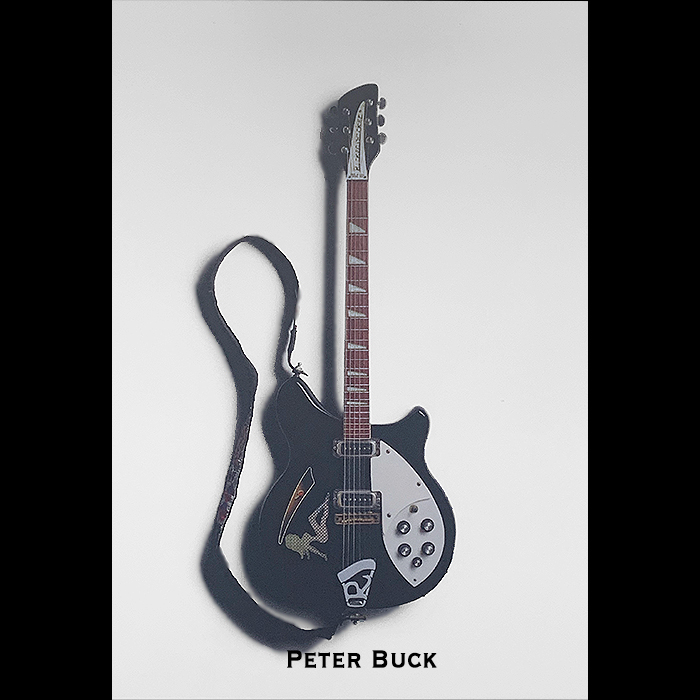
I love a Rikki 360, while what makes this one iconic is the smart and judicious application of a bumper sticker - which makes it unique and stand-out. There were other Rikki's at the show - but none so easily identifiable as this one.
I know Peter Buck only peripherally - as being a member of REM, while I much admire is choice in guitar.
Not much more to be said here - just a regular Rikki 360 - but with that wholly identifiable pinup bumper sticker. Something about it tickled my senses at the show - and hence it features in this listing! It's how you react to something that makes it art!
PETER FRAMPTON - 1954/55 Gibson Les Paul 'Black Beauty'
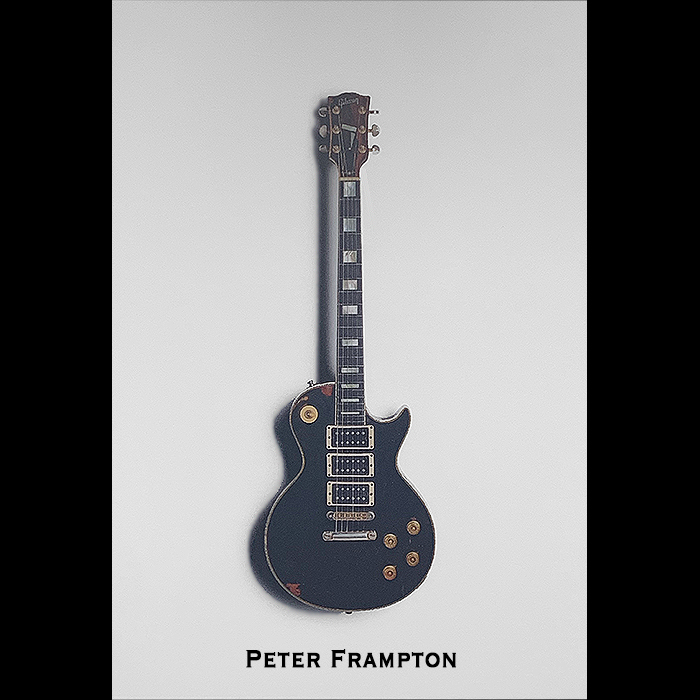
Peter Frampton's 3-pickup all-black Les Paul is so so iconic - I think it's been stolen and recovered twice now. Hopefully Peter gets to hold onto it for life now!
This format of Les Paul I exclusively associate with Peter Frampton - and while there are no other unusual markings or idiosyncrasies to further distinguish this guitar - it's still inexorably linked to Peter Frampton.
I'm personally not a fan of some of the Gibson Ergonomics, in particular their headstock design, and I would probably prefer a tremolo bridge in place. This is still the most iconic Les Paul design for me, and the one I most gravitate towards. While I feel that my ideal Les Paul PAF style guitar is probably the PRS Dave Grissom DTG special!
I'm all about practicalities and ergonomics, and the scientific method, and not at all fixated on vintage nostalgia tropes - unlike most guitar gear enthusiasts!
RAT - 1977 Aria Pro II 'Death Box'
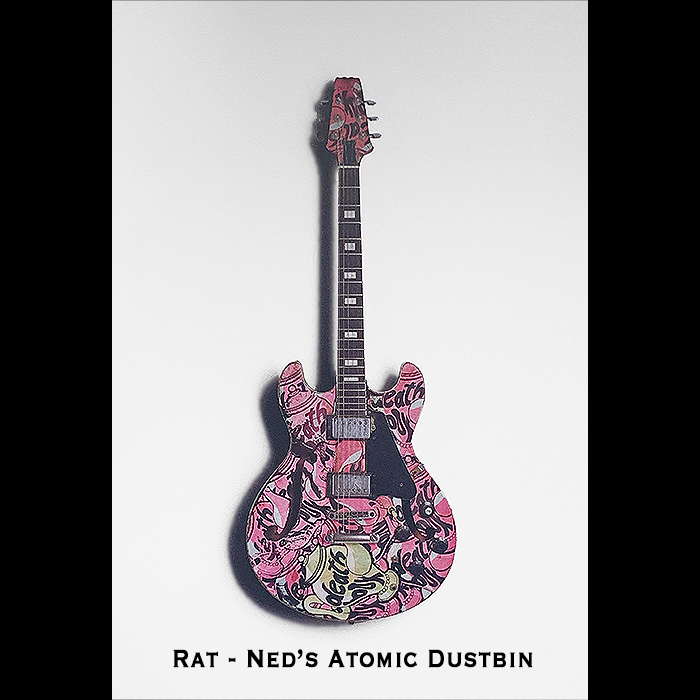
Again, I'm not particularly familiar with 'Rat' from Ned's Atomic Dustbin - while I recall that band fondly, and in particular their epic 'Kill Your Television' song from 1991.
This is not the same guitar as featured for that song - at least not that I recall it from the video. It's a highly personalised and striking design though! With the 'Death Box' motif repeated thoughout in a fetching shade of pink!
It's a very individual design and iconic for that reason - while I don't know the guitarist well enough to associate with said guitar, I really like he look of it - including that appropriately tapered headstock design!
ROSS HANNAFORD - 1992 Chandler 555 Classic
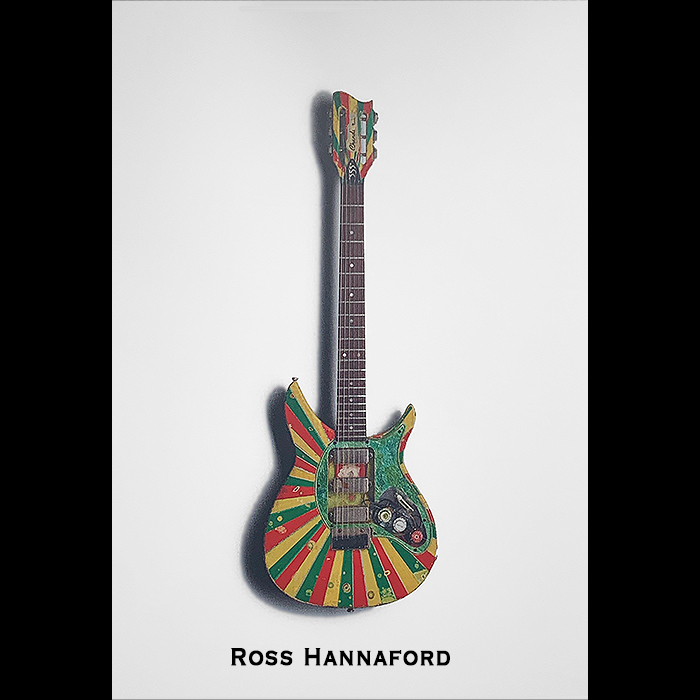
I'm alas not familiar with legendary Australian musician Ross Hannaford who was at his peak in the 70's as part of the band 'Daddy Cool' and later carried his legacy forward with his Ross Hannaford Trio and solo works.
Interestingly this guitar is from a later period (1992 >), and alas Ross passed away in 2016. I was not aware of this great man until now!
I love his choice in guitar though - with it's sort of colourful 'Africa' colour scheme - those 3 colours - Red, Yellow and Green festoon a number of African nation state flags, as well as that of Bolivia - but it's really an African theme in its styling - while it also kind of features Australia's core Gold and Green colours - but the addition of red tethers it to Africa in its symbolism and feel.
This was my favourite guitar at the show - a really striking encounter - it's vibrant and distinct in shape - possibly a little bit Rikki in places, and a whole lot of something else!
This for me is a perfect iconic guitar. - it's entirely standout, and can only be associated with a singular artists - that's the essence of iconic for me - instant recognition and association!
STEVE VAI - 1993 JEM7V WH 'EVO'
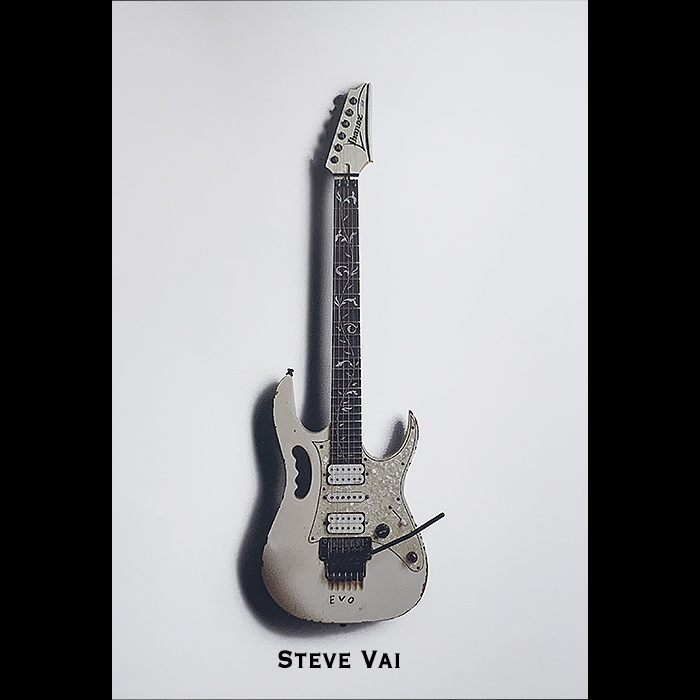
Steve's first signature Ibanez guitar is so influential and iconic - and inspirational, and marks one of the most successful artist collaboration ever. Where we've had a few signature Ibanez's over the years from Steve - most notably the Jem, Pia, and Universe designs. Steve Vai's website lists 400 of his guitars - surely few are quite so prolific!
You have the famed 'Monkey Grip' and 'Tree of Life' Inlays which are so iconic of Steve Vai. This is surely the most famous and most successful proper sinature guitar of all time. While some will argue it's the Gibson Les Paul - which I feel is a slightly different sort of animal - but depending on your own criteria - those are surely your two top choices!
It's instantly identifiable, and has fully maintained its legacy all these years. There have been dozens of special editions of this guitar over the years - and they still sell particularly well Supposedly Ibanez's best selling signature edition of all time!
TOM MORELLO - 1987 Mongrel Parts Custom 'Arm The Homeless'
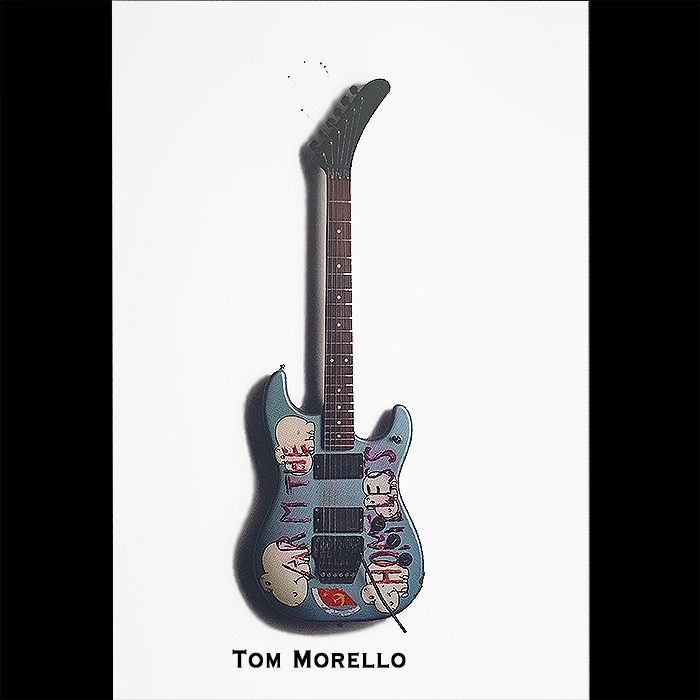
Another of my favourite players - who actually has properly 3 iconic guitars to his name - a 1982 Fender Telecaster 'Sendero Luminoso', this custom assembled 'Arm The Homeless' disparate parts / mongrel guitar (Gibson Explorer / Kramer Barracuda style neck presumably?), and then the later black and white FSR Stratocaster 'Soul Power'.
On balance the 'Arm The Homeless' mongrel is probably rightly the most prominent of those, and therefore exactly the right choice for this exhibition - while I would have accepted the 'Soul Power' one also,
Tom is a wonderful player and staunch human rights advocate and incredibly technicalyl proficient - he's a master of delivering superior riffs - and most copy his fabled Whammy use on the 'Killing in the Name of' track - especially me!
The Official 'Scale' Book
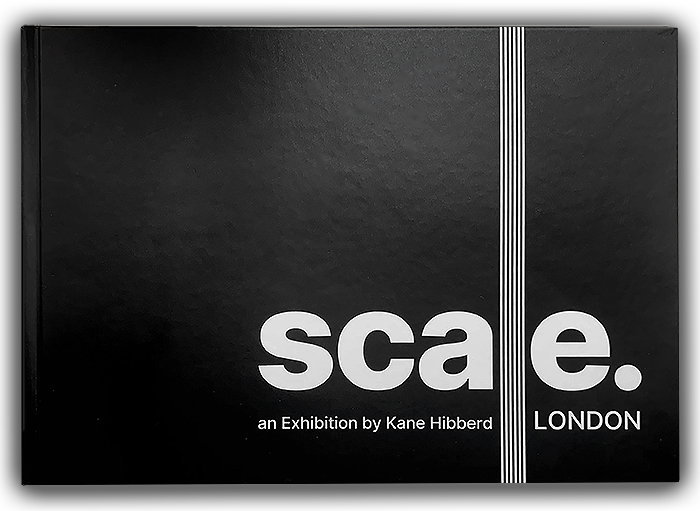
I explained that there was too much of a spotlight / lighting glare on many of those full-size guitar portraits - and I soon gave up trying to photograph the exhibits - as my iPhone really wasn't hacking that environment, So I thought I should use the book that I was planning to buy - to extract the visuals I needed - which was a most imperfect process as I shall endeavour to explain.
I paid £52.50 for the Book and a Tote Bag - so I don't know the actual split - I guess we can say the Tote was at least a fiver, and the book is very nicely made / bound - but with some slight niggles for me. Actually Jacinta provide me with the right split - The Book is actually a very reasonable £40, while the Tote Bag is a marginally pricey £12.50
I can't state enough how superb those actual life-size photos are at the exhibition. They are absolute perfection - wholly natural - beautifully lit, arrestingly vibrant, luminous, and crisply detailed - almost like getting an augmented view of those guitars.
Now - there is a print and graphic phenomenon roughly known as relative pixel colour density - which means that when you shrink down a picture - you loose definition, vibrancy and luminosity, The guitars look a lot duller and less distinct when those visuals are reduced down. You often see this phenomenon in an art gallery / at art print stores. For example - the 'Lumas Gallery' that used to be in Covent Garden (new store opening soon) - had these amazing full size graphic prints and portraits in their windows - and then in various different sizes of artwork within the store - all the way down to postcard size. For each of those progressively smaller variants there was a reduction in vitality and luminescence. The colours become both darker and more washed-out in places (Less deep, less luminous) - and you need a significantly brighter red on a small format to render the same results as the full-size work - red can be a particularly sensitive colour in that respect.
So for the book - the pictures are much duller takes on the crisp bright luminous works at the exhibition. And like with audio - you can only play with the spectrum you have been provided - so it's nigh impossible to tidy those images up fully satisfactorily - as the pixel density gets too much in the way - and takes all the liveliness and vibrancy out of those images.
This book really needs to be twice the size to accommodate decently detailed and luminous pictures - and you need a colourist to check the reductions agains the originals and to ensure the same colour spectrum is maintained. You will always loose a lot of depth and detail - which aren't recoverable at those sizes - but you need to adjust the colours for them to render correctly at that size - otherwise you end up with overly dull and somewhat desaturated, leaden and somewhat lifeless pictures. That's not to say the Book isn't decent - it's certainly a good quality of print - but someone needs to target the coloration calibration / saturation and pixel density of those works.
Also the Book only really includes the photos - with the briefest of text descriptions. I would have loved to have had short sweet summaries of the Audio Narrations too! It's something Chat GPT et al do so well - just feed the Audio into that app and tell it to do a one pargraph summary!
The Book is a decent enough souvenir of the show, but it's currently kind of lesser than it could be. Those images are so stunning in real life, and therefore comparatively disappointing in the book - with that loss of detail, luminosity and vibrancy - and saturation even. Inevitably there will be some reduction in quality - but those aspects can be and should be ameliorated.
So he book is still a pretty decent souvenir, where I feel it could have been even better - to adequately represent the show. The show is in every way magnificent and inspirational, the book not quite so much!
The Book is a decent 220 pages long with an Artist Index in the back. Would have been nice to have a Brands and Models index too - so you can access the guitars in different ways. I think the book needed to be slightly bigger with better rendered and crisper and more true-colour images. The Books is decent enough quality, while it's lack of the narratives and has slightly compromised / diminished images which mean that it can't fully represent the all-round excellence of the show. The book at the very least needs to be colour-adjusted. The images just need to be crisper and more colurful to properly reference the brilliance of the show!
Final Thoughts
I had a wonderful time at the show, and had a really wonderful and in-depth conversation with event manager Jacinta Hickson - who was delightful. Overall the actual physical show was magnificent and inspirational - everyone should visit! And you have plenty of time still as the show continues to the end of August!
There were some peculiarities and idiosyncrasies about the show. Initially I thought it was all about still live and performing guitarists and guitars - still active on the world stage as such. But there are a number of anomalies with that approach - my favourite guitar of the show - the Ross Hannaford Red Gold and Green Chandler 555 was my overall favourite, while Ross sadly passed away in 2016! So that guitar is certainly no longer live and active therefore.
There were also 2 really odd exhibits - the Fletcher Dragge battered broken body of a 1990's Ibanez RG Custom - no neck, missing most of the electronics and hardware, yet still attached to a strap! That is the weathered carcass of a guitar for me - and had no place at the show - it smacks of a piss-take! Also the Jeff Ling 1980's Seiwa Rockman 9 had no strings - therefore non-operational - no idea what that was doing as part of the exhibition either? Surely someone can do the courtesy of stringing up that guitar! All very odd!
Moreover there were a number of odd choices - for instance Noel Gallager selecting a fairly standard 3-Colour Sunburst 1960 Fender Strat - in place of the Epiphone Riviera and Sheraton guitars he is usually associated with. J Mascis had a very standard Blue Sparkle 1958 Tele in place of one of his more common and colourful Jazzmasters. Jonny Marr was represented by a 1982 330 Rikki, while he is usually associated with the Fender Jaguar - as the guitar he most commonly uses. Kane allowed all those artists to have the final say on which guitar to pick - and some of the results are decidedly odd.
I can understand why Jack White featured his new signature Fender Triplecaster - which is still very much a future classic no doubt - but his best known guitar association is with the Red and White Valco Airline Res-O-Glass 'JB Hutto' - I would have preferred to see that in place of the new one - which hasn't really fully served its innings yet - it's all too new for such a grandiose exhibition - and feels more like a promotional effort than proper guitar art!
There was a slew of very famous guitars at the show - that I will allow you to discover for yourself - generally the breadth and depth of different guitar makes and models was pretty fantastic, while there were some obvious repetitions too with certain makes and models (and not necessarily the most famous reference for those models!) - and some fairly anonymous choices also - which I would imagine would be curated out of the show at the second pass. And my two favourite brands weren't featured at all - Kane could at the very least do Carlos Santana for PRS, and Nigel Tufnel for Music Man - the Albert Lee Mr Horsepower Nigel Tufnel Spinal Tap 2001 Yellow guitar with Ref Flame graphics! (only 25 made!).
The actually show was flawless for me - including the audio commentaries and those exceptional photographs. I'm a member of the Tate Modern, and fairly frequently attend gallery shows - where an essential element for me is a cute coffee shop at the back. That really is the only additional thing I think would do nicely if added - as well as some more detailed instructions on how to navigate the maze. For the next one I would like to see a floorpan with the optimal route indicated. I was not sure of the best way to access the upper level - and ended up a few stairwells on the far side of the building - before realising that I needed to go back out to the reception and onto the main staircase!
They recommend Liverpool Street as the nearest transport hub - and it's about 15 minutes walk from there up - along Bishopsgate, Great Eastern Street, and then Curtain Road. Possibly it's a little quicker from Old Street Station (Northern Line) - while Liverpool Street supports far more services. A very pleasant walk really - even in the pouring rain.
I thoroughly recommend a visit - I paid £24.40 (including fees) for my ticket, and then £52.50 for the Tote Bag and Book - as mentioned (Book £40 | Tote £1250). If you want to do the show properly and listen to all the audio narratives - you should really allocate around half a day. I was in and out of here in around 2 hours - but I mostly didn't listen to the narratives! Certainly not for every single exhibit!
SCALE is absolutely worth a visit - a must for every guitar fan for sure - get your tickets [Now] - it's so well worth it, and you have until the end of August to get yourself there! I'm sure this Exhibition will be touring the world - so people in other lands will have further opportunities! I look forward to visiting different curations of this show in the future - ut will be interesting to see which new ones come in and which incumbent ones get booted. By all means feel free to boot out that body only carcass! And then re-string that other guitar for a proper shot. I certainly wouldn't want to see a smudge of ashes representing one of Jimi's burnt out guitars! Although that could conceivable find a place at the Tate Modern instead!