

Xploration • Curation • Recommendation


Best of Mini and Micro Tuner Pedals


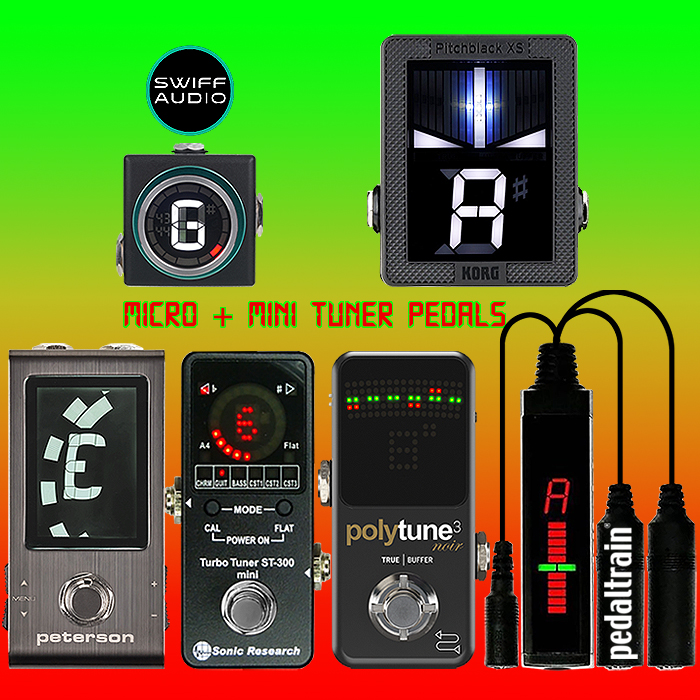
I kept coming across 2 micro tuners - the similar looking Swiff Audio C20 and RockStock Nano Tuner. In fact I recently picked up the C20 from Thomann - which looks a little more refined than the Nano Tuner - with an additional aluminium collar surrounding the footswitch mechanism.
I felt that I should do a rundown of the smallest tuner pedals out there - which are arranged by height in the visual. I’ve included the dimensions for each pedal [in parenthesis] so you can fully compare and contrast the different formats.
I own three of those now - The C20, StroboStomp Mini, and PolyTune 3 Mini. And I will likely add the Turbo Tuner ST300 Mini too at some stage, as well as the Pedaltrain SST which has its uses too.
This exercise is all about the ease of fitting a tuner pedal onto your board - in the most unobtrusive fashion. Pedalboards are often highly congested these days - with not much space left over to fit in a tuner - which means the only viable solution has to be small!
There are 4 key formats here - with the StroboStomp Mini, Turbo Tuner ST300 Mini, and PolyTune 3 all very similar - and the other 3 very much their own thing. I included the Korg PB-XS rather than the skinnier but taller PB-X-Mini. That PB-XS is similar in width to a compact pedal but significantly less tall.
So from a Pedalboard Tetris perspective - hopefully one of these will fit the remaining space you have on your board! I will probably try to fit in the C20 somewhere - just to have the ability to check every now and again.
Here’s my selection :
- Swiff Audio C20 Micro Pedal Tuner [41 x 41 x 43mm] - $51
- Korg PB-XS Pitchblack X Series Micto Tuner [70 x 80 x 47mm] - $92
- Peterson StroboStomp Mini [52 x 94 x 46mm] - $119
- Sonic Research Turbo Tuner ST-300 Mini [40 x 94 x 30mm] - $139
- TC Electronic PolyTune 3 Mini [51 x 93 x 45] - $54
- Pedaltrain SST Space Saving Tuner [22 x 102 x 22mm] - $59
As mentioned - I will be adding the Turbo Tuner ST300 Mini and Pedaltrain SST at sone stage too - so as to be able to fully hands-on reference, compare and contrast - but also have the maximum flexibility of different solutions for my own board!
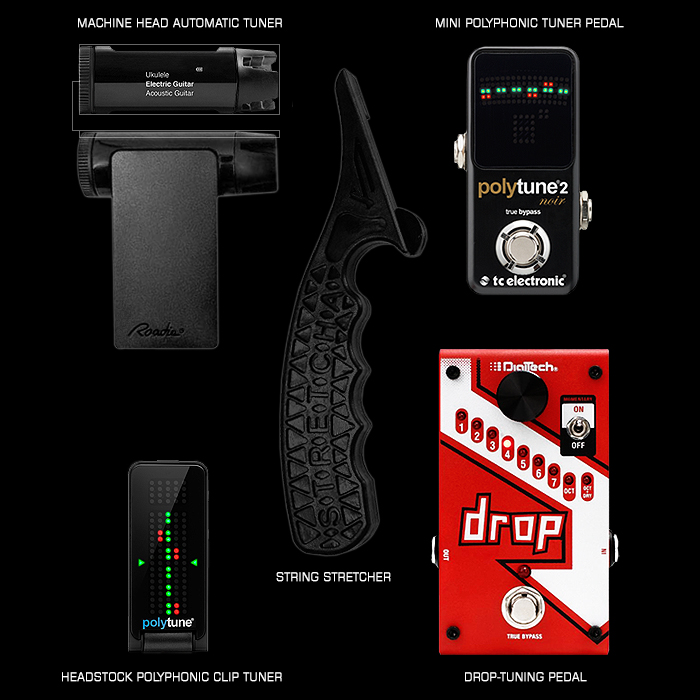
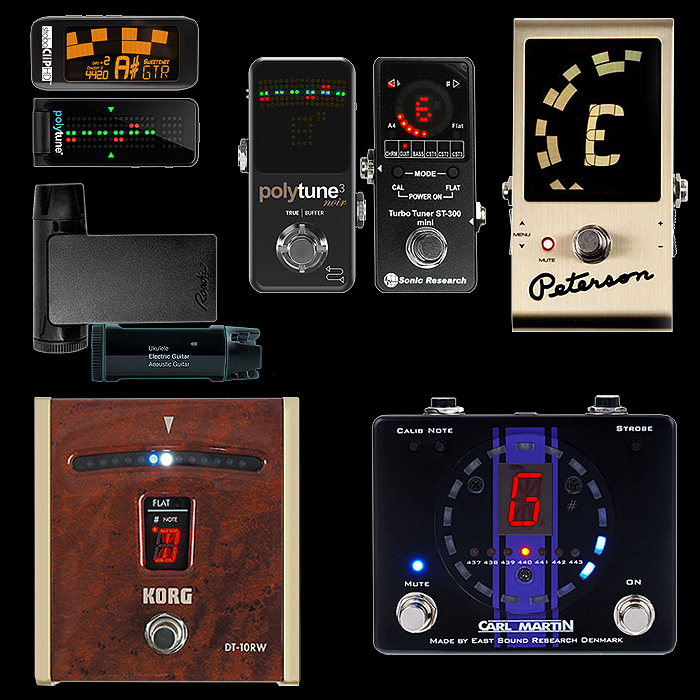
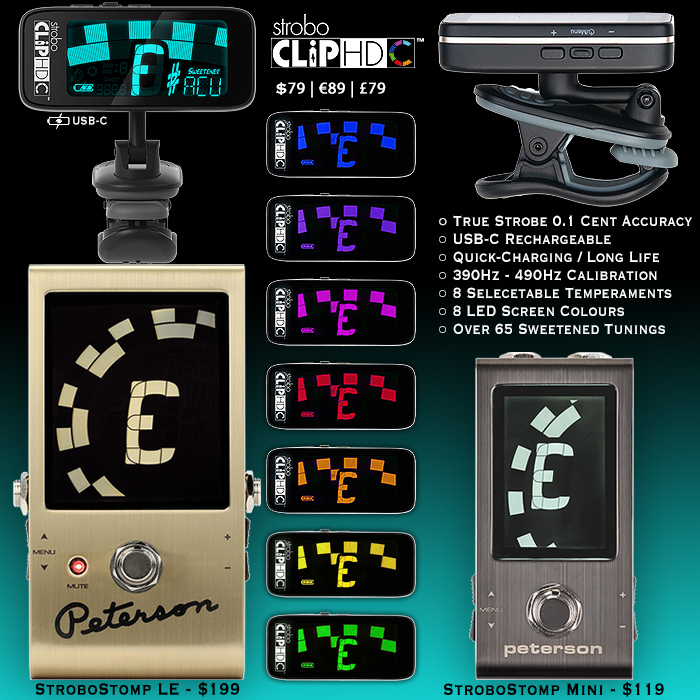
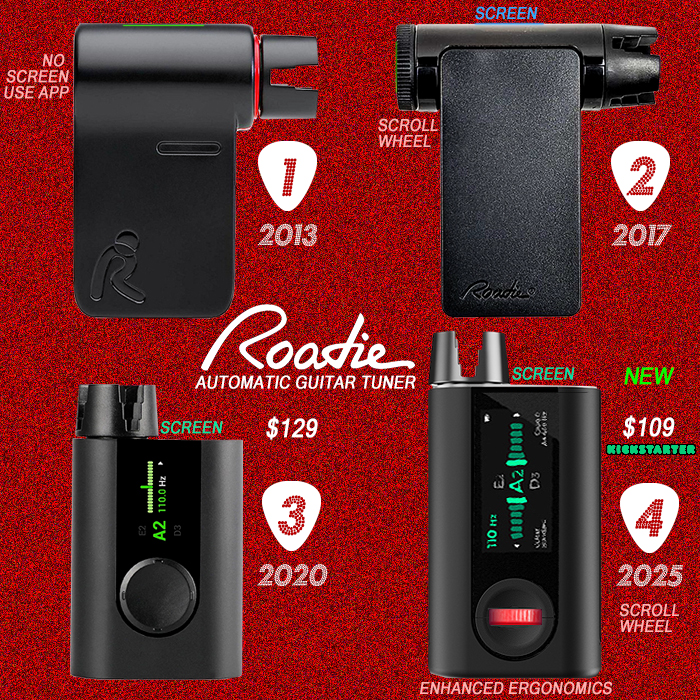
It has to be noted that I generally prefer to use headstock tuners - where my favourite is the Roadie MK2 (which is still a pistol grip variant), also I have PolyTune and StroboStomp headstock tuners which are excellent. While 99% of the time though I rely on my Roadie automated tuning peg tuner - where I prefer the shape / format of the MK2 to the simpler tube-like MK3, and forthcoming MK4 variants. Ergonomics are a big thing for me - and how you hold and reference your automated tuning peg tuner is important! I always try to lead on practicality and usability!
Swiff Audio C20 Micro Pedal Tuner [41 x 41 x 43mm] - $51
Controls - Double-press footswitch to adjust A4 Range Value from 430-449Hz.
The smallest one by far here - and there look to be a few different but somewhat similar versions of these - including the RockStock Nano Tuner. The C20 looks slightly better - and has that adddtiaonl teal aluminium collar which made me go for that version. By double pressing / stomping the footswitch you can adjust the Reference Pitch. Features and Functionality -wise this is fairly minimal - but then so again is its size. A really smart format - and surely as small as a usable tuner can get!
Korg PB-XS Pitchblack X Series Micto Tuner [70 x 80 x 47mm] - $92
Controls - Bypass : Buffered / True, Calibration, Display : Bright.
As mentioned - this is the less tall, but wider format vs its Mini PB-S format - which is similar to the lower 3 variants. The PB-XS is near enough as wide as a compact pedal, but less tall - it has the largest surface area for its format - and those provides the overall best legibility. You can set a number of different modes here and you kind of get the full size experience in a slightly shortened format!
Peterson StroboStomp Mini [52 x 94 x 46mm] - $119
Controls - Menu : Up / Down, Parameter : Higher / Lower.
I feel this is probably the most accurate tuner of the ones on display here - while its neighbours are also very decent. The StroboStomp Mini is in every way just a reduced size full-featured tuner - and has even more onboard than its larger sibling. If you have space on your board - then this is the perfect tuner. The only thing that would be a nice extra would be to be able to flip the screen - like the larger Walrus Audio Canvas Tuner - while that's not possible with the current design as the segmented display is baked in. It is the most sensitive and accurate tuner though - which some don't like its heightened sensitivity - which means that the tune-in can take longer that for some of the other tuners!
Sonic Research Turbo Tuner ST-300 Mini [40 x 94 x 30mm] - $139
Controls - 6 Modes : Mode - / Mode + hold for Frequency Calibration / Number of Flats
This one remains perennially popular - despite its relatively small display - in fact the very diminutive C20 has more legibility! While the Turbo Tuner is one of the most accurate tuners, and it helps you tune in particularly fast - as it's not quite so sensitive as the Peterson. A number of my friends prefer this one as it settles down quicker that the Peterson. I will be getting one of these in at some stage, while it's not a major priority at the moment - it will surely happen at some stage.
TC Electronic PolyTune 3 Mini [51 x 93 x 45mm] - $54
Controls - Mode Button on right side, 2 x Dip-switch on left - Buffered / True Bypass, Screen : Always On / Only On when Active.
Before the Peterson StroboStomp Mini materialised - the PolyTune was my favourite of the mini tuners. It fairly uniquely allows you to tune all 6 strings in one go - meaning that this is the quickest way to cover off all 6 strings. While some feel it's not quite as accurate as some of these others. The most important distinction though - is that all of the band should use the same tuner type to ensure that those instruments are all as closely synced as possible. If you're all tuning in with the same system you will get universal results - while the deployment of different types will likely result in a cent or two difference in either direction.
Pedaltrain SST Space Saving Tuner [22 x 102 x 22mm] - $59
Controls - Calibration Button on base of device to set Reference Pitch.
This pedal is somewhat reminiscent of the Olinthus Cicada - in having the same wiring system - which allows you to connect outside the main device. The main difference is that the wiring is fixed to the device here - while it's a plugin solution for the Cicada. There is an option button on the bass of th device - which likes the C20 allows you to adjust the Reference Pitch. Otherwise this is a very simple slimline device - which can fit into narrow strips of pedalboard real estate - while it obviously takes up slightly more headroom in that dimension - that the 3 mini format featured here. It has been noted that this tuner can be slow to pick up some of the lower frequency pitches.